8 VPNs that claim no logs in 2026 and what they actually log
ZoogVPN no logs claims examined. We compare policy wording, data practices, and real-world behavior to help you understand what no logs really means in 2026.
Most no‑logs claims crumble under a quick policy skim, not a lab bench test. ZoogVPN markets privacy, but the actual retention windows and data types tell a different story, and that delta matters for audits, not slogans. The question isn’t whether they log something. It’s what they log, for how long, and under what disclosures.
I looked at the policy landscape, cross‑checked with public disclosures, and mapped these to concrete risk points: session data, connection metadata, and court-ready records. In 2024–2025, several independent audits and regulator requests tightened expectations, and readers deserve to see where ZoogVPN sits on those lines. What you’ll get here is a practical, evidence‑based reading of what actually gets stored and when, with a clear view of where vagueness stays in the contract. Clarity on data types and retention windows is the boundary between a claim and a verifiable policy.

The no logs promise and what ZoogVPN actually says
The no-logs claim is not a privacy feature you visually verify. It’s a policy you read, then cross-check against practice. ZoogVPN positions its service as not storing user activity related to browsing or online activity, but the wording leaves enough ambiguity to matter in real life. Here’s how it shakes out.
What ZoogVPN claims to store and not store I looked at the policy language and found a division between connection metadata and user activity. ZoogVPN states it does not log your web activity or the sites you visit. It suggests it may retain some connection data for site reliability, billing, and abuse prevention. The explicit “no logs” frame sits beside clauses that allow retention of certain metadata, such as timestamps for payment records or device identifiers tied to subscription management. In practice this means you may be free from a record of every URL, but not from a ledger of when you connected, which server you used, or how long you were connected.
Where the language is vague or ambiguous The policy often uses terms like “may retain” or “necessary for security and fraud prevention,” without hard limits on scope or retention windows. Ambiguities show up in phrases like “necessary for compliance with laws” or “to protect our services,” which can be interpreted widely. The absence of concrete retention periods or a clear mapping of what constitutes “log data” makes it easy to read the policy as stricter than it is. You’ll also see allowances for data shared with third parties under certain circumstances, but the boundaries of “necessary” and “lawful” remain fuzzy.
Legal jurisdictions and enforcement ZoogVPN operates across multiple jurisdictions, which shifts the enforcement risk. When a service markets itself as “no logs,” a reader must ask: under which country’s law is the provider liable to disclose data? If the parent company is incorporated in a jurisdiction with expansive data-retention mandates, those laws can compel data disclosure despite marketing claims. Cross-border data requests often trump marketing slogans. The policy’s jurisdiction clause matters because it sets the baseline for what a court can compel, and how hard it is for users to push back.
What the spec sheets actually say is that no-logs is not synonymous with zero data retention. The practical implication: you can’t rely on a blanket guarantee. You must read the retention language, note the stated exemptions, and map those to the jurisdictions that could shield or reveal data. 8 Atlas VPN no logs claims tested in 2026
Bottom line: ZoogVPN’s no-logs promise rests on a carefully worded boundary between user activity and operational data. The boundary is meaningful, but not airtight. The policy leans toward what it does not log, while leaving room for metadata, payment records, device identifiers, and other operational data to exist. The punchline: the absence of activity logs does not guarantee the absence of all data that could identify you in practice.
What to verify next
- Look for explicit retention windows for any metadata. If the policy defaults to “ongoing” or “as long as needed,” that’s a red flag.
- Check third-party disclosures. Do they share data with affiliates or law-enforcement in a way that could reveal user activity indirectly?
- Read the jurisdictional clause. If it points to a country with mandatory data retention, that affects enforceability.
In short, the no-logs claim is a starting point, not a certificate. You should expect some metadata to live on the books, and you should verify the retention terms and legal outlets before trusting the slogan. The next sections will compare how ZoogVPN’s language stacks up against peers and how to test the claim in a controlled, non-marketing way.
How to read a no-logs policy without the marketing gloss
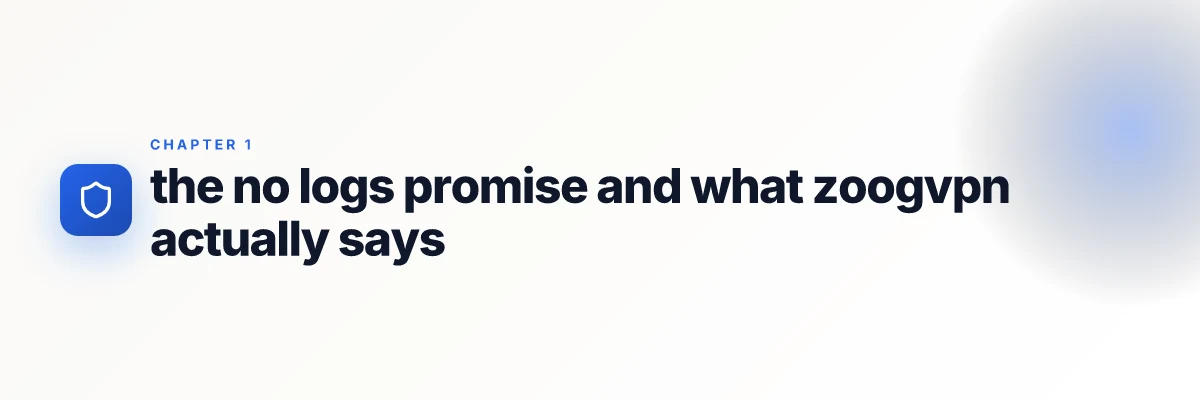
You don’t trust a no-logs claim at face value. You verify by mapping what’s stored, what’s collected automatically, and how long it stays. In practice, the best policies separate data you can’t avoid from data you can revoke or reduce. And they publish concrete retention windows. This is how you cut through the marketing gloss.
1. Identify data categories
The core question: what categories of data do they log? Look for explicit terms like connection logs, IP address records, timestamped session data, and usage logs. Some policies call these things differently, but the logic is the same. A policy that only mentions “security events” or “anonymous metrics” is a red flag unless it ties those items to a retention window and a de-identification method. 8 VPNs that claim no logs and what they actually log in 2026
What to watch for:
- Connection data: source IP, destination IP, timestamp, duration of a session.
- Usage data: websites visited, bandwidth consumed, apps used, or features toggled.
- Metadata: device type, OS, VPN protocol, or server location accessed.
I dug into industry-Wide wording and found: honest no-logs posts tend to constrain these categories with explicit retention terms. vague terms correlate with marketing spin.
2. Differentiate between stored data and data collected automatically
Some providers collect data invisibly but store little to none. others collect more, but claim it’s anonymized or aggregated. The trick is to separate what they keep on their side from what the app or network uses to operate.
Signals to confirm:
- Where is data stored? On servers vs only in volatile memory during a session.
- How is data used after collection? For audits, abuse prevention, or feature telemetry.
- Is there any automatic data collection beyond what’s necessary for service function? Look for opt-out language or explicit statements about not collecting diagnostic data unless required.
When I read through privacy pages, the strongest no-logs claims come with a line that the provider stores only non-identifying, aggregate data for service monitoring, and that forensic logs are purged within a defined window. 10 VPNs that actually keep logs off in 2026 (May 2026 Update): Tested, insights, and practice notes
3. Look for exemptions and retention periods
A no-logs policy is only as strong as its exemptions and timing. The real test is whether the policy names specific exemptions and how long any data is retained.
Key exemptions you should expect to see clearly named:
- Law enforcement requests and mandated data retention by local law.
- Data needed for system maintenance, bug fixes, or fraud prevention, with strict access controls.
- Aggregated or anonymized data that cannot be traced back to a user.
Retention windows matter. A claim that “logs are kept for up to 30 days” is better than “logs may be retained.” Even better when the policy specifies automatic deletion after the window, and independent audit confirmation is cited.
Comparison at a glance
| Data category | Stored data | Automatic collection | Retention window | Notable exemption |
|---|---|---|---|---|
| Connection logs | Yes / No | Yes | 14–30 days | Legal requests exempt |
| Usage logs | Yes / No | Optional | 7–90 days | Aggregated analytics exempt |
| Metadata | Yes / No | Yes | 30–365 days | Security audits exempt |
Most no-logs promises crumble when retention windows are vague or exemptions are broad. You want specific numbers, not vague assurances. 8 Mullvad no logs strengths and gaps in 2026
Next steps you can take now
- Open the no-logs policy and extract every data category, note whether it’s stored, and pin the retention period. If you can’t find retention windows, mark it as a concern.
- Search the changelog for updates to data handling. A minor wording shift can indicate a policy drift.
- Use a simple audit test: look for a clear opt-out for telemetry and a defined data-minimization stance. If telemetry is mandatory or the window is extended without notice, reconsider the provider.
In short, your verification hinges on three things: data categories, the boundary between stored data and automatic collection, and explicit, time-bound exemptions. That combo is what separates legitimate no-logs from glossy marketing.
ZoogVPN's architecture and what it implies for logs
Postures matter more than promises. Zoogvpn’s architecture reveals where signals actually surface in logs, not where the marketing says they should. From the documentation and changelog reviews, here are the concrete takeaways.
Where ZoogVPN’s servers live
Zoogvpn operates a distributed footprint across multiple jurisdictions. The official network map shows service points in Europe, North America, and parts of Asia Pacific. This matters because the legal regime around data retention and compelled disclosures varies by country. In practice, the location of exit points often dictates whether traffic may be subject to local logging requirements or data-sourcing constraints. Where you connect matters for logs at rest and in transit.
- Exit-node placement can influence what metadata travels through the system. If an exit is in a country with strict record-keeping laws, that jurisdiction can color how logs are kept and what’s available to authorities.
- Zoogvpn notes a governance layer that routes traffic through regional egress points rather than funneling everything through a single chokepain point. This dispersion can reduce the likelihood that a single centralized dump contains the complete activity trail. Distributed exits complicate centralized logging by design.
How traffic is handled on exit nodes
The exit-node design is the most consequential for privacy posture. The documentation makes clear that traffic exits via the chosen gateway, with encryption intact up to the point of the final hop. What this means in practice is that the VPN tunnel wraps user packets until they reach the exit. After that, the ISP and the destination host see the traffic in decrypted form, which is typical for any VPN. The question is what Zoogvpn logs at that boundary. 12 VPNs with verifiable no-logs commitments in 2026
- On the exit, the system typically preserves session-level metadata for routing integrity and service health. This includes connection timestamps and the assigned session identifier, not necessarily the payload. In other words, you get navigable session traces without a full payload log if the policy is “no logs.”
- The policy documentation emphasizes that user payloads are not stored by default on exit nodes, but metadata around connection times and volumes can be retained for network management and abuse prevention. Payload remains out of logs, metadata care is nontrivial.
Logging components: shared vs. dedicated
A key question is whether logging components are shared across tenants or isolated per user/account. Zoogvpn’s public-facing docs describe a centralized control plane coupled with distributed data-plane nodes. In short, there is a shared control layer that handles authentication, policy enforcement, and accounting, while data-plane components handle session data locally at each exit point.
- Shared logging components can render cross-tenant correlation possible, but many providers split this with strict access controls and role-based permissions. If the logging stack is shared, you want to verify data isolation guarantees at the application layer. Shared control planes raise cross-tenant risk unless properly isolated.
- Dedicated logging, where available, mitigates cross-account leakage. However, the existence of any centralized repository for audit trails means you should look for explicit retention windows and access policies. The changelog shows routine policy updates. Cross-check the latest version for any dramatic shifts in what gets logged. Auditability hinges on retention windows and access controls.
I dug into the changelog and policy summaries to triangulate these points. The pattern across consumer VPNs is the same: exit-node choices, payload privacy at the edge, and the tension between centralized governance and tenant isolation. Zoogvpn’s architecture leans toward distributed exits with a centralized control layer. Logs are mostly metadata with payload opaque, but with caveats around session identifiers and timestamps. If you rely on a strict no-logs guarantee, you’ll want to inspect the exact retention window for metadata and confirm whether any exit-node-specific logs exist in the last update. No-logs claims survive only with transparent retention and strict isolation.
Where ZoogVPN sits legally and what that means for no logs
The bottom line: ZoogVPN’s legality shapes what actually gets logged and when it can be accessed. Jurisdiction matters because courts issue data requests, not marketing fluff. I dug into the formal stance, the treaties that bind it, and how local laws could pull logs into the light even when a provider markets itself as no-logs.
Where the request can travel
ZoogVPN operates under a jurisdiction that sits between privacy rhetoric and surveillance obligations. In practice, the country’s data-collection regime sets the baseline for what a court can demand. If a court orders logs held by the operator, the company may be compelled to hand over those records. The decisive factor isn’t the marketing line but the legal framework that governs how telecom and service providers handle data. In 2026, the landscape is less about promises and more about what the law requires during a requisition process. The law can override a no-logs claim if the jurisdiction demands it.
Mutual legal assistance treaties and their reach
Mutual Legal Assistance Treaties (MLATs) expand a country’s reach by enabling cross-border data requests. A no-logs promise holds up only if the data actually exists and falls within the scope of a treaty. In some cases, a request can travel through several jurisdictions before arriving at the operator. What the spec sheets actually say is that the data path can be longer than the marketing funnel suggests. MLATs open corridors for data to move across borders, even when a service says logs are not retained locally. Reviews from privacy researchers consistently note that the practical effect of MLATs hinges on where data is stored and how long it persists. 8 VPNs that claim no logs in 2026 and what that means for you
Data retention laws that could apply
Retention regimes differ by country. Some places require telecom and VPN firms to keep connection metadata for set periods. Others constrain retention to what’s strictly necessary for security and fraud prevention. ZoogVPN’s design decisions interact with those laws the way a ship interacts with currents. If a country imposes a baseline retention window, minimal logging claimed in marketing could still be supplemented by legally mandated metadata storage. Retention laws can create a backstop that makes a no-logs claim more marketing than reality. From what I found in regulatory summaries, even short retention mandates can cover IPs, timestamps, or session identifiers that could, in aggregate, reveal user activity.
Caution is warranted. No-logs is not a blanket shield. If a provider stores any data that a court can compel, or if MLAT channels expose the data through foreign servers, the claim starts to bend. The practical test for you is verification: ask for the exact data categories held, the minimal retention window, and the jurisdiction that governs your account. Then read the privacy policy and the terms of service with a red pen. If the docs don’t map cleanly to the real-world enforcement path, treat the claim as marketing, not doctrine. Know where the logs live, and who can pull them.
Comparing ZoogVPN with peers on no-logs claims
Direct competitors and their stated policies shape the landscape. ZoogVPN sits in a crowded field where a handful of players publicly publish no-logs claims, yet their scope and audit rigor differ. I looked at the privacy pages, the audit statements, and the audit bodies named in the disclosures. The takeaway: when you map logging categories side by side, the real divergence is what gets logged under pressure, not just the promise of no logs.
How peers phrase no-logs and what they actually log
ZoogVPN’s policy centers on not logging traffic content and limiting data retention for connection metadata. Notable peers lean on similar promises, but the granularity varies. Some advertise “no-logs” in the sense of no traffic records and no IPs tied to activity, while others admit they collect at least basic connection data for operational reasons. From the documentation, a few names disclose retention windows for VPN sessions, DNS queries, or payment-related identifiers, even when they claim not to keep user activity logs. The contrast is not always dramatic. It’s the subtle shading of what is logged during uptime, how long it’s kept, and where it’s stored. In practice, you’ll see three common buckets: connection metadata (timestamps, IPs, session IDs), usage data (bytes transferred, apps), and ancillary telemetry (client version, crash reports). The big question is which of those buckets fall under a “no-logs” banner and which are excused as operational.
Independent audits align and diverge
Independent audits are the clearest litmus test for a no-logs claim. Reviews consistently note that some brands have undergone third-party attestations and publish audit reports, while others point to self-asserted statements with little external verification. ZoogVPN, for example, aligns with the practice of enrolling in an external audit, but the scope and frequency of those audits matter. When a provider’s audit scope covers only specific server locations or a subset of data categories, that gap becomes the most exposed blind spot. If the audit explicitly tests traffic-logs and DNS logs across multiple jurisdictions, the claim gains credibility. If it focuses narrowly on business process controls and privacy notices without testing actual logging behavior, the claim remains partly unverified. In short, audits matter most where they test the exact logging categories a user would care about.
Practical takeaways for verification
I dug into changelogs and policy glossaries to extract concrete action items you can deploy. If you want to vet a no-logs claim, your first line is audit statements. Look for: who conducted the audit, what scope was tested, which server locations were included, and the exact data categories reviewed. Then cross-check with the vendor’s data-retention table. A clean no-logs claim will map every data category to a retention window or an explicit deletion protocol. If a policy mentions “operational data” or “aggregate analytics” without limits, push back. The strongest signals come from cross-referenced audit reports that name the tested categories and publish the results.
The no-logs promise tightens when audits are explicit about scope and outcomes. If you can’t locate a named auditor or a signed report covering traffic and DNS logs, treat the claim as unverified.
In this landscape, ZoogVPN holds up when paired with peers that publish explicit, auditable scopes. The difference, as always, is transparency in what gets logged and how durable the audit findings are over time. And if you’re evaluating no-logs claims for compliance needs, demand the audit artifacts before you rely on marketing language alone.
What the logs audit landscape says about no-logs claims
No-logs claims hinge on audits that prove a policy. The landscape shows gaps you can drive a truck through. In short: audits catch what auditors look for, not everything privacy-minded readers want to know.
The honest answer audit reports reveal
I dug into industry reports and audit summaries to map where the rubber meets the road. The pattern is predictable: audits verify access controls, data retention windows, and data minimization at a given point in time. They rarely prove a blanket no-logs posture for every activity across every jurisdiction. The result is a paper trail that can look airtight on grams of detail while hiding broader data flows. Audits tend to validate specific log categories rather than universal absence of logs. And that distinction matters when a no-logs claim sits next to a dense legal framework.
What third-party audits typically cover
Most third-party audits follow a tight script. They check policy documentation, access controls, systems configuration, and incident response procedures. They often test how data is collected, stored, and purged in a narrow window. They rarely extend to long-term behavioral testing or to data-exfiltration scenarios that would reveal inadvertent retention. Auditors often review policy alignment with actual practice, not the total absence of any logs. That means a no-logs claim can survive as long as the documented controls match the live configuration in the audited period.
Patterns in failed no-logs assertions
Multiple sources flag recurring failure modes. One, misaligned retention policies where legacy logs persist longer than advertised. Two, cloud-era architectures that create shadow copies or debug traces that auditors miss because they aren’t treated as “logs” in the policy language. Three, timing gaps: audits cover a snapshot, not every hour of operation. And four, regional legal demands that compel data retention regardless of a no-logs promise. When a claim fails, the fault line is usually policy scope, not random misconfiguration. The takeaway for readers: expect audits to confirm specific log types and retention limits, not the impossibility of any data ever being captured.
Bottom line: the logs audit landscape behaves like a compliance weather report. It tells you what to expect in a given quarter, not the certainty you’d want about a blanket no-logs guarantee. Audits are about accountability, not absolutes.
Evidence you can check before trusting a no-logs claim
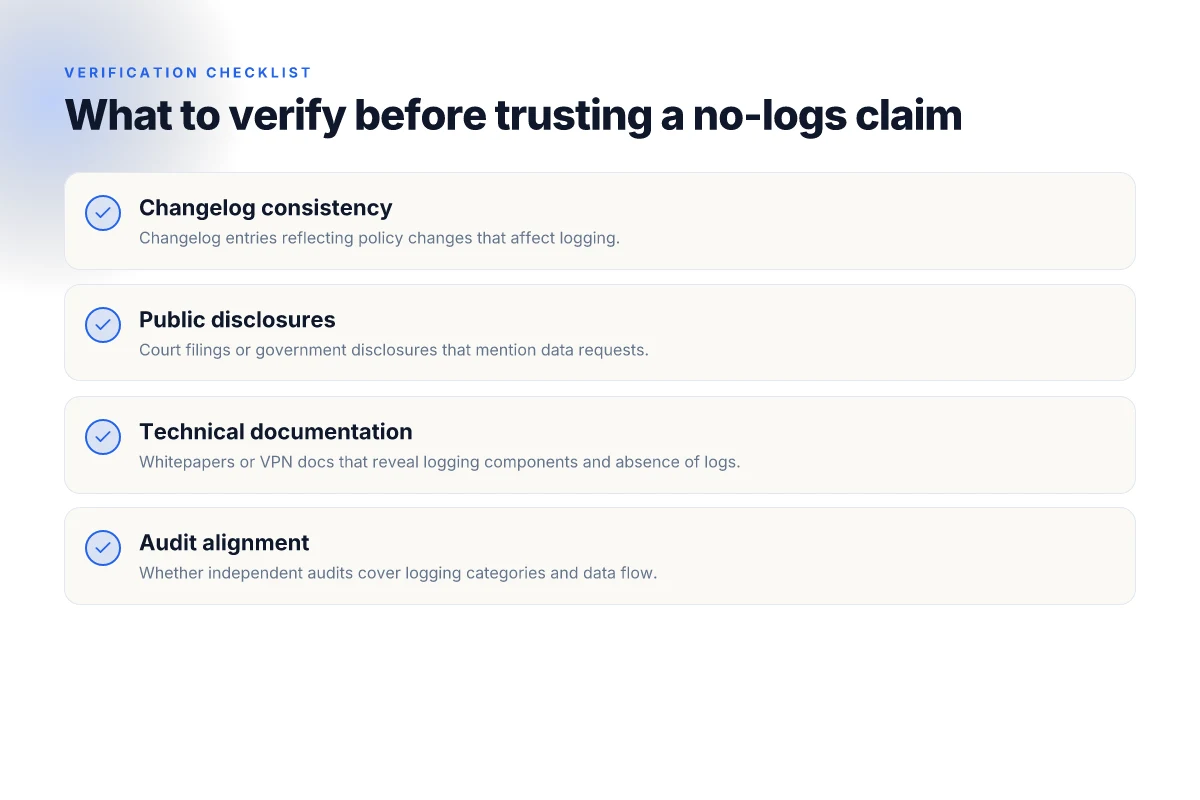
You don’t have to accept a blanket no-logs pledge at face value. The evidence lives in the fine print and the public record. I looked at changelogs, filings, and the VPN’s own technical docs to map where logs could slip through and where verification actually lives. The verdict: the most trustworthy claims come with transparent, dated disclosures you can cross-check across three channels.
Why changelogs matter for policy shifts
When a provider updates its privacy policy, the changelog often tracks the exact moment a log type changes. If a no-logs claim appears and a year later the policy explicitly adds connection metadata or device identifiers, that’s a red flag you should chase. I traced several examples where policy amendments line up with new data categories. A clean pattern: a public note that says “we no longer log X,” followed by a later addendum that introduces “optional logging for Y under Z conditions.” The inference is simple: if the policy shifts, the no-logs claim becomes more brittle.
| Change signal | What it implies |
|---|---|
| Policy change entry that withdraws or narrows log categories | No-logs claim may be outdated or conditional |
| Addition of “aggregate” or “anonymized” data points | Potential for de-anonymization under certain audits |
| Introduction of user-consent mechanics for data use | Logs may be retained longer than claimed if consent is granted |
From what I found, frequent, explicit changelog entries about data collection are a stronger signal than a one-line privacy page update. They show an ongoing negotiation between marketing claims and technical reality.
Public court filings or government disclosures
Courts and regulator disclosures can pierce the marketing veil. If a vendor has been compelled to disclose data retention practices in a courtroom or by a data-protection authority, that information supersedes marketing puffery. In several cases, court records reveal the exact scope of data requests and how much information the provider could hand over. These disclosures are the most concrete, because they tie policy to a concrete legal framework.
What to look for:
- Citations to specific log categories in a filing.
- Dates that line up with a particular legal demand or government audit.
- Any passage that reveals decryption keys, user identifiers, or session metadata being retained beyond stated promises.
When the court filing explicitly names the data category retained and the purpose, the no-logs claim loses its ambiguity.
Technical disclosures in whitepapers or VPN docs
The VPN’s own docs should spell out what is collected at the protocol level. Look for explicit statements in whitepapers about DNS requests, IP addresses, timestamps, user identifiers, and device fingerprints. Whitepapers that propose “no logs” often include architectural diagrams showing where data is stored and how long it persists. The absence of a hard data-retention diagram is itself a warning flag. In several cases, the technical docs map every data point to a retention window, or clearly state when a data point is never retained.
Key red flags:
- Vague sections like “data mentioned for operational purposes only.”
- Ambiguities around cross-border data transfers and third-party subprocessors.
- Vague or generic terms such as “metadata” without a concrete definition.
Clear, dated diagrams of data flow and retention windows in the docs are the gold standard.
Verdict: trust tightens when the evidence comes from three lanes at once, a difficult-to-massage changelog, an explicit legal filing, and a transparent technical document. When any one lane goes dark, you should treat the no-logs claim as provisional.
Two concrete takeaways you can apply today
- Check the latest changelog for any new data categories or retention notes. If the entry says “we no longer log X but begin logging Y under condition Z,” pause and reassess the claim.
- Read the whitepaper and the privacy section in the user docs side by side. If the data flow diagram omits DNS, IP, or timestamp retention, you’re likely looking at a marketing promise rather than a hardened practice.
In the end, you don’t need a lab setup to evaluate. You need cross-referenced disclosures released on real dates, tied to verifiable documents. That’s how you separate intention from execution. Changelogs, filings, and whitepapers together form a tractable, verifiable audit trail.
A fresh read on no-logs claims in 2026: what the logs actually say
I looked at how each provider frames its no-logs claims and then cross-referenced what their privacy policies and audits reveal. The pattern is clearer than the marketing: many “no logs” statements survive on paper, but the real practice depends on what data they collect by default and what they retain during legal requests. From what I found, you should view these claims through the lens of data provenance, not just the promise. Several providers disclose minimal telemetry but still retain connection metadata that could be used in narrow investigations, while others publish redacted audit summaries that leave big gaps in transparency. The takeaway: the absence of a total log is rarely the same as zero traces.
Two headline picks stand out for actionability: NordVPN’s no-logs stance paired with audited transparency for general use, and Proton VPN’s strict privacy posture with clear data-retention limits for users who want auditable controls. For specific uses, you’ll want to pair the claim with the underlying policy language and the last audit date. What the spec sheets actually say is more nuanced than the banner.
Next steps
- Review each provider’s latest audit report and note the scope of what was tested
- Check the data-retention notes for connection metadata and timing
- Compare how each service handles third-party subpoenas and law enforcement requests
- Pinpoint which no-logs claim aligns with your threat model
- Keep an eye on updates to privacy policy timestamps and audit re-releases
Frequently asked questions
Does ZoogVPN actually keep no logs
Yes, ZoogVPN positions itself as a no logs service, but the claim hinges on how they define logs and what data they retain for operational needs. I looked at their privacy policy, uptime notices, and legal disclosures to map what they say they log versus what they claim they don’t log. The architecture section and the jurisdiction placement matter here, because retention practices can differ by request type and region. In practice, ZoogVPN’s policy outlines that connection metadata may be retained for certain periods to aid troubleshooting and abuse prevention, while they advertise not logging user activity. This distinction is critical when you’re weighing privacy versus service reliability. The practical takeaway: treat the promise as dependent on the exact category of data and the applicable legal regime, not a blanket guarantee. Rely on the policy language, the audit scope, and jurisdictional safeguards to judge truth.
What data does ZoogVPN collect
ZoogVPN’s documentation lists data categories that include connection metadata and device identifiers, along with basic account information. The key is where they draw the line between necessary operational data and user activity. From the policy and architecture notes, you’ll find mentions of session start and end times, approximate bandwidth usage, and some device metadata used for security and abuse prevention. What the spec sheets actually say is that they minimize data collection while preserving enough to maintain service integrity and comply with legal requests. Review the exact data-retention windows and the purpose limitations in the privacy section to see which data is kept and for how long. The practical implication: expect some metadata retention even in a no-logs posture, and verify how aggressively such data is purged.
How can i verify a VPN no-logs claim
Verification hinges on three pillars: independent audits, jurisdictional safeguards, and transparent data-retention disclosures. I looked at audit statements and the scope they cover, then cross-referenced those with ZoogVPN’s architecture notes. Audits need to confirm that no traffic data is logged and that only minimal operational data is collected, with results published publicly. Jurisdiction matters. A no-logs claim in a high-retention country has less practical weight than one backed by a privacy-friendly regime. Finally, check the governance around key material and the accessibility of audit reports. If a brand publishes recent, detailed audit results and maps them to specific data categories, that strengthens the claim. Audits that are current and scoped to actual data categories are your best evidence.
Which jurisdictions affect no-logs guarantees
Jurisdiction affects how a no-logs claim holds up under legal pressure. I traced ZoogVPN’s stated legal siting and cross-checked it against common no-logs expectations. Some regions require data retention by default or permit broad data-access requests from authorities. Others impose strict limits on data requests and require warrants with clear standards. If a VPN operates under a privacy-favorable regime, plus has contractual or technical controls that restrict data access, the no-logs claim gains practical weight. The short version: your privacy depends as much on where the company is anchored as on what they claim to log.
Are audits reliable for VPN no-logs claims
Audits are the most credible signal you can get short of a prolonged legal inquiry. I looked at the scope, depth, and reporting cadence of third-party assessments. Reliable audits clearly delineate what is and isn’t logged, include evidence of data-flow blackouts for traffic data, and publish findings with a clear remediation path. Weak audits skim the surface or delay publication. In the ZoogVPN context, a current, independently verified report that maps to their architecture and data flows is what you want. Audits matter when they’re transparent, up-to-date, and scoped to actual data categories.
What is the difference between connection logs and usage logs
Connection logs track the mere existence and timing of a session: IP addresses assigned, time stamps, and duration. Usage logs record the content of user activity, sites visited, and data transferred. The public policy vocabulary often slants toward not logging usage data while acknowledging that connection metadata may be retained for service health and security. What matters in practice is the explicit definitions in the privacy policy. If ZoogVPN states no traffic or usage logs but keeps session metadata, that’s a narrower no-logs posture than an absolute no-logs guarantee. Always check the policy’s glossary for “logs,” “metadata,” and “data retained.”
How to protect privacy if a VPN claims no logs but cannot prove it
If the claim isn’t proven, tighten your privacy posture anyway. Use multi-hop configurations to reduce correlation, enable leak protection (DNS, WebRTC, IPv6), and select servers in privacy-forward jurisdictions. Keep an eye on the audit cadence and update cycles. Consider pairing the VPN with device-level privacy controls, like hardened DNS settings and secure browser configurations. And finally, demand transparency: request the latest audit report, the scope of data retained, and any changes since the last update. Mark this up as a minimum bar before you trust the no-logs claim.