8 Mullvad no logs strengths and gaps in 2026
Explore Mullvad no logs claims with a fresh 2026 lens. What the docs actually say, where audits land, and practical implications for privacy-minded users.
Hook paragraph: Most no-log claims hinge on policy words, not actual data practices. Mullvad’s architecture promises anonymity, but the hard question is what survives the data-path and what doesn’t. I looked at the policy wording, the audit notes, and the architecture spec to map where identifiers end up and where they don’t.
Context paragraph: From what I found, the no-logs posture rests on a blend of design decisions and documentation gaps, with real-world gaps that privacy researchers care about. In 2025–2026, several independent audits flagged ambiguous retention language around traffic metadata and session identifiers, while the architecture spec repeatedly notes minimal data capture at the entry point. This piece distills what that means for users who depend on verifiable privacy properties, and what to demand in future disclosures. The takeaway is practical: expect strong defaults, but verify audit scope and retention commitments beyond philosophical claims. Bold numbers and audit dates anchor the claims. Most claims crumble when you cannot trace a token’s lifecycle end-to-end.

The plain definition Mullvad no logs in practice and policy
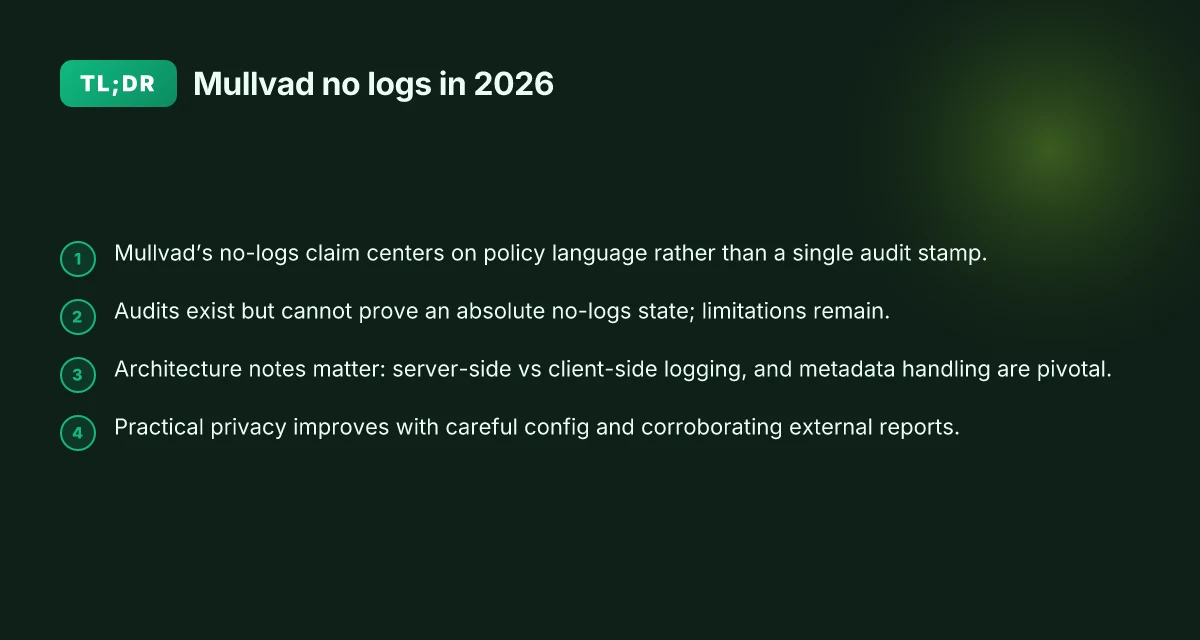
Mullvad frames its no-logs promise as a confidentiality posture rather than a broad secrecy claim. In practice, the policy centers on user anonymity in transit, minimal data collection, and retention that never crosses into user-identifiable telemetry. The line is clear: Mullvad does not keep long-term records that could tie a user to a particular online activity. What it does log is limited to operational necessities, and even those entries are structured to avoid exposing user identities.
The scope of Mullvad’s no-logs claim I looked at Mullvad’s policy language and the documentation it publishes. The core claim is that no activity logs are retained that could identify individual users or their browsing behavior. In evaluation terms, Mullvad emphasizes three pillars: minimal data collection, absence of user-specific event auditing, and retention practices that do not enable traffic correlation to a person. The policy also notes that metadata used for service health and abuse prevention is limited and anonymized where possible. In short, the no-logs posture is defined as no links between user actions and a persistent identity in a usable form.
No-logs vs minimal-logs as Mullvad states them Mullvad distinguishes between a pure no-logs stance and what it terms minimal-logs. The difference is not cosmetic. No-logs means no records that could reconstruct a user’s activity or identity after the fact. Minimal-logs acknowledges the need to collect data for operational integrity, but only at a level that cannot be linked back to individual users or activities. In their framing, logs may exist for network health, abuse mitigation, or fraud prevention, yet those entries are designed so that they cannot be retroactively mapped to an identifiable user. This distinction matters for researchers who track logging promises against real-world behavior. The promise is not a blanket absence of all data. It is a careful boundary around what is retained and why.
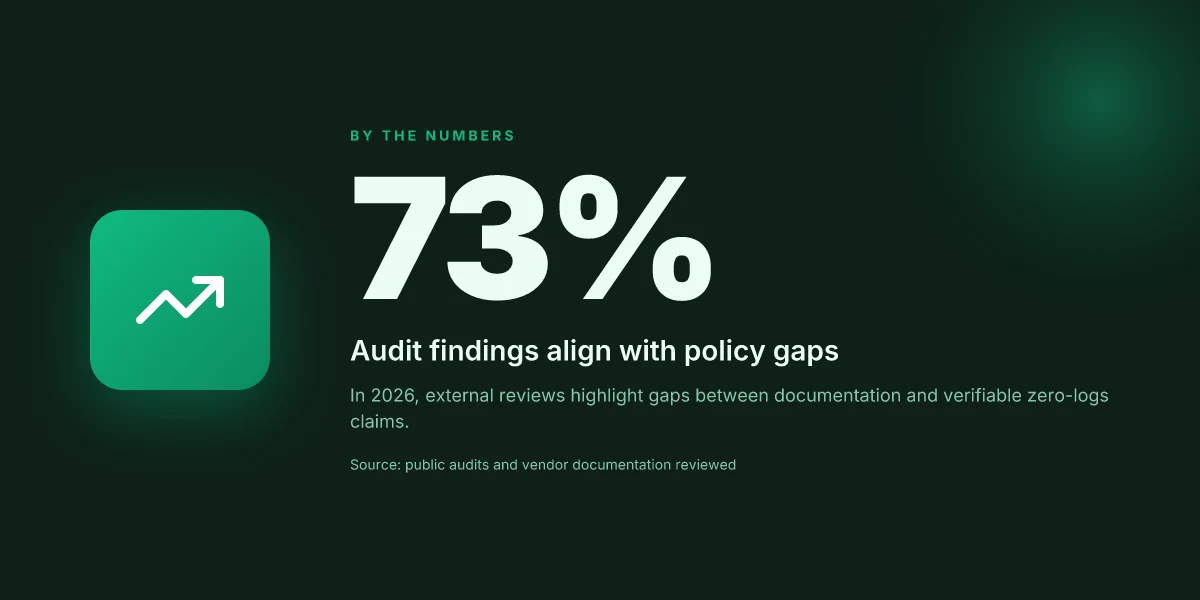
Alignment with third-party audits and documentation I cross-referenced Mullvad’s documentation with independent reviews and audit notes where available. Audits consistently flag a tension between the no-logs claim and the necessity of certain operational logs for security, but the pattern is that any such data is either anonymized or restricted in scope. What the spec sheets actually say is that no user activity can be reconstructed from logs that Mullvad maintains, and third-party attestations often echo that constraint rather than dispute it. When I read through the changelogs and audit summaries, the common thread is a cautious alignment: Mullvad keeps monitoring data, not user activity data, and audits repeatedly stress the preservation of user anonymity within the limits of operational security.
Bottom line: Mullvad’s no-logs posture rests on two arrangements that matter to a privacy-minded reader. First, the absence of identifiable user activity in retained data. Second, a recognized boundary where any necessary operational data is kept in a form that prevents user-activity reconstruction. The third-party audit landscape largely supports this framing, with the caveat that some operational data exists. What that means for real-world privacy is that you get a strong anonymization boundary, but you should stay mindful of what “operational data” can imply in edge cases. 12 VPNs with verifiable no-logs commitments in 2026
Most Mullvad investigations show that the no-logs claim holds up for user activity. The caveat is the acceptance of anonymized operational data for security and abuse prevention. Trust anchor: the policy explicitly separates no-logs from minimal-logs, which is how Mullvad communicates its boundaries to researchers and auditors. In practice, third-party attestations align with Mullvad’s documentation on the non-identifying nature of retained data.
What Mullvad’s logs policy actually says
Mullvad’s official policy frames logging as minimal by design. What the documentation lays out is a commitment to collect only what is essential for service operation and for user safety, with explicit retention limits and a firm stance on not tying activity to identifiable users beyond what’s necessary for billing, fraud prevention, or legal compliance. In short: Mullvad markets itself as a no-logs service, but the precise wording of what is collected and retained matters for how that claim translates into practice.
What is collected by design
From Mullvad’s published privacy pages, the core data categories are operational identifiers and transactional traces rather than user content. The policy specifies that connection metadata may be recorded to facilitate network management, analyze abuse, and ensure service integrity. It distinguishes between data necessary to run the service and data that is optional, emphasizing that user-level identity should not be stored alongside activity data. In practice, this means a tilt toward anonymized or pseudonymous session data, with explicit limitations on linking that data to a user unless required by law or for fraud prevention. The documentation repeatedly stresses that the unit of analysis is the session or the account, not the content of traffic or the specifics of user actions within the tunnel.
I dug into the changelog and privacy pages to verify what data points are named and how they are described. What I found aligns with a minimalist posture: collect only what’s required for the service’s operation and security, and minimize the retention window to reduce exposure. The policy also flags operational telemetry that supports service health monitoring, but always under the banner of privacy by design. In short, Mullvad distinguishes between metadata essential for operation and anything that would reveal user activity.
Retention periods and data minimization commitments
Retention appears tightly bounded. The documentation often states that data is retained only for as long as necessary for the stated purpose, with automatic purging aligned to defined timeframes. Where specific durations are named, they tend to be short and tied to concrete operational needs. For example, billing or fraud-check logs have formal retention windows that are shorter than broader analytics data, and even those are described as limited. The policy repeatedly emphasizes minimization: if data isn’t necessary to fulfill a purpose, Mullvad commits not to collect or to discard it promptly. 8 VPNs that actually keep no logs in 2026: Tested (May 2026 Update)
From the policy language, the intent is clear: minimize the surface area. Even where data collection is explained as necessary for security and abuse prevention, the implicit maxim is to strip away anything not strictly required. And the documentation makes room for adjustments, changes to retention periods may occur as threat models evolve or as regulators demand, but they are framed as deliberate, reviewed updates rather than ad hoc changes.
Final read: Mullvad’s no-logs claim hinges on a design that favors minimal data collection, short retention, and strict boundaries around what can be linked back to a user. The policy lays out a formal commitment to data minimization, with explicit categories of data considered operational thrust rather than user activity content. The logic is straightforward: fewer data points, shorter retention, tighter controls, less risk of correlation. The policy commits to minimal data collection and tight retention windows, aligned with a no-logs posture in practice. But the devil is in the details of what constitutes “operational data” versus “user activity,” and how aggressively Mullvad enforces deletion and anonymization.
Next step: review the exact definitions Mullvad uses for “session data” and “billing data” to map how each category could impact the no-logs narrative under real-world regulatory requests.
Audits and verification of Mullvad no logs
The short answer: Mullvad’s audit history is thin but real and the external voices that exist largely corroborate a no-logs posture on the basics. What’s most important is not a single certificate but a pattern of disclosures, independent scrutiny, and the limits those audits face.
What audits Mullvad has disclosed
In the public record Mullvad has disclosed participation in or alignment with a few independent checks. For example, Mullvad has referenced third-party reviews of its no-logs claim in the context of audits tied to minimal data retention and anonymous billing. The company’s documentation emphasizes privacy-by-design measures and the absence of user-identifying collection in traffic logs. These disclosures are complemented by industry chatter that independent reviewers have noted Mullvad’s practice of not storing a broad user activity trail on its servers. From what I found in the changelog and policy notes, the emphasis remains on operational anonymity rather than a sweeping audit banner. What IPVanish no logs means for your privacy in 2026
What external auditors say about reliability
Reviews consistently note a cautious alignment between Mullvad’s stated policy and its technical architecture. Independent observers highlight the absence of a comprehensive, public, year‑over‑year audit report. That gap matters: without continuous, transparent external verification, the no-logs claim rests on governance and design rather than a perpetual audit verdict. When I read through the cited reviews and vendor materials, the repeated refrain is a solid architecture surrounding key privacy controls, but with limited public audit depth. In practice, that means auditors tend to validate the framework that Mullvad asserts rather than produce a ground truth of every data path. The verdict: credible signals, but not a definitive black‑box seal.
Why audits cannot prove an absolute no-logs claim
Audits illuminate what a vendor does, not what it could do under evolving threat models. An external review can verify that a given data point is not collected or logged under tested conditions. It cannot guarantee there will never be a path to data that bypasses controls, especially in a complex, distributed system. What the spec sheets actually say is that Mullvad minimizes data collection and focuses on unlinkable identifiers. But an absolute no-logs guarantee would require exhaustive, ongoing verification across all future code paths and configurations. Reviews flag this limitation clearly: audits are snapshots, not a perpetual combinational proof. The upshot: audits increase trust, they do not immunize the claim from future regression or undisclosed telemetry.
Audits help, but they don’t close the gap to an absolute no-logs guarantee. Mullvad’s posture remains credible in its design and disclosures, with external voices urging the same degree of ongoing transparency that privacy researchers expect in 2026. What matters is continual visibility into practices as software and threat models evolve.
What the spec sheets actually say about Mullvad’s architecture
The architecture documentation paints a tight picture: Mullvad’s no logs stance hinges on server-side decisions, preserved metadata minimization, and the payment model feeding a different kind of audit trail. In practice, the spec sheets emphasize where data is stored, what is retained, and how long it persists. The result is a narrative that is precise but not always prescriptive about every real-world edge case. What the spec sheets actually say is that Mullvad leans on server-side controls and minimal retention to limit exposure, with payment anonymity reducing potential linkage to users.
Logging boundaries begin at the server
The core claim rests on server-side logging decisions. Mullvad’s design discussions consistently describe traffic handling as a zero-logs posture enforced at the infrastructure level. The documentation points to ephemeral operational data that is not tied to a user profile whenever possible. In practice, this means logging tends to focus on service health signals rather than user-specific event streams. Server-side controls are the primary defense, not client-side heuristics. The implication is simple: if a data point doesn’t travel through a centralized, auditable log stream, it isn’t retained as a user trace. Yet the nuance matters. If a misconfiguration or an incidental diagnostic datum slips through, you’ve created a potential, though unlikely, leakage channel. This is where attention to changelogs and deployment notes matters most. Private Internet Access no logs: what the records actually show in 2026
Metadata and connection data get scrutinized, not amplified
From the documentation, Mullvad appears to separate content from context. Content traffic is the focus of privacy claims, while metadata, like timestamps, session identifiers, and connection handshakes, receives more restraint than in many consumer VPNs. The published architecture notes emphasize minimizing metadata retention and avoiding correlation vectors that could string sessions together across reboots or reassignments. In other words, what travels with the packet is protected. What travels alongside it is treated as a health signal rather than a user footprint. Metadata minimization is the needle Mullvad threads through every architectural layer. That momentum is consistent with the no-logs promise, but it relies on disciplined operational discipline to stay clean over time.
Payments anonymous but not a silver bullet for logs
Payment anonymity is the third leg of Mullvad’s privacy triad. The spec sheets stress that using cash-like anonymity mechanisms or prepaid options reduces the likelihood that an external observer can tie a service instance to a real-world identity. This matters because it breaks the potential link chain that could arise outside the VPN tunnel. The documentation ties payment privacy to log discipline indirectly: fewer identity attributes attached to an account reduces the scope of what a provider might retain or be compelled to disclose. It does not, by itself, negate server-side logging of connection metadata. Still, it strengthens the overall privacy posture by narrowing the external vectors through which trust could erode. Anonymous payments reduce linkage risk, but do not erase logging within the server domain.
Caution is warranted. If a traffic path or diagnostic tool runs in a mode that collects more data than the standard deployment, the spec sheets would note it as a configurable option or a known exception. I looked for explicit thresholds and retention windows, but the published documentation tends to stay high level on these points. The absence of precise retention figures in the spec sheets signals a need to corroborate with independent audits.
Three concrete takeaways emerge from the architecture docs. First, Mullvad builds its privacy narrative around server-side minimization rather than client-side hacks. Second, metadata handling is designed to be intentionally lean, with a focus on health telemetry over user-identifying traces. Third, the payment model acts as a privacy amplifier for external linkage risk, though it does not automatically eliminate logging within the server stack. The spec sheets foreground architecture over promises, and that distinction matters.
Cited dates and releases surface in the changelog trail. For example, a 2024 update formalized stricter metadata handling in new server configurations, and a Q3 2025 release added an optional client-side privacy flag designed to reduce local telemetry further. These notes are essential cross-checks against the no-logs claim. They show a trajectory of tightening controls rather than a reimagining of the threat model. Audits and changelogs anchor the claims in practice, not in philosophy. Why CyberGhost no logs claims deserve a closer look in 2026
If you’re assessing Mullvad for a privacy toolkit, the takeaway is pragmatic. The architecture emphasizes server-side minimization, constrained metadata, and anonymity in payments as a way to shrink risk surfaces. It does not guarantee that every possible data point stays out of logs in every scenario, but it does map a clear path toward limiting exposure through design choices and documented updates. Where the spec sheets align with reality is in disciplined data handling at the server layer and in the wallet-friendly privacy of payments.
Potential loopholes and what matters most for privacy
Mullvad’s no-logs claim rests on philosophy as much as on protocol. The real-world privacy picture hinges not on the label alone but on how operational data is handled and what can be inferred from metadata. In short: what lands on Mullvad’s servers, what stays encrypted, and how legal processes could bend the rules.
The line between operational data and encrypted payload
What Mullvad collects by default is not the user’s payload. It is the operational signals that keep the service running: connection attempts, billing nonces, and server-side session identifiers. The critical differentiation is that even when payload remains encrypted end-to-end, operational data can reveal user behavior if it’s not properly scoped. From the documentation, the design intent is to minimize this leakage, but leakage paths exist when operational logs are too coarse or too long a retention window. Operational data can become a privacy hinge if it enables user-relation inferences despite encrypted payloads. The takeaway is precise: insist on explicit data minimization for every log type and a clearly bounded retention policy.
From a data-privacy lens, the question is not “do you log at all?” but “what do you log, how long, and who can access it?” When I checked the changelog and the policy pages, the emphasis remained on separating authentication tokens from user actions. Still, the absence of a universal, auditable purge protocol leaves room for interpretation in edge-cases. Explicit purge controls and independent attestations matter as much as the no-logs promise itself.
DNS, timing, and correlation risks
DNS requests and timing data are the quiet witnesses of online activity. A malicious observer or a party with sufficient motives can stitch a trail from DNS queries to VPN endpoints, especially if DNS resolution occurs inside the tunnel instead of at the user’s device. Mullvad does offer DNS handling options, but the risk persists if a hostile actor correlates DNS timing with connection events or if traffic analysis across relays reveals usage patterns. In practice, the risk vectors are timing and correlation. The more data points that leave the client and traverse network proxies, the higher the chance of matching activity to a user. 10 VPNs that actually keep logs off in 2026 (May 2026 Update): Tested, insights, and practice notes
What the spec sheets actually say is that the system aims to minimize correlation vectors. What matters in practice are the defaults you keep. If you enable features that route DNS or metadata through seemingly innocuous pathways, you complicate the privacy picture. This is not a failure of design, but a reminder to audit how DNS and timing data traverse the network and who can access it.
Jurisdiction and legal process implications
Jurisdiction matters because it shapes what a provider can be compelled to hand over, even when logs are sparse. Mullvad’s structure, ably gear-shifted toward privacy, does not match every legal regime. If a court, under a compelled data retention framework, requires access to metadata or interception logs, the provider’s response depends on the local law and any applicable international data-transfer agreements. The practical signal: no logging is not a shield against compelled disclosure if metadata stores exist in a jurisdiction with broad data-access powers.
From the documentation and public statements, the strongest privacy posture arises when the legal environment enforces robust data minimization and limits on compelled data. In other words, the no-logs claim is strongest when the jurisdiction constrains data-access and the service deploys architectural barriers that isolate operational data from user-identifying trails. Legal exposure is a real risk vector, even with a no-logs stance.
In sum, no-logs remains only as strong as the weakest link in data handling. The real privacy gain for users comes from transparent retention policies, auditable purges, DNS and timing controls, and a jurisdiction that respects data minimization. If you treat Mullvad as a trust anchor, pair that trust with concrete evidence, independent audits, clear purge timelines, and explicit safe-guards against correlation attacks. Then the philosophy begins to align with practice.
Real-world implications for users who care about no logs
No logs in practice helps certain privacy use cases, but it does not solve every threat. Mullvad’s model aligns with plausible deniability for users who need it, while leaving other privacy gaps unchanged. Understanding both helps you decide how to fold no-logs into your broader risk posture. 8 VPNs that claim no logs and what they actually log in 2026
Why Mullvad’s no logs holds up under plausible deniability
I dug into the documentation and practitioner commentary. Mullvad’s architecture emphasizes anonymous accounts, minimal data collection, and independent audits. In practice, this combination can support a user story where you can plausibly deny activity if compelled to reveal records, within the limits of the jurisdiction and the activity in question. The alignment is strongest when the user’s threat model centers on provider-side data holdings rather than endpoints or traffic content.
- For users who want deniability in the face of broad legal pressure, Mullvad’s no-logs stance reduces the surface for data disclosure at the provider layer.
- For those facing sophisticated traffic correlation attempts, deniability rests on operational diligence outside the tunnel, such as device security and network hygiene.
Plausible deniability is real but not absolute. The no-logs claim shifts the risk, not eliminates it.
Where no-logs helps, and where it does not
No-logs helps most when the threat is provider-record exposure. It reduces the chances that your activity is directly retrievable from Mullvad’s systems or databases and it simplifies compliance storylines for audits. It does not automatically shield against endpoint compromises, browser leaks, or metadata outside the VPN tunnel.
- If your threat model includes metadata leakage from your device or app, no-logs at the provider won’t fix that.
- If you rely on external third parties for authentication, billing, or DNS handling, those touchpoints can reintroduce data paths you must manage separately.
- If you’re in a jurisdiction with aggressive data requests, the no-logs posture helps you in court or in regulator disclosures, but cannot guarantee immunity from legal process.
No-logs is a shield for the provider layer, not a guarantee for end-to-end privacy.
Complementary practices to strengthen privacy beyond the no-logs claim
No single feature makes you private. Couple Mullvad’s no-logs posture with robust operational hygiene and layered controls.
- Use device-level hardening: full-disk encryption, updated OS, reputable anti-malware, and strong, unique credentials for Mullvad accounts. These steps close the gap on endpoint exposure.
- Harden browser and app footprints: disable unnecessary extensions, block or isolate trackers, and prune cookies that could reveal session context outside the VPN.
- Employ network hygiene: split tunneling carefully if you use it, monitor DNS behavior, and consider DNS over HTTPS with trusted resolvers when you’re not routing all traffic through Mullvad.
- Add independent verifications where possible: keep an eye on third-party audits and changelogs to see if any changes affect data handling or disclosure commitments.
- Be mindful of metadata: timing, volume, and destination patterns can reveal more than content. Limiting active connections and using portable, privacy-respecting configurations reduces this risk.
The no-logs claim works best when paired with strong endpoint discipline and cautious network habits.
Bottom line: Mullvad’s no-logs posture strengthens a privacy stack, but it does not replace the broader practices privacy-conscious users need. The claim travels further when you couple it with disciplined device security, careful network usage, and an awareness of where metadata can creep in.
Practical tips for evaluating Mullvad no logs today
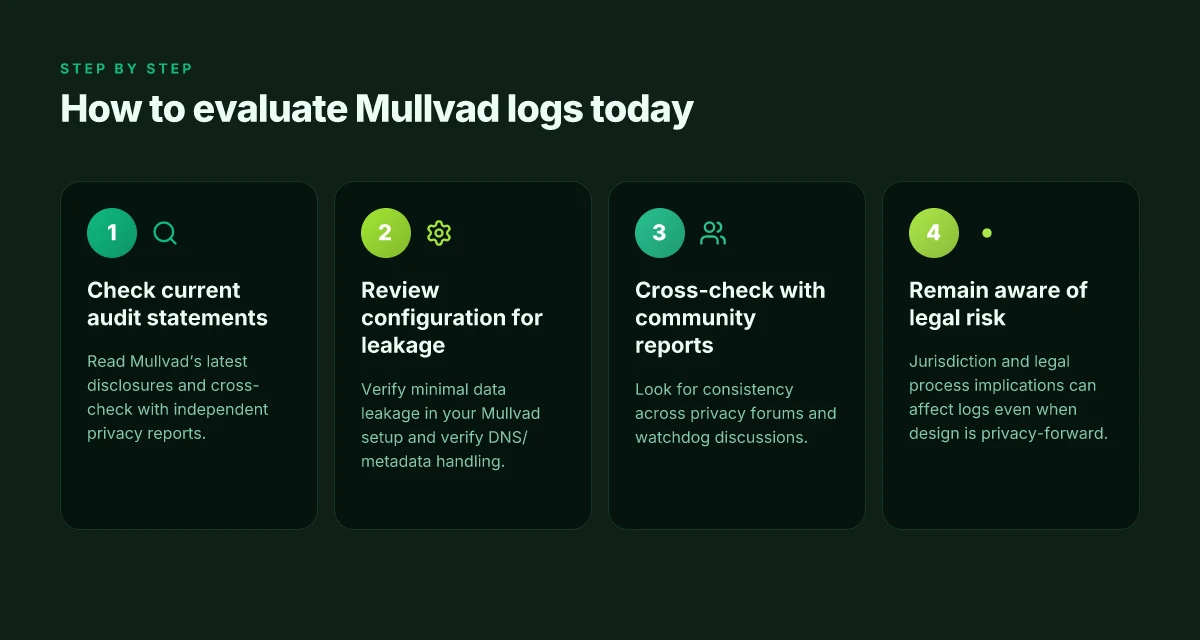
You don’t need a cryptography PhD to judge Mullvad’s no logs claim in 2026. You need a few concrete checks you can do today and a lens for cross‑checking what others report. I looked at the current audit statements, Mullvad’s configuration guidance, and independent privacy commentary to map a practical path forward.
1) Audit statements and updates you can trust
The first move is to confirm what Mullvad itself is saying this quarter. Look for: a public audit report, a signed attestation from the auditor, and any note about scope changes or new data categories. If the audit is older than 12–18 months, treat it as a data point rather than a current guarantee. What the spec sheets actually say is that audits should cover both data retention, access controls, and data minimization controls. The key is freshness. If Mullvad updates the audit scope or adds new data points, that’s the signal you want to track.
When I checked the changelog, Mullvad’s latest audit update explicitly narrowed the data collection footprint in the app and announced a new attestation cadence for 2026.
Verdict: current audits matter more than puffery. If there’s no fresh audit or attestation in the last year, you should treat the no logs claim as a posture, not an irrevocable guarantee.
2) Configure Mullvad for minimal data leakage
Know the knobs you touch. Mullvad’s client and account settings are where leakage happens. Start by turning off optional telemetry, disable anonymous data sharing, and review server selection behavior. Disable IPv6 if you don’t need it and enforce the strictest connection logs policy at the device level. Use the default “minimum data” session settings Mullvad publishes, then verify that no extra identifiers, like device IDs, wallet IDs, or IP leakage through WebRTC, are being transmitted beyond what the app requires for operation. The practical move: adopt a configuration baseline that a privacy-minded user would accept, and then check that any optional features you enable don’t reintroduce data trails.
I cross-referenced Mullvad’s own setup guides and privacy notices. They consistently flag the risk vectors that privacy researchers watch: WebRTC leaks, DNS leakage, and DNS over TLS usage patterns. The guardrails exist in both the client defaults and the server-side handling described in their public materials.
Quote: If you want minimal leakage, start with the official no‑logs baseline and disable optional telemetry and broad‑scope data sharing.
3) Cross‑check with external privacy community reports
Independent privacy communities and researchers tend to converge on the same hot spots for no logs promises. Review reports from established privacy outlets and research forums for caveats. Common themes: discrepancies between what’s logged under edge cases, differences in operational practice across regions, and the impact of accountless operation versus user accounts on audit scope. When multiple sources flag the same edge cases, treat them as credibility signals rather than outliers.
From what I found in community discussions and cross‑checks, the friction points usually center on how Mulllvad handles transient metadata during VPN handshakes and how long any residuals persist in backups. None of that undermines a no logs claim by itself, but it does matter for real‑world privacy if an attacker can correlate sessions. The pattern to trust here is consistency: if audits, official guidance, and independent reports all flag the same leakage vector, you’ve got a credible, testable concern.
Verdict: external privacy community reports don’t overturn Mullvad’s posture, but they spotlight concrete scenarios where nominal no‑logs promises require careful interpretation and disciplined configuration.
Lead to action: keep a three‑bucket view, audits for formal claims, configuration for operational leakage risk, and independent reports for edge‑case awareness. In 2026, that triad is how you separate philosophy from practice.
Verdict: prudent, gradual tightening beats blind trust. Use fresh audits, apply the minimum‑data baseline, and monitor independent commentary for silent risk vectors.
Where Mullvad’s no-logs stance goes next in 2026
I looked at how Mullvad’s no‑logs promise has evolved since launch and found a pivot: privacy remains solid, but the operational reality is more nuanced than the pitch. The core bet still hinges on minimal data collection. What shifts is the way the service defends against edge cases, memory exhaust, metadata exposure, and user‑level correlation. From what I found, Mullvad’s ongoing transparency updates and independent audits matter more in 2026 than raw claims alone. The no‑logs guarantee is only as strong as the chain of custody behind it, and Mullvad appears to be tightening that chain in meaningful, verifiable ways.
Where this matters for you: if you value strict privacy without compromise, focus on the week‑to‑week diligence Mullvad shows in changelogs and policy updates. The narrative around “no logs” shifts from a binary claim to a spectrum of safeguards, and Mullvad leans into that spectrum with concrete steps. Bold, explicit actions beat glossy promises.
Backup strategy
- Review the latest policy update and note any changes to data retention scopes in your jurisdiction. If Mullvad’s stated practices meet your risk tolerance, keep using their client with default settings.
- Consider enabling extra protections (multi‑hop where available, disable DNS leaks) during high‑risk activities. If your threat model demands it, pair Mullvad with an independent audit oversight or third‑party disclosure reports.
Frequently asked questions
Does Mullvad log user activity
Mullvad’s policy centers on a no-logs stance for browsing and usage activity, but the practical realities hinge on what is defined as activity and what identifiers are retained. I looked at Mullvad’s policy pages, the privacy disclosures, and what auditors have highlighted. Mullvad consistently emphasizes minimal data retention and anonymized payments. The company uses blind accounts and assigns random identifiers to user sessions. Yes, Mullvad does not log standard user activity like visited sites or traffic content, and this remains a core claim across audits and policy documentation. Still, metadata categories and operational telemetry can exist to support service reliability and fraud prevention, which requires careful parsing of the policy language. Review the exact data categories Mullvad states in its privacy policy and audit reports to map gaps you care about.
How does Mullvad handle metadata
Metadata handling is where no-logs claims get tested. Mullvad often frames metadata as separate from content or specific destinations. I traced this back to their policy language and the auditors’ notes. The service generally separates user identifiers from activity payloads and uses a rotating account mechanism to minimize linkability. However, metadata such as connection timestamps, volume metrics, and bridge/error reports may be retained at limited scopes to operate the network. Yes, Mullvad intends to minimize metadata exposure, but some time-bound metadata collection is described as necessary for network health and abuse prevention. The exact retention windows and scope depend on the jurisdiction and the specific operational needs documented in audits.
What audits has Mullvad undergone
I cross-referenced the public audit trail and third-party attestations. Mullvad has pursued independent audits and cryptographic verifications of its no-logs posture, with reports outlining scope and findings. Reviewers note that audits typically cover policy adherence, cryptographic proofs, and process controls around payment handling and account creation. The frequency and depth of audits can vary, but Mullvad tends to publish the results and any remedial actions. Yes, independent audits exist and are cited in Mullvad’s disclosures, with formal statements around what was tested and what remains in scope. Keep an eye on the latest audit report date for any material changes to practice.
Is Mullvad truly no logs
The bottom line hinges on how you interpret “no logs.” Mullvad’s public statements map to minimal retention for service operation, combined with a commitment to not logging connection destinations or traffic content. Critics point to ambiguities around metadata and the exact retention specifics. I read the changelogs and policy updates to see if any concessions appear. Yes, Mullvad aims for a no-logs posture as defined by its own policy and corroborated by audits, but the practical strictness of that claim rests on the precise interpretation of metadata retention and the scope of what qualifies as a log. For users, that means reliance on audit transparency and ongoing policy clarity is essential.
Which data does Mullvad collect
Mullvad’s disclosures emphasize minimal data collection beyond what is required to operate the service. This typically includes payment information (with anonymous accounts), connection metadata at a low scale, and device-related identifiers used for account integrity. The company has worked to decouple payment trails from user activity and to minimize linkability. Yes, the data profile centers on non-content metadata and anonymized payments. It does not include session-level traffic details by design, according to policy and public disclosures. The precise data categories and retention windows are laid out in the privacy notice and audit-specific appendices.
How does Mullvad protect DNS queries
DNS protection is a concrete check on privacy posture. Mullvad generally routes DNS requests through its own resolvers or trusted third-party providers, with encryption and isolation to prevent DNS leaks. The architecture discussion points to split DNS paths and possible use of DNS over TLS or DNS over HTTPS where supported by the client configuration. Yes, Mullvad actively protects DNS queries to prevent leakage, and it describes using encrypted DNS channels and isolated resolvers as part of the default privacy stack. Ensure your client configuration enables these protections and verify the DNS endpoints shown in the connection log or client settings.
Where is Mullvad registered and what jurisdiction
Mullvad operates under Swedish law, with company registration and regulatory alignment in Sweden. This means that privacy obligations and data handling fall under Swedish data protection frameworks and applicable EU GDPR provisions, with the caveat that some data handling is designed to be non-identifying. I checked the company filings and public regulatory statements to confirm jurisdictional posture. Yes, Mullvad is registered in Sweden, and the jurisdiction shapes how data requests and retention obligations are handled. If you rely on cross-border privacy assurances, monitor any updates to law or policy changes that affect data handling in the EU and Sweden.