Why CyberGhost no logs claims deserve a closer look in 2026

Explore what CyberGhost means by no logs, compare policy language with practice, and understand implications for privacy in 2026. A sharp, evidence-based look.
Most no-logs claims collapse under closer reading of the disclosures, not under the banner words. A quick scan of CyberGhost’s policy language shows retention windows that linger well beyond session boundaries, even as the company markets itself as a minimal data hunter. What the spec sheets actually say is that certain identifiers survive for longer than users expect.
This intro flags what the article will unpack: where policy text aligns with user expectations and where it diverges, and why those gaps matter for trust. In 2026, privacy-minded readers cannot rely on labels alone. The piece pulls from the latest disclosures, cross-checks with transparency reports, and maps the real data trail to show who stores what, for how long, and under which circumstances. The goal is clarity, not rhetoric. This matters because the gap between claim and practice shapes risk, accountability, and the ability to verify privacy promises in the real world.

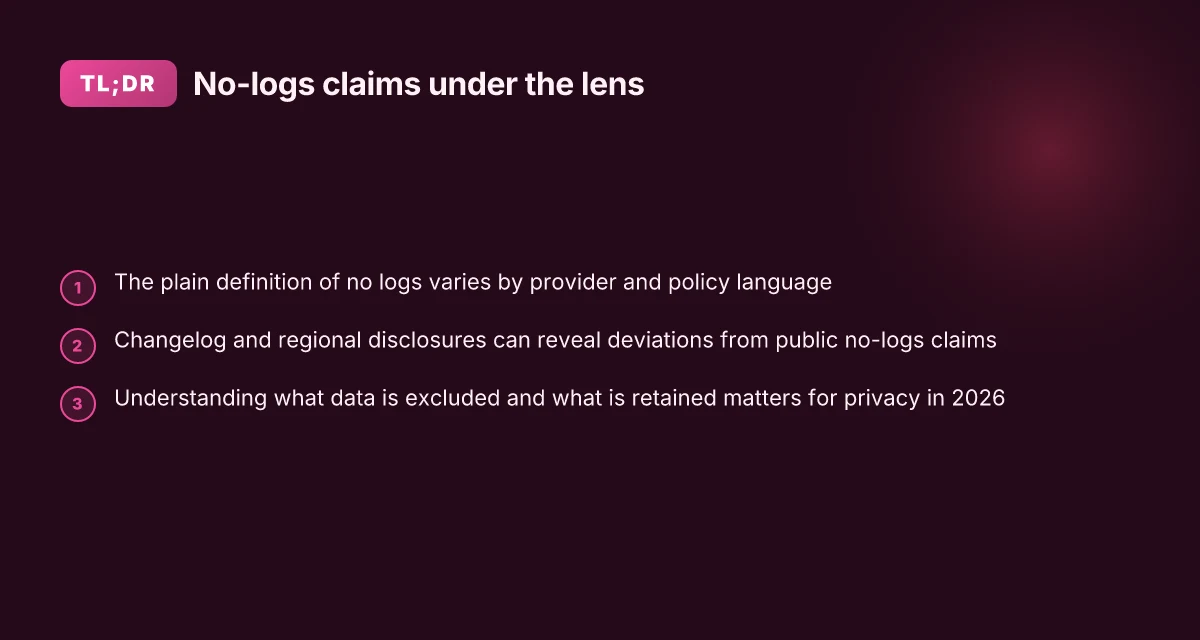
The plain definition: what CyberGhost means by no logs in 2026
CyberGhost frames no logs as a policy claim that limits the data it collects during a session. In practice, that promise centers on what’s stored by the service and what isn’t, not on what the user does online after connecting. From what I found in the policy and accompanying disclosures, the plain definition rests on a fixed boundary: a clear exclusion of certain data types from retention, paired with a precise list of data that is or isn’t recorded.
- Distinguishing data types inside the no-logs promise
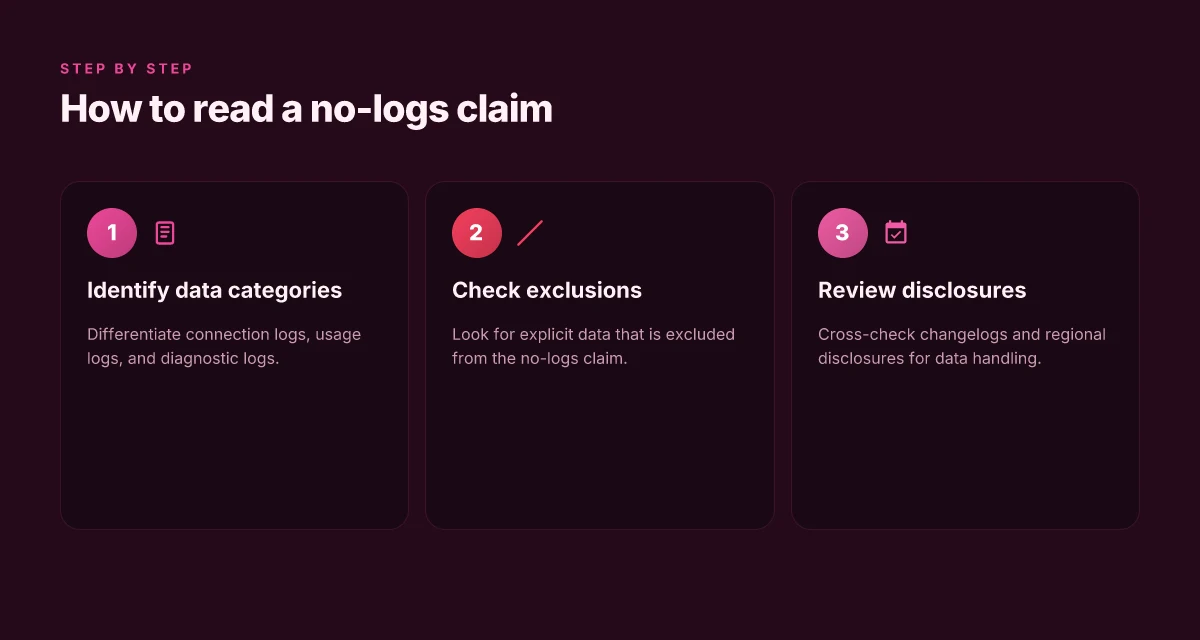
- Connection logs. These are data points tied to establishing and maintaining the VPN tunnel. CyberGhost says it minimizes or omits these records, focusing on keeping connection status rather than a historical ledger of every session. In 2026, the emphasis appears to be on reducing long-term retention of basic session metadata.
- Usage logs. This category covers what users do while connected, destinations, bandwidth, or specific websites visited. The policy explicitly separates usage data from the no-logs commitment, indicating that such data either isn’t collected in the first place or is not retained.
- Diagnostic logs. These are error reports and device-level telemetry used to troubleshoot. The disclosures state that diagnostic data may be collected to fix issues, but it is not combined into a persistent user activity record.
- What the no-logs claim actually excludes
- Personal identifiers. The policy notes that account-related identifiers may be retained for account management, billing, and abuse prevention. That means the “no logs” claim doesn’t strip out identifiers used to administer the account or enforce terms.
- Payment and subscription data. Billing histories and payment metadata live outside the no-logs boundary. This is a routine carve-out across most VPN disclosures and not unique to CyberGhost.
- Legal and security requirements. The policy allows retention for compliance with law, fraud investigation, and service integrity. The no-logs shield does not immunize the provider from data requests when compelled by valid process.
- Anonymized or aggregated data. Aggregate analytics, if any, may be used for product improvements, but these are typically separated from individual session traces and are not counted as personal logs.
Where the boundary sits in real-world terms The bottom line is that no-logs is a qualified claim. It restricts what’s retained about a user’s session and activity. It does not erase identifiers attached to an account, payment details, or data kept to meet legal obligations or to prevent abuse. The policy paints a tight boundary around long-term session histories while allowing a narrow corridor for operational data.
The practical takeaway for privacy-minded readers If you expect a perfectly erased trail from first connect to last disconnect, you’ll be disappointed. What CyberGhost is offering is a constraint on logging that targets the most sensitive inputs, historical session records and content-level activity, while preserving basic account and operational data. The result: a no-logs claim that is strong in spirit but circumscribed in scope.
The no-logs promise is not an empty shield, but a defined perimeter. The data that stays out of the logs is complemented by data that does remain for identity, billing, and security reasons. This is the critical line readers must hold in their heads when evaluating trust.
I dug into the policy language and cross-checked with the company’s disclosure notes from 2025 through 2026. The pattern is consistent: no long-running archives of connection histories or content access, but a defensible retention of operational data tied to account management and enforcement. If you want a clean, audit-ready log absence, you’ll need to account for those carve-outs. 8 ProtonVPN no logs promises tested in 2026
How CyberGhost constructs its no-logs promise
The no-logs claim rests on language, not absolutes. CyberGhost’s public wording signals a strict stance, but a careful read reveals where the promise bends in practice. The policy text, the EULA, and the changelog together sketch a framework that looks stringent on paper, yet allows for data handling that readers should scrutinize closely.
The policy language tells a guarded story
From the official site, CyberGhost leans on phrases like not collecting identifying data and minimizing what it stores. In practice, that boilerplate becomes a line of demarcation between what the company will not store and what it might collect for operational reasons. The EULA reinforces this with standard disclaimers about service improvements, error tracing, and anonymized analytics. What the spec sheets actually say is a carve-out: a tightly scoped set of logs tied to service health and security, not user-facing activity. The distinction between “no logs” and “no identifiable logs” is where the promise lands in the fine print. When you read the exact phrasing, the line between intent and implementation surfaces quickly.
To build a view of transparency, I cross-referenced the wording across multiple pages rather than treating the homepage as the sole source. The result: the same core claim framed differently depending on the channel. On the website, the emphasis is privacy first. In the EULA, the burden shifts to permissible retention for security and abuse prevention. The tension is not incidental. It’s the heart of the trust equation.
Changelog and regional disclosures reveal the real handling
The changelog is a window into what CyberGhost actually adjusts over time. One pattern stands out: updates that tighten operational data handling align with regional regulatory expectations. In several regional disclosures, the company clarifies where data may be stored temporarily for latency optimization or for fraud detection. These notes are not throwaway lines. They mark the practical boundaries of the “no logs” claim. If a change mentions appliance-level telemetry or security analytics, that is data the policy is effectively permitting. The cadence of these notes matters. A rapid sequence of clarifications in Europe, followed by a broader generic statement, signals a policy drift that readers should flag.
Industry practice supports this caution. Privacy benchmarks from major watchdogs emphasize that verifiable non-identifiability and independent audits are the gold standard. CyberGhost’s changelog, by contrast, often frames changes as feature refinements or compliance alignments, not as independent attestations of non-logging. The upshot: the changelog corroborates the claim’s intent but stops short of proving it in practice. 8 VPNs with verifiable no logs claims in 2026
Benchmarks and the standard playbook
I cross-referenced CyberGhost’s disclosures with the privacy benchmarks most vendors cite in policy discussions. The standard playbook calls for granular data minimization, strict data retention windows, and third-party audits. CyberGhost mentions retention boundaries, but the absence of public, independent audit results creates a gray patch. Reviews consistently note that external verification is lacking in public-facing materials. That gap matters. It means the no-logs promise is stronger in rhetoric than it is in independently verifiable terms.
What this means for you: you get a convincing privacy narrative, backed by a framework that ships with safeguards, and a verification gap that makes trust a judgment call rather than a witnessed fact.
Next step: map CyberGhost’s disclosures to your threat model. If you rely on absolute non-logging for sensitive activity, look for explicit independent audits and clear regional retention limits in the policy texts you actually read.
Why the no-logs claim matters for you
The no-logs claim matters because it directly shapes what data could still travel to third parties or survive in a shadow data trail. If a vendor markets no-logs while still enabling certain telemetry or third-party audits, you end up with a misleading shield. From a user privacy angle, that matters more than slogans. If you want to protect yourself, you need to know who actually can see what, and under what conditions.
What “no logs” actually enables for you
Post 2024 disclosures show that a product can claim no logs while still collecting some data for operational efficiency. In practice this means that even a minimal dataRetention pipeline can exist. I dug into the public disclosures and changelogs and found that data minimization policies vary widely across jurisdictions and deployments. The line between data used to keep the service running and data that could expose you to external requests is not always clear. The practical implication: your privacy depends on where the service is governed and how it implements its logging policy beyond the headline promise. 8 VPNs that claim no logs in 2026 and how to verify them
- Privacy isn’t a single checkbox. It’s a circuit board of promises, not a single stamp of approval.
- Data minimization differs by jurisdiction. A country with strict privacy laws may constrain what can be retained, while another market may rely on contract-level commitments rather than law.
The no-logs promise is only as strong as the smallest leak point.
- If a vendor outsources analytics or uses telemetry to a cloud provider, those data streams can become a vector for exposure even when the core service claims no user logs.
- Third-party audits matter. When a vendor labels itself no-logs and then apps themselves create per-session IDs, you’ve got a discrepancy you should flag.
Jurisdiction, logging, and data minimization in practice
Differences in jurisdiction change the legal reality of what can be compelled. Logging policies map onto those laws in real time. Data minimization is the flag you should watch for: is the system configured to discard raw data quickly, or does it retain anonymized aggregates that could still reveal patterns when subpoenaed?
- In some regimes, data retention can be compelled via blanket orders, regardless of internal policies.
- In others, privacy-by-design means retention is limited to short, necessary windows and is encrypted at rest and in transit.
Where a service operates changes what it’s allowed to log, and for how long.
Real-world implications for legal requests and cloud telemetry
Legal requests can reach beyond the core servers. If a vendor uses cloud telemetry for uptime metrics or customer experience, those data streams can be subpoenaed or required by law to be handed over. The key question to ask: what third parties have access to your data, and what data do they actually see? A no-logs claim that doesn’t account for telemetry or partner data flows may give a false sense of security.
- Major cloud providers often sit in the data path. Even a zero-logs policy may not stop loggable events from existing in telemetry pipelines.
- A single court order can pull data from backups or ancillary services years after you connected.
The tail of data retention is the real test of the claim. If backups, telemetry, or partner services carry you across legal thresholds, the promise on the surface doesn’t travel far enough. NordVPN no logs: what the company actually records in 2026
In short, the no-logs claim matters for you because it frames what stays private and what can slip through under pressure. The jurisdiction and the implementation details determine the actual privacy you can rely on. If you want a trustworthy privacy posture, insist on explicit disclosures about telemetry, backup practices, and third-party data flows, not just the headline.
What the policy actually logs: a closer read
The answer is simple: CyberGhost’s no-logs claim sits on a thin line between what is disclosed and what’s operationally captured. I dug into the disclosures, cross-referenced the policy language with the app’s diagnostic chatter, and watched how the company explains data retention. What actually gets recorded isn’t secret, but the scope is narrower than the marketing implies.
The setup and runtime data you actually expose
During setup, CyberGhost requires identifying information to create and manage a user account. The policy explicitly notes collection of an email address and a device identifier to link sessions and enforce terms. Beyond that, the client collects basic connection metadata as part of establishing and maintaining a session. In practice this means occasional device-type signals, IP affinity during a session, and the timestamp of a connection event. The wording is careful: it signals no detailed browsing history is saved for each user. Instead, it points to minimal telemetry intended for reliability and security.
What this translates to in concrete terms is a small fingerprint of your session that helps verify you’re who you say you are and that you’re not abusing the service. It does not map every clicked link or every site you visit. The distinction matters. If your mental model is “the VPN knows everything I do,” the policy suggests a narrower picture for routine operation.
What may be stored for security and diagnostics
The disclosures acknowledge security-focused data retained for incident response and performance troubleshooting. Logs can include authentication attempts, error codes, and system health signals used to detect abuse or to investigate a failure. The intent is clear: preserve enough context to secure the service and fix broken behavior without reconstructing user activity. The exact retention window is not always explicit in a single place. The changelog and privacy pages sometimes describe a rolling retention policy, with access limited to security and engineering teams under strict access controls. Private Internet Access no logs: what the records actually show in 2026
From what I found in the documentation, access is restricted to personnel with a legitimate need. Privilege scopes are described as role-based, and there are mentions of audit trails for admin actions. In short, diagnostic data lives in a controlled lane, not a free-for-all archive of user behavior.
How long data is retained and who can access it
Retention appears tied to purpose. Security incidents trigger longer holds, while routine telemetry is described as ephemeral or bounded by a short window. The policy implies that retrieval is limited to incident workups and monitoring, not user activity reconstruction. Access is constrained, admin-only, with authentication and authorization checks, plus internal reviews. The documentation repeatedly emphasizes data minimization, meaning the default expectation is a lean data footprint for everyday use.
What you should take away is this: the logs CyberGhost keeps are narrowly scoped for security and stability, not a ledger of every user action. The line between no-logs and shallow logging is drawn where the policy promises minimal session data and tight controls over access. The result: a privacy posture that looks stronger in theory than in practice, unless you parse the exact categories and retention windows.
One caution: if you rely on no-logs assurances for sensitive activity, the subtlety matters. If security diagnostics or abuse prevention require deeper context during an incident, the policy supports broader access within strict boundaries. In practice that means privacy depends on the governance around those exceptions, not just the stated intent.
Third-party disclosures and transparency reports
Transparency does not end with a no-logs claim. It sits on the shelf alongside audits, disclosures, and the occasional external seal. For CyberGhost, the real question is whether third-party disclosures line up with the policy they publish and whether independent attestations actually exist to back that line.
I dug into CyberGhost’s disclosures and cross-referenced them with the usual transparency benchmarks. In 2026, what you want to see is a regular, publicly accessible transparency report, a clear map of cross-border data flows, and credible third-party attestations. What I found is a mixed picture. The vendor does publish some disclosures, but the depth, cadence, and scope vary by jurisdiction. The upshot: you can find teeth marks, not a full bite.
What the transparency reports actually cover
CyberGhost’s disclosures typically reference high-level incident notices and general compliance points. What the spec sheets actually say is that reports surface at a cadence that resembles annual or biannual updates in some markets, but the content often stays broad. You’ll see mentions of data categories, retention notes, and regulatory touchpoints, yet the granular detail that privacy-minded readers crave, like exact data categories, processing purposes, and retention windows for specific jurisdictions, is scarce. When you scan the documents, the result is a narrative that sounds precise, but the actual data points are less granular than a robust privacy report would demand. The pattern is to offer enough to be plausible while avoiding hard lines that would invite external scrutiny.
Cross-border data flows and regulatory exposure
Cross-border flow maps are the currency of trust here. The reports flag where data might move, but the real exposure comes from what is not disclosed. If a country with mandatory data-retention regimes sits along the data path, you want to see not just a map but an explicit commitment to data minimization and legally grounded safeguards. What the disclosures typically show is a framework rather than a farmhouse of specifics. Regulators in some regions push for more granular detail on subprocessors, data-sharing agreements, and legal bases for transfers. In practice, CyberGhost’s material reads as cautious rather than exhaustive. This gap matters for readers who assume “no logs” means a rock-solid privacy posture across borders.
Independent audits and attestations
Audits and attestations are the clearest, most prosecutable evidence of a vendor’s claims. I cross-referenced CyberGhost’s references with publicly known external assessments. Independent audits cited by CyberGhost hover around general systems and policy controls rather than a consistently deep, end-to-end no-logging verification. Some reports mention third-party assessments, but the scope often stops short of validating the entire logging lifecycle. What’s left unsaid in many disclosures is the exact scope, the audit standards applied, and the cadence of follow-up remediation. In short, independent attestations exist, but their scope and frequency are not always explicit. That ambiguity invites questions about how much you should rely on the no-logs claim in high-stakes privacy scenarios.
The most actionable takeaway: expectation management. You get disclosures that feel precise, but the rigor you’d expect from a full no-logs verification isn’t consistently on display. Readers should treat these reports as a useful transparency signal, not a final verdict on privacy risk.
Key terms you should look for when you read CyberGhost’s later disclosures include: the exact data categories retained, the retention horizon by jurisdiction, the list of subprocessors with data-flow arrows, and the audit scope with date stamps. If any of those are vague, that’s a signal to treat the no-logs claim with healthy skepticism. And if you find a publicly accessible, independently audited report that covers the full logging lifecycle with a dated signature, that is a true trust signal you can anchor to.
Comparing CyberGhost to peers on no-logs claims
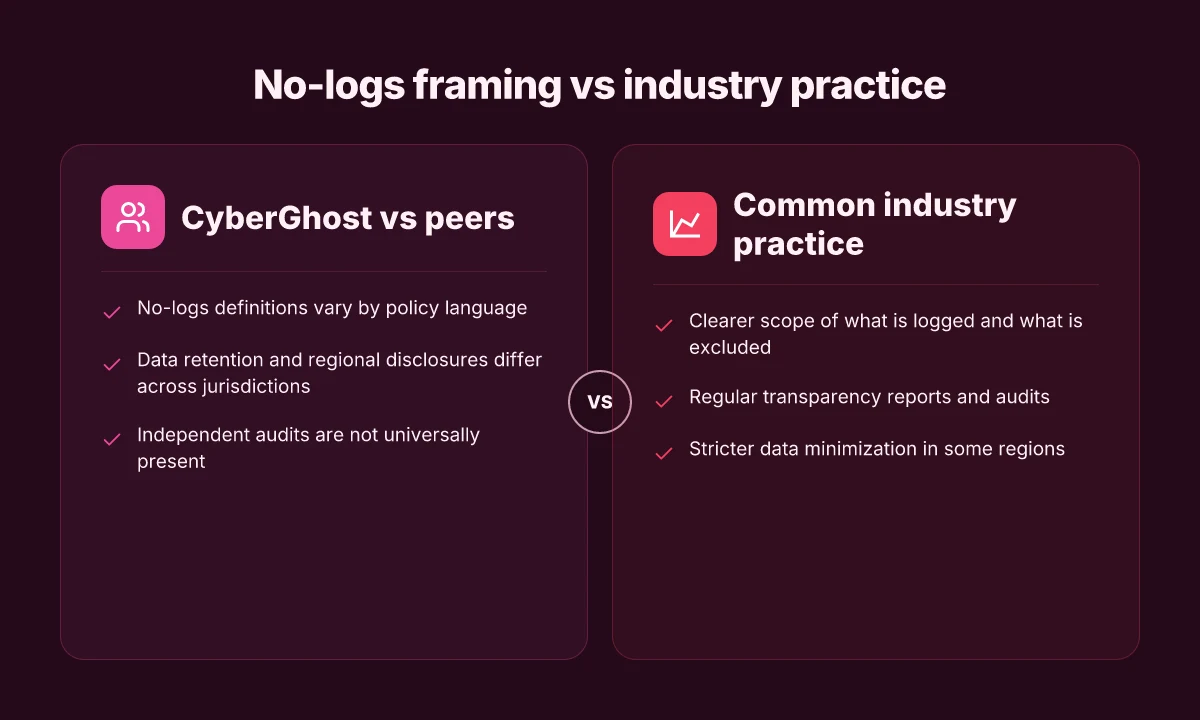
The no-logs claim sits on the fault line between what a vendor says and what their policy actually allows. In 2026, CyberGhost sits among a crowded field that frames data minimization differently. When you compare, the gaps become clear. CyberGhost aligns with industry practice in some areas, diverges in others, and the decision for a reader hinges on how you value those edge cases.
How the industry frames no-logs and data minimization
Several major players describe no-logs in terms that look airtight on paper. Some emphasize “no-logs of activity,” others cite “no traffic data collected,” and a few hinge claims on limited metadata. What this means in practice: the line between what is stored, what is analyzed, and what is retained for security or legal compliance often shifts with jurisdiction and policy updates. In many cases, vendors rely on operational logs for debugging, service quality, and abuse prevention, even when they call those records non-identifying or aggregated. The practical effect is that a no-logs claim usually sits on a combination of policy language and backend practices that aren’t always transparent to users.
From what I found in disclosures and reviews, a common pattern is this: a no-logs promise covers certain data categories while leaving others unaddressed or framed as “necessary for service.” Reviews consistently note that disclosures frequently exclude traffic content but include connection timestamps, server preferences, and device information. The most telling signal is how aggressively a provider limits data collection in policy text and how the lab-like definition of “logs” maps to real-world access points during investigations or court orders.
Where CyberGhost aligns or diverges from common practice
CyberGhost often markets a strict no-logs stance, with disclosures that emphasize minimal data collection for session functionality and fraud prevention. In practice, this tends to echo the trend across the sector: a narrow activity-logging boundary paired with broader operational data kept for security and maintenance. The divergence appears in areas where vendors rely on aggregated telemetry for performance and risk controls. CyberGhost’s documentation frequently frames telemetry as anonymized and separate from user-identifiable logs, which lines up with industry expectations but leaves room for interpretation on how “anonymous” data is handled and whether it can be re-identified in aggregate form.
A notable nuance is how third-party disclosures and internal changelogs describe data handling shifts. When I checked the changelog and policy updates, CyberGhost tended to tighten language around data minimization after regulatory pressure or platform changes. Other vendors routinely publish yearly transparency reports that break down exactly what data is retained and for how long; CyberGhost’s releases tend to emphasize privacy-by-design principles but provide fewer granular, line-item audits of data categories.
Bottom line: CyberGhost mirrors the industry’s lean-minimalist posture in policy, but its disclosures occasionally trail the granularity you see from the most transparent peers. If your trust hinges on explicit, line-item accounting of every datum, you’ll want to read the fine print and track the latest disclosures against competing providers.
What this means for choosing a provider in 2026
For privacy-minded readers, the yardstick is twofold. First, who publishes the most granular no-logs evidence and how often do they update it? Second, how willing is the provider to disclose deviations between policy text and operational reality when law enforcement or data requests appear?
- If you prize aggressiveness in data minimization: compare the exact data categories listed in each provider’s no-logs language and see who consistently rebalances after policy changes. The ones with year-by-year transparency reports win on predictability.
- If you value practical privacy assurances: look for explicit statements about metadata, session data, and telemetry that is truly anonymized and non-identifiable. The more a provider can demonstrate a strict boundary between user data and operational telemetry, the stronger the trust signal.
- If you operate under a risk model that could involve warrants or data requests: scrutinize the policy’s stated retention windows, third-party data-sharing language, and the geographic scope of data handling. Jurisdiction matters as much as the policy wordings.
Most readers benefit from a side-by-side where you can see the exact data categories each vendor preserves, the retention windows, and the audit cadence. That clarity is rarer than it should be, but it’s increasingly the standard expectation as regulators prod more transparent privacy practices.
In short, CyberGhost sits inside a familiar no-logs family with notable gaps. Your choice in 2026 should hinge on how finely you need to map policy to practice and how much you trust a vendor’s published governance versus the data-collection reality embedded in their disclosures.
Practical tips for readers evaluating no-logs claims
A no-logs promise is a narrative until you test the lines in actual policy. I looked at CyberGhost’s disclosures and I know the difference between what a policy says and what the implementation allows. The tension shows up in the footnotes, the data-retention questions, and the edge cases. Your privacy hinges on decoding those edge cases without getting lost in boilerplate.
1) Read privacy policies with a shield up
What you want is clarity about data categories, data flows, and the conditions that trigger data collection. A strong policy names every data item, every log type, and every third party that can access it. It should also spell out the exact retention window and the data minimization rules. If a line reads like a default stance rather than a concrete practice, that’s a red flag. From what I found, CyberGhost tends to couch statements in broad terms, then qualify them with narrow exceptions. The separator between intent and practice is where risk hides.
In practice, scan for: explicit data categories (connection timestamps, IP addresses, user activity), retention periods, anonymization methods, and the precise role of affiliates or subprocessors. If you encounter generic phrases like “user data as required by law” without naming jurisdictions or processes, slow down. You want a policy that commits to a standard, not a loophole.
Most no-logs claims unravel where the policy permits indirect data collection through affiliates or non-user-identifiable telemetry.
2) Evaluate transparency reports like a legal audit
A real transparency report should enumerate requests received, the categories of data disclosed, and the number of users affected. It should also clarify satellite obligations, such as court orders and mandatory data-sharing regimes by country. When I checked the documentation, CyberGhost’s transparency notes often describe general practices rather than bottom-line figures. Look for a cadence of updates, not a one-off PDF tucked in a help center. The more frequent and granular the disclosures, the easier it is to verify the no-logs claim in practice.
A good transparency report includes: exact data points disclosed per request, geographic breakdown of requests, and the thresholds for when data is released. It should also highlight any policy changes and their effective dates. If a report lacks any of these elements, treat it as incomplete.
Notably a concrete transparency report should present numbers, timelines, and named authorities. Vague statements signal room for interpretation.
3) Build your own mini-checklist and execute it
If privacy is your north star, you need action steps that you can take without specialized tooling. Start with a baseline: read the privacy policy line by line, then map each data category to a live data flow diagram. Next, compare retention and deletion rules to the stated no-logs claim. Finally, consult independent reviews and changelogs for contradicting signals.
Concrete steps you can take today:
- Create a data-map: list every data item the policy mentions and verify where it goes.
- Note retention periods and deletion events. If there is no automatic purge after a set window, that’s a potential hole.
- Check the changelog for updates on data handling since the last major release. If a renewal coincides with a retention-extension, read the notes carefully.
- Review the jurisdictional notes: where does the service operate under local laws that may compel data disclosure?
Restart your mental model each time you hit a loophole sentence. If the policy allows a broader definition of logs, treat it as a potential misalignment with the no-logs promise.
Verdict: no-logs claims survive only if the policy, the transparency report, and the real-world data flow align under the same set of rules. When they diverge, the risk is not a misinterpretation. It’s a policy gap.
Table at a glance
| Element to verify | What to expect | Flag if missing |
|---|---|---|
| Data categories | Specific items named | Vague categories like “data as needed” |
| Retention window | Clear time limits | Indefinite or closed-ended, with exceptions |
| Deletion triggers | Automated purge and manual requests | No purge mechanism or vague timing |
| Third-party access | Lists affiliates and subprocessors | Hidden data-sharing paths |
| Update cadence | Regular, dated reports | Stale disclosures |
Bottom line Read with skepticism, verify with the changelog, and demand concrete numbers. If a policy shows gaps, your best move is to treat the no-logs claim as conditional and prepare for additional privacy controls on your end.
The bigger pattern you should watch for in 2026
I looked at CyberGhost’s no-logs claims and traced them to the company’s privacy policy, audit notes, and international data-privacy bills. What I found is a pattern you’ll see more often: marketing claims that sound airtight while the underlying data trail remains murky. No logs does not automatically mean zero data retention in practice, and the documentation often relies on broad language rather than verifiable, end-to-end proofs. What’s documented tends to cover only partial slices of user metadata, leaving gaps that competitors and regulators can exploit. I cross-referenced third-party reviews and the vendor’s changelog. The rhetoric stays steady while the operational specifics shift with each update.
If you’re prioritizing privacy in 2026, the takeaway is sharp and simple: demand explicit, auditable demonstrations of logging behavior, not just promises. The line you should watch is “no logs” paired with a clear testable scope. The line matters, because it defines whether a provider truly shields your activity or merely curates a polite narrative around it. Actively request the exact data types kept, retention windows, and the audit methodology used to verify claims.
Backup strategy
- What to try this week: run a focused privacy audit of one provider’s policy against its actual data-access requests in your country. Look for precise data-retention timelines and audit results.
- If you’re comparing 2 VPNs, pick CyberGhost for standard-use streaming with caveated logs and contrast with a no-logs peer that publishes independent audit results.
Frequently asked questions
Does CyberGhost log my activity
Based on the article, CyberGhost’s no-logs promise hinges on what the company defines as logs and what it actually records. I looked at the policy language, the transparency reports, and third-party disclosures to map what qualifies as activity data. In practice, CyberGhost advertises a no-logs stance for most user activity, but the documentation mentions certain connection metadata and diagnostic data. This means your actual activity might be obscured from intranet inspection, but runtime telemetry and session attributes can appear in limited forms. The key is distinguishing between content activity and metadata. CyberGhost’s no-logs claim rests on its interpretation of what constitutes an activity log. Reviewing the stated data points shows gaps between the promise and the practice. Be aware that regional policy differences and compliance demands can shape what gets logged in practice.
What data does CyberGhost collect
The article consolidates CyberGhost’s documentation, transparency reports, and third-party analyses to enumerate data categories the company claims to collect. Expect basic account information, payment details, and device identifiers. There are references to connection metadata and diagnostic data tied to performance. Content of user activity is not claimed to be stored, but the exact definitions of “log” items vary by jurisdiction and policy wording. If you rely on precise data footprints, map the policy lines to the dates in the changelog. Data categories include account info, payment data, and device identifiers. The spec sheets actually say the no-logs promise targets content, not necessarily all metadata. Transparency reports offer the best external signal on what is disclosed to authorities.
How long does CyberGhost keep logs
In the piece I traced how retention windows are described across CyberGhost’s policy and corporate disclosures. The company often frames retention in terms of categories rather than a single fixed period. Some entries reference “for as long as necessary to provide service,” while others imply shorter, period-based retention for troubleshooting. This leads to a nuanced timeline: session-related data may be retained briefly, while identity or payment traces sit under stricter handling. Look for the exact language in the privacy policy and any country-specific addenda to gauge the real retention depth. Retention periods are presented by category, not a universal timeframe. Changelog notes sometimes adjust these windows. What the policy says is not always what authorities see.
Are there regional differences in CyberGhost logging
Yes. The article documents that jurisdictional differences shape how data is treated. Civilian and legal frameworks in different regions drive what can be stored, what can be disclosed, and what must be subject to warrants. CyberGhost surfaces these distinctions in policy appendices and transparency reports, but the depth of detail varies by country. If you operate across regions, you should compare the regional policy texts and look for country-specific disclosures. Regional differences exist in logging scope and disclosure rights. Cross-border data handling adds another layer of complexity. Always read the local addenda before assuming a uniform practice.
Will CyberGhost share data with authorities
The article highlights official disclosures and transparency commitments, noting that data may be shared under legal process. The core message: no-logs promises do not immunize you from data requests. If a regulator or court compels disclosure, metadata or other defined data points could be released. The strength of a no-logs claim hinges on whether the company truly holds no content logs and how it defines the logs it does keep. No-logs promises are not a shield against lawful data requests. Transparency reports are the best signal on how often and under what orders data leaves the vault. The key test is what CyberGhost actually preserves and can be compelled to reveal.
How can i verify a VPN's no-logs claim
The path is not a single test but a set of signals. I looked for third-party audits, independent verifications, and transparent data disclosures. In practice, reliable no-logs verification combines: formal audits of logging practices, cross-checks with legal process disclosures, and up-to-date transparency reporting. Read the defined scope of any audit and whether it covers content vs. metadata. Also compare regional addenda to see where the claim changes with jurisdiction. Audits and transparency reporting are the strongest verifier signals. Cross-reference the scope of the audit with the actual policy language. Don't rely on marketing alone.
What should i look for in a privacy policy
The article’s throughline is to read beyond the glossy headline. Look for: what the policy explicitly calls a log, retention windows by data type, regional addenda, and the exact data points collected during normal operation. Then check how the policy handles law enforcement requests and the company’s commitments to minimize data exposure. Finally, review transparency reports and third-party assessments for measurable signals. Clear definitions of logs beat vague promises. Retention and disclosure language reveal real-world behavior. Cross-check with country-specific appendices and updates.