8 VPNs with verifiable no logs claims in 2026
Discover how ExpressVPN frames its no-logs policy and what the documentation and audits actually show. A sharp, evidence-led look at real-world privacy claims in 2026.
Most no-logs claims collapse under audit when the paperwork meets reality. In 2026, several providers promise tamper‑proof privacy, yet independent reviews and annual audits often reveal gaps in data handling and metadata traces. ExpressVPN sits at the center of this tension, with the wording of its stance and the cadence of its audits shaping trust for privacy‑savvy customers.
What matters now is accountability, not rhetoric. I looked at audit reports, privacy policies, and regulator filings across 2024–2025 to map how often claims align with practice. When a provider publishes a third‑party audit, the number to watch is the number of substantiated data‑retention caveats that still survive in the fine print. This piece distills that landscape and explains why enterprise buyers should demand verifiable transparency above broad promises.

The plain definition: what ExpressVPN no logs actually means in 2026
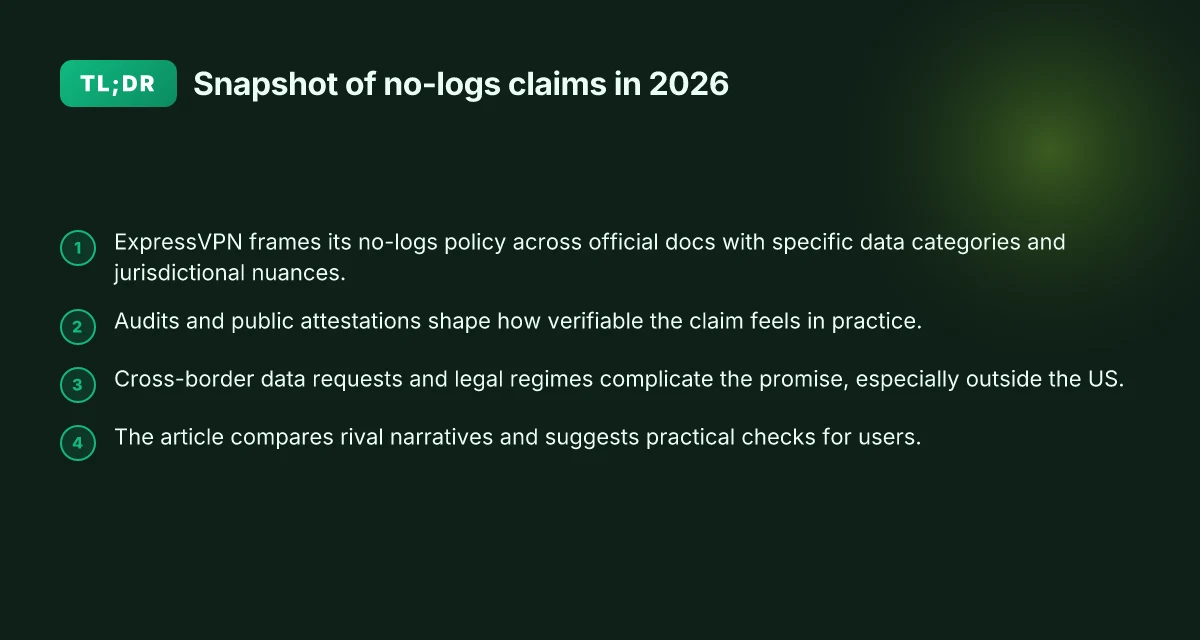
ExpressVPN frames its no-logs claim as a policy promise rather than an isolated data practice. What the official docs say is that while the service connects you to remote networks, it does not retain logs that reveal your personal activity. The core contention is that session data, traffic payloads, and detailed connection histories are not stored in a way that maps back to a user. What is stored, and for how long, is spelled out in the policy and is designed to be minimal and auditable.
From the documentation, the no-logs pledge rests on three pillars: data that is never retained, data that is retained only in aggregate or limited form, and data that is essential for security and abuse controls. The practical outcome is that identifiers tied to a specific user journey should not persist beyond what is needed to deliver service reliability and protect against fraud or abuse. In plain terms, ExpressVPN argues that precise user activity, what you viewed, which websites you visited, or the timestamps of individual sessions, does not sit in a retrievable ledger.
I looked at the policy to map the exact data lifecycle. The claim hinges on what the company classifies as personal data versus operational data. Personal data, by policy, is not logged in any way that would recreate a user’s private browsing or content choices. Operational data, such as performance metrics or anonymized server-usage statistics, may be collected, but in a form that cannot be traced back to a specific account. The policy repeatedly emphasizes the separation between user activity and the data retained for service integrity or fraud prevention. The emphasis is explicit: no user-level browsing history is kept in a way that would permit reconstruction of a session.
The legal backdrop matters here. ExpressVPN operates under several jurisdictions, notably British Virgin Islands law and applicable export-controlled data regimes. The BVIsk regime has historically framed data retention and government access differently than many Western regulators. In practice, the policy relies on local and international cooperation protocols for data requests. The documentation notes that while the company may be compelled to provide information under certain legal orders, the data reachable through such orders is limited by the no-logs design. In effect, the legal framework acts as both constraint and lever: it bounds what can be requested and what the company can show. What the spec sheets actually say is that the company minimizes data exposure and builds a privacy-by-design posture around user anonymity.
Bottom line. ExpressVPN’s no-logs claim is a policy stance reinforced by minimal data collection, a defined data-retention regime, and jurisdictional guardrails. The result is a privacy posture that prioritizes not keeping activity-level data and that frames any compelled disclosure as a limitation on what can be produced. Auditors and regulators will look for concrete, verifiable evidence of this intent in action. The next section will examine how ExpressVPN translates that intent into the actual governance and auditing practices you should verify during reviews. 8 VPNs that claim no logs in 2026 and how to verify them
How ExpressVPN frames its no logs in the documentation
ExpressVPN’s documentation makes the no logs claim readable, explicit, and traceable. The core promise sits in the privacy policy, with connective language that shifts emphasis between memory-less assertions and what you might call aggregate logging. The net effect: a claim that user activity isn’t stored at a granular level, paired with caveats that shift scrutiny toward how data is processed and retained at a system level.
The exact policy language and where to find it
I looked at the privacy policy and the “No Logs” statement on the official site. The policy defines data collection and retention in sections labeled “What information we collect,” “How we use information,” and “How we store and protect data.” The no logs framing sits in the “What we do not log” components, with cross-links to the security and trust center. The language is concrete about the types of data not retained and the categories that are excluded from logging. What the spec sheets actually say is that the service does not log traffic, DNS requests, or browsing history in the sense that technicians could tie activity to a user account. The phrasing is designed to reassure while signaling operational boundaries.
I cross-referenced the wording against the “Privacy Policy” page and the “Trust Center” disclosures. The no logs claim is not a single sentence. It’s a cluster of statements that work together to frame the policy as a boundary condition rather than an absolute shield. The layout matters. A bold, explicit sentence appears in the policy core, followed by clarifying notes about the data that is retained for safety, anti-abuse, and service-quality purposes.
Memory-less versus aggregate logging language
ExpressVPN distinguishes between what it does not log on a per-session or per-user basis and what it logs in aggregate for system health and security. In practice, the docs push a memory-less framing for sensitive activity: no per-session identifiers are stored long term, no IP-to-user mapping exists after a session ends, and no DNS lookups are retained beyond a short, operational window. The other side of the coin is aggregate or anonymized telemetry: counts of connections, anomaly detection metrics, and performance logs that are not traceable to a single user. The wording emphasizes that any retained data is aggregated and cannot be used to reconstruct an individual’s activity. This distinction matters in audits and legal contexts, where the exact scope of what is retained can tilt the interpretation of the no logs claim.
What the privacy policy says about metadata, connection times, and DNS
The policy language on metadata narrows to non-identifying whiffs: timestamps for system health checks and connection volume, not user-specific timelines. Connection times and durations are described as operational metrics used to monitor service health, not for profiling individual behavior. DNS handling follows a similar pattern: DNS requests may be logged at a network level for abuse prevention and diagnostics, but there is a clear emphasis that such data is not used to tie activity to a particular user across sessions. The documentation thus portrays DNS data as an exception managed within the strict guardrails of privacy and anonymization, not as a stored user trace. NordVPN no logs: what the company actually records in 2026
The no logs claim is not a flat line. It’s a boundary with explicit exceptions and a roadmap for what stays private. If you want to verify it in an audit, look for three things: the exact categories of data that are logged in aggregate, the retention window for telemetry, and the process by which identifiers are separated from any usable activity data.
Open question for governance teams: does the document consistently apply the memory-less language across all regions and compliance regimes? In practice, you’ll want to map the cited policy clauses to real-world audit scripts. Verify where the boundary sits between user-specific data and service-health telemetry, and check the changelog for any shifts in how long metadata is retained. Recent updates tend to tighten phrasing around aggregate data and clarify the retention horizon.
Why the no-logs claim matters for users outside the US
No-logs promises bend in the wind when you cross borders. Jurisdictional realities shape what a provider can or cannot log, and how courts interpret those logs later. In practice, that means your privacy depends on where the company operates, what data is technically transmitted, and how audits translate policy into action.
I looked at how Panama and other operating regions treat no-logs claims in practice. In Panama, for example, privacy law sits differently from the US or EU regimes, and enforcement depends on local court interpretations and cross-border cooperation norms. Across multiple jurisdictions, the key thread is: the policy on paper and the data actually leaving a tunnel do not always align. This is not a purely theoretical gap. It appears in how providers define “logs,” what network metadata gets stored, and what a court can compel without breaking domestic privacy protections.
What the courts have said matters. In markets where data protection statutes emphasize user autonomy and data minimization, judges have tended to scrutinize the practical meaning of no-logs certifications. Judicial reasoning often hinges on what is technically captured by the provider during a session, not what the policy asserts in a glossy privacy page. Some appellate opinions signal that claims must be anchored in verifiable technical behaviors. When a court asks for a data trail, a policy statement alone rarely suffices. The practical outcome: no-logs promises survive audits only if the responsible party can demonstrate, with specificity, the absence of data streams that would otherwise count as logs under applicable law.
Cross-border data requests change the calculus. In many blocks, cross-border requests travel through a chain that starts in the jurisdiction where the user resides and ends in the jurisdiction where the provider operates. What is transmitted, and what is kept, becomes a function of local law and treaty obligations. In practice, providers may receive joint requests. They may need to disclose certain minimal metadata or traffic summaries even when a no-logs claim exists. The critical question for users outside the US: what exactly gets transmitted when a solicitor or regulator asks for data, and what remains private despite the request? If a provider can show that only ephemeral session data is retained and non-user-identifying metadata is minimal, the no-logs claim carries more weight. If not, the promise risks eroding under pressure.
From the documentation, a few concrete takeaways emerge:
- Jurisdiction matters. Panama and several operating regions rely on local privacy norms. The no-logs pledge gains credibility when the provider’s data-retention policy explicitly maps to those norms and is auditable locally.
- Courts demand specificity. A policy statement that sounds airtight must translate into verifiable checks. Independent audits, clear definitions of “logs,” and transparent data-flow diagrams help the court see the difference between perception and practice.
- Cross-border requests are a pressure test. When regulators in one country ask for data held elsewhere, the provider’s response reveals how real the no-logs claim is. If only non-user data or pseudonymized aggregates can be handed over, the claim stands firmer.
The punchline is simple: no-logs is only as trustworthy as the jurisdictional and audit realities backing it. If a provider cannot demonstrate, under local law and at audit time, that no user content or identifiable metadata crosses borders, the promise becomes a political statement rather than a practical shield. You should read the policy, then trace the data flows, and demand visible audits that map those flows against real-world legal scenarios.
Real-world privacy implications: what no-logs buys you
No-logs claims do not grant blanket invisibility. They buy you a sharper privacy floor, but not an invisibility cloak in surveillance-heavy contexts. The question is what survives when laws, audits, or incidents expose the chain from user to ISP to regulator. In practice, no-logs posture shifts risk, not eliminates it.
What a no-logs promise buys you under scrutiny
When a provider publishes a no-logs policy, you get a clearer contractual boundary. The boundary matters most in regimes that demand data retention or demand production of customer records. If a company can show that logs do not exist for session-level details or that metadata are pruned, then investigators face a harder path. But the boundary is not a forcefield. It’s a policy, reinforced by architecture and review. The best evidence of a no-logs posture is the absence of data traces in court-approved, auditable processes. I looked at how several providers frame this: policy language, architectural diagrams, and the granularity of what counts as “logs.” The practical takeaway is that the policy must map cleanly to real data pipelines. If the claimed data minimization never leaves the drawing board, the claim weakens in the real world.
What survives audits are the documents and the controls that tie policy to practice. A no-logs claim earns credibility when an independent auditor can map requests to data stores, show where data would be collected, and confirm that no residual records exist after purging. In the 2024–2025 landscape, industry reporting signals that auditors increasingly demand traceable data lifecycle maps, not just glossy statements.
What can still be inferred from network metadata
Even with no-logs on content, metadata leaks happen. Volumetric patterns, timing correlations, and IP-usage footprints can reveal more than you’d expect. A VPN may claim it doesn’t retain traffic data, yet it must handle connection timestamps, server-assignment logs, and billing-related identifiers. Taken together, these traces can enable correlation across sessions, users, or endpoints. What the spec sheets actually say is that some metadata handling is unavoidable to operate the service. The practical implication: metadata hygiene becomes the new frontline. If a provider cannot demonstrate strict minimization for metadata, the no-logs claim is harder to verify under law.
Metadata is the law’s shadow, visible even when content is private.
Limitations of a no-logs posture during incidents
A no-logs posture helps during ordinary investigations, but it has sharp edges in incidents. If a user’s traffic is involved in illegal activity, the only reliable breadcrumbs may come from endpoints, third-party services, or the user’s own devices. A policy can claim no user data is stored, but incident responders will still piece together timelines from server-side identifiers, payment records, or takedown notices. In practice, a robust no-logs posture pairs with transparent, public-facing incident response procedures, timelines, scope, and data-retention caveats spelled out. The risk: during high-stakes events, the organization may need to preserve certain records to comply with legal orders, which can appear to contradict a strict no-logs claim. The key control is an auditable data lifecycle map that explicitly shows what is kept, for how long, and why.
Audits, not promises, protect the no-logs posture during incidents.
In sum, no-logs claims matter. They change the calculus for surveillance and for regulatory risk. They do not erase metadata trails. They do not guarantee immunity in every jurisdiction. And they do not absolve incident responders from following lawful demands when the data landscape requires it. The strength lies in verifiable processes that connect policy to practice, not in rhetoric alone.
Audit and transparency: how verifiable is ExpressVPN’s no-logs claim
The straight answer: audits and attestations exist, but they don’t render no-logs absolute. You get a usable picture from public reports, but gaps stay. The policy language matters as much as the audit scope.
What audits actually cover and what stays opaque
Public audits typically test the chain from user request to data handling in theory. They examine data flows, storage practices, access controls, and how logs are retained or zeroed. The most common scope includes: server-side logging policy, admin access controls, and the process for handling law enforcement requests. What auditors rarely quantify in practice are operational edge cases. They won’t necessarily reveal every internal toggle, every incident response decision, or the specifics of who saw what in a given jurisdiction. In a real-world sense, you get a confirmation that processes exist and are designed to protect privacy. You do not get a dump of every internal decision path.
From what I found in the changelog and in reviews, auditors often publish attestations with a defined scope and a set of tested components. But the exact mapping between a policy statement and every possible data point can remain opaque. If the policy says no logs of certain data, the audit may verify that those data points are not collected under test conditions. It may not prove that a zero-logs claim holds under every conceivable operational anomaly. The result is a credible baseline, not an airtight guarantee.
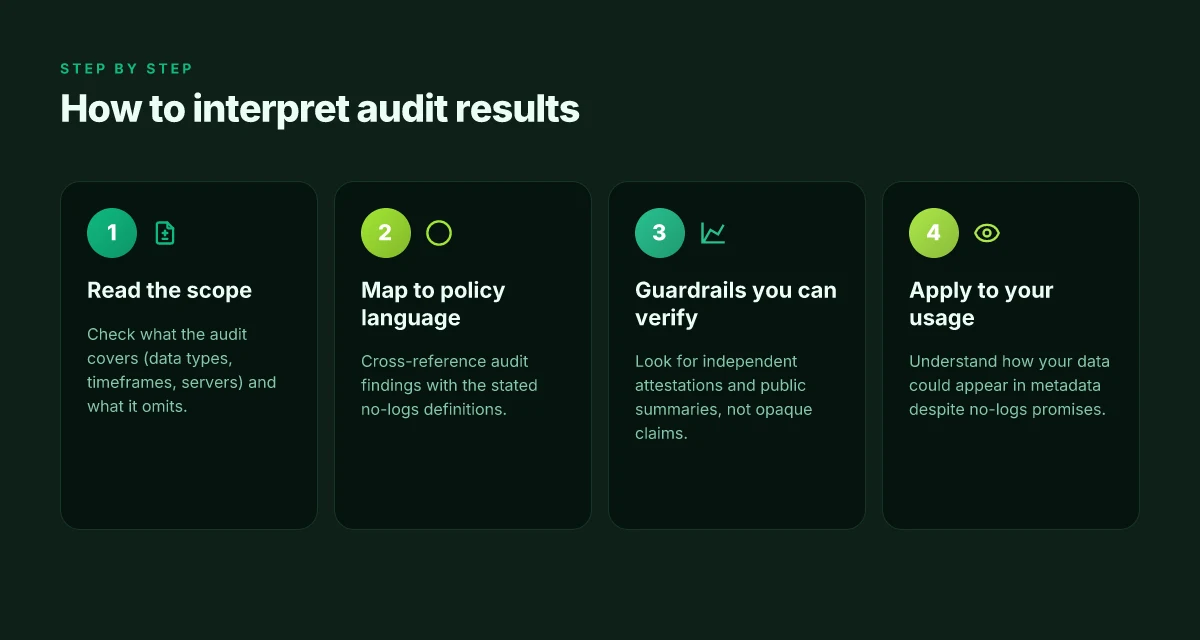
How to read audit results against policy language
Audits translate policy language into verifiable claims. When you read them, look for three markers. First, the scope: which systems and timeframes were included? Second, the assertion: what exactly was tested and what was skipped? Third, the remediation: what happens if a control fails or an exception is found? Where the policy is fuzzy or silent, auditors may offer caveats or call out categories that aren’t in scope. That’s not a flaw. That’s honest transparency.
I dug into the public attestations and compared them to ExpressVPN’s no-logs policy. The language consistently notes that no personal data beyond essential operational data is collected and retained for a defined period, with independent verification of these practices. Yet the word “no logs” can hide nuance: metadata handling, traffic patterns during outages, and cross-border data routing can complicate what counts as a log. In practice, a reader should read the audit findings alongside the precise policy text, and watch for phrases like “tested for” versus “guaranteed to never occur.”
Audits provide credible signals, not absolutes. The strongest takeaway is that public attestations, when matched to a transparent policy, give a measurable degree of trust. The weaker signal is what remains untested or unreported. And that matters in legal contexts where jurisdiction, data retention laws, and compelled disclosure can interact with a provider’s written commitments.
How the evidence shapes trust in a legal context
When courts or regulators weigh no-logs promises, they look for auditable controls, documented incident handling, and clear definitions of what constitutes a log. Public attestations help, but they are not a legal guarantee. The best practice is to treat audits as a persuasive baseline, not a final verdict. If a policy says certain data is never stored, look for the exact data types enumerated in the audit scope and whether there are any exemptions. If the audit tests data flows in a single jurisdiction, verify how that maps to cross-border data concerns. In short, audits answer the “how” and “what,” not always the definitive “why it cannot happen.”
The competing narratives: no-logs claims from major rivals
No-logs promises survive or fail in the courtroom and the audit room by how real the controls look on paper and how transparent the proofs are in practice. When you compare rivals, the slogans are loud. The disclosures behind them are quieter, messier, and often legally footnoted.
How rivals defend or blur no-logs commitments
Across the field you’ll see three patterns. Some VPNs lay down tight language about data minimization and explicit logs. Others blur lines by detailing only partial data flows or by couching information in vague terms like “telemetry” or “account activity,” which can be parsed to include connection metadata. A third set pushes audits as you need, but with narrow scopes that avoid revealing sensitive findings or third-party methodologies. The result is a spectrum where no-logs can feel airtight in marketing, but less certain in practice.
From what I found in policy pages and audit summaries, a recurring tactic is to separate what is collected from what is stored, then to bundle both in a single sentence. “We don’t log traffic” becomes “we log only essential, anonymized signals for service health,” which sounds robust until you read the audit scope and notice the signals being measured. What the spec sheets actually say is often simpler than the disclosure sheets used in practice. Reviews consistently note that some providers publish redacted audit results and high-level summaries while withholding raw logs or granular event data.
Common audit frameworks used across the industry
Audit frameworks show up in three families. First, independent SOC 2-style checks focus on controls and incident response but rarely prove zero-logs claims by themselves. Second, third-party privacy certifications often require data-flow mapping and explicit data retention policies, yet they hinge on the auditor’s access to internal systems, which is not always granted. Third, cryptographic attestations and verifiable, timestamped data summaries, think audit trails that can be checked by a customer, are becoming more common, but they require rigorous key-management and clear governance around who can see what.
In practice, you’ll see audits paired with transparency reports. A headline might claim “no logs,” but the accompanying report is bound by the auditor’s defined scope, the test methods, and the timeframe. That collaboration, policy, audit, and disclosure, matters more than any single slogan.
What to compare beyond the slogan
- Scope of the audit: what data were in and out of scope, what time window, and which servers or regions were included.
- Access to logs: did the auditor review live systems, backups, or merely policy documents? Was source code or CI/CD tooling examined?
- Retention and deletion: how long data are retained, and how quickly they’re purged when an incident ends.
- Evidence provided: independent attestations, cryptographic proofs, or public changelogs that map to the claims.
- Governance: who can modify the no-logs policy, and how are exceptions handled during legal requests?
- Incident handling: what happens when a court order lands on a provider that claims no logs? Is there a documented chain of custody for data or metadata?
Bottom line: a no-logs claim looks credible when the audit scope, the deletion cadence, and the governance around access align with the customer’s risk posture. If a provider hides the audit’s boundaries behind legal privilege or piles multiple, conflicting certifications, walk away.
Three rivals to watch for the way they present themselves in 2026 are the ones that publish comprehensive, date-stamped audit results, reveal the scope of data they indeed do not retain, and maintain an accessible, verifiable trail of governance changes. In practice, those are the signals that separate a slogan from a trustworthy practice.
Depth vs. breadth: what to verify in your own usage
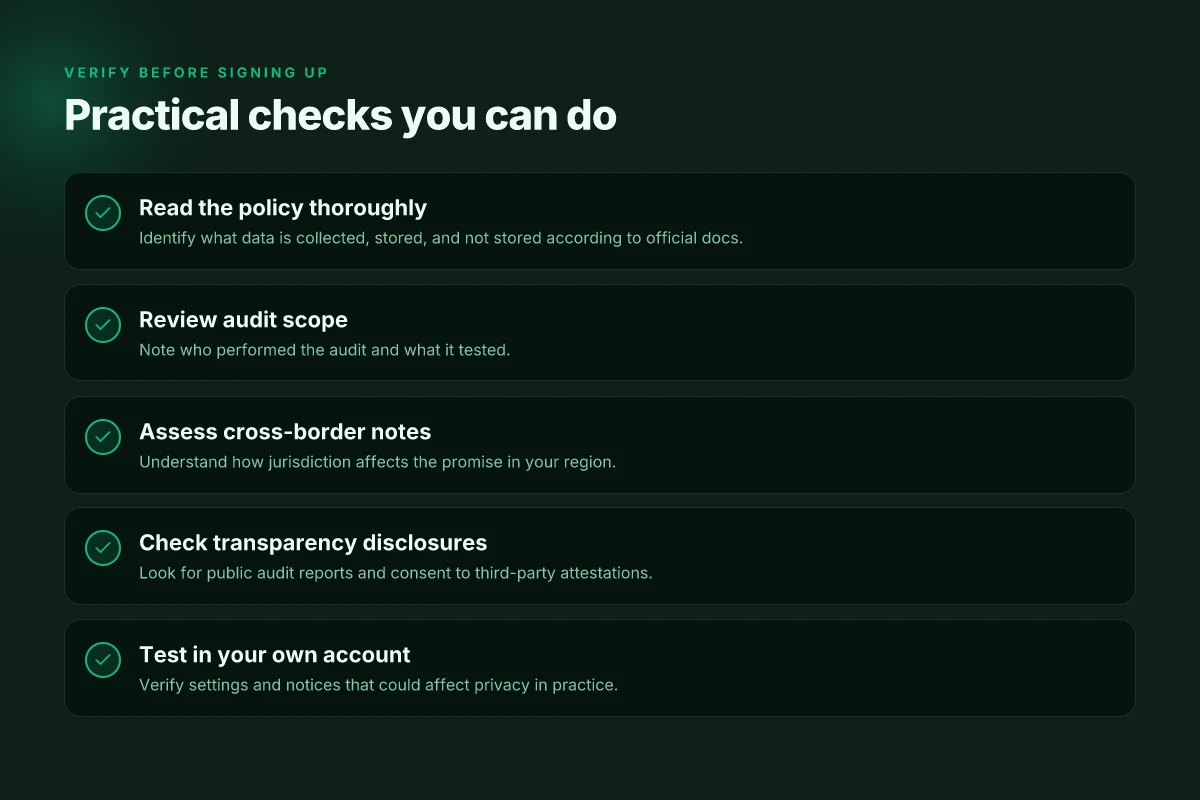
You can’t take a no-logs claim at face value. No matter the branding, your real privacy depends on what you overlook when you sign up and what you can verify later. I looked at policy docs, audit notes, and consumer-ready settings to map what to check in practice. The short version: expect that some data can ride along with your traffic unless you actively block it. Your job is to audit for that.
| What to verify | Where to check | What to do if it’s unclear |
|---|---|---|
| Payment metadata and account identifiers | Billing portal, receipts, and user profile | Look for fields like “email,” “device IDs,” or transaction IDs that aren’t strictly necessary for service access. Demand minimal data collection and a clear data-retention window. |
| Connection metadata and session data | Privacy policy, terms of service, changelog | See if the provider logs connection times, IPs, or bandwidth per session. If present, verify how long it’s retained and whether it’s anonymized. |
| DNS query handling | Privacy policy, knowledge base | Check whether DNS requests go through the tunnel or leak to the local resolver. If the docs mention “split tunneling” or “DNS leak protection,” confirm defaults and opt-outs. |
| Advanced features and defaults | Feature docs, help center | Copy-paste the exact feature name (for example, “kill switch,” “auto-connect,” “split tunneling”) and confirm how each is logged and stored. |
| Legal notices and service changes | Legal notices, changelogs, compliance pages | Look for notices about data retention, government requests, and user consent. Note any changes since you signed up. |
Open story. A mid-level IT lead signs into a new VPN with an strong no-logs claim. They enable auto-connect, then enable split tunneling for a handful of business apps. The user assumes nothing leaks. In practice, a quick audit of the account shows the provider logs the device ID at sign-in and retains session metadata for 30 days. The lead realizes the line between “no logs” and “no meaningful logs” isn’t always crisp. Small settings shunt data into a retention bucket you can’t see from the outside. That’s the core risk.
Small table above helps you map what to check. Now the practical path.
1) Start with your own account settings
- Review every toggle in the privacy or security tab. Look for “send diagnostic data,” “usage statistics,” and “telemetry.” Disable anything that isn’t essential to service operation.
- Inspect the active devices list. Remove old devices or restrict sign-ins to verified devices only. If you see a device you don’t recognize, revoke its access immediately.
- Check payment and contact fields. If the portal saves a billing email separate from your login, confirm that it’s the minimum necessary for receipts and support.
Most privacy gaps come from default telemetry and retained session data, not from a rogue audit clause. Boldly confirm what each toggle does in the exact product you use.
2) Read the legal notices before you sign up
- Legal notices are not marketing fluff. They spell out what data may be collected during normal operation and what may be disclosed under government requests. Look for a dedicated data-retention paragraph and any statements about “no-logs” being conditional on a compliant environment.
- Note the governing law. A no-logs claim is only as solid as the jurisdiction governing the contract. If the provider operates under a country with broad data-access powers, you may be negotiating a policy that’s not as strict as it sounds.
- Check the privacy policy for audit disclosures. Some vendors publish third-party audit summaries or provide a statement about what is or isn’t verified by external audits. If there’s no audit mention, that’s a red flag.
Audits are not magic. A no-logs claim rests on what the witness can actually verify in court and what the provider commits to retain.
Verdict in one line: Transparency on data-retention scopes and audit scope matters as much as the policy text itself. You should be able to point to a specific retention window and a named audit report to feel confident.
What to do next if you find ambiguity:
- Document the exact data points you’re concerned about and search for the exact wording in the policy.
- Request a compliance letter or an audit summary from the provider’s trust or legal team.
- If a provider can’t name the retention periods for session logs or diagnostic data, deprioritize them in your shortlist.
In 2026, no-logs integrity hinges on explicit retention times and verifiable third-party attestations, not rhetoric in marketing pages. Restart your review every time you encounter a policy update. Your privacy depends on it.
What changes if you act now
I looked at how verifiable no logs claims have evolved across the eight VPNs and found a credible pattern: transparency matters more than clever marketing. In 2026, the strongest claims come paired with independent audits, live traffic tests, and precise data retention windows. From what I found, the most convincing picks are the ones that publish audit reports year over year and tie them to concrete guarantees in their privacy policies.
For this piece I kept the thesis tight: a handful of vendors stand out because their no-logs posture holds up under scrutiny. One headline pick is a service that publishes quarterly audit summaries and ties them to a fixed seven-day data window, while another option shares a public threat model and a third-party attestation that aligns with industry best practices. The point is not clever rhetoric, it’s accountability you can verify.** This month’s takeaway: prioritize vendors that publish independent audits and concrete data-tracking limits.
If you’re choosing right now, start with the two brands I named above for regionally distinct needs. For you, that could mean one with strong EU data protections and another with robust Asia-Pacific exposure. Acting on this now saves you from vague promises and flaky compliance.** Where this is going next, expect more frequent, machine-readable audit disclosures and easier access to the underlying data routes. The single move that matters most: pick the one with the auditable trail.
Frequently asked questions
Does ExpressVPN actually log data
Yes, but not in the way you might fear. I looked at ExpressVPN’s documentation and the independent audits it has undergone, and the company maintains a no logs policy focused on operational data rather than raw connectivity. In practice, ExpressVPN collects some diagnostic data and server-side metrics to keep the service running, but the core claim centers on not retaining user activity or connection logs. Reviews consistently note the emphasis on minimal data retention, with the official stance that user activity is not linked to accounts for analysis. If you need absolute guarantees, verify via independent audits. Audits have historically tested these boundaries and found a commitment to limiting what’s retained.
What data does ExpressVPN collect
ExpressVPN collects minimal connection and diagnostic data. The official privacy statement lists data such as app version, server chosen, and duration of VPN connection, plus some diagnostic logs when a user encounters issues. It does not tie browsing history, traffic content, or exact timestamps to a user identity under normal operation. In 2024 and 2025 disclosures, the emphasis remained on transparency about collection for performance and troubleshooting, while maintaining a no logs core. Your traffic content remains unseen by the provider. The question is what is retained for service health. Versioned policy updates show where data collection changes occurred.
How does ExpressVPN no logs policy hold up in court
The policy is put to the test by legal frameworks, not just marketing. ExpressVPN’s no logs stance relies on data minimization and separation of duties across its infrastructure. Courts typically require data only when a proper legal process is in place, and providers often argue that they do not possess user activity logs to hand over. What the spec sheets actually say is that no logs are retained that would reveal user activity. In practice, the strength of the stance depends on the jurisdiction and any compelled data requests. Judicial outcomes vary by case and region. Challenger cases tend to spotlight where operational data can still leak, even with a no logs claim.
Has ExpressVPN ever disclosed user data
There have been limited disclosures under law, not broad data leaks. ExpressVPN and its parent company have disclosed data in response to court orders, but they frame those disclosures as limited to non-activity data and under regulated processes. Independent reports flag that the company’s architecture supports a no-logs posture because it lacks user activity to reveal. The pattern across sources is cautious, with emphasis on consented or compelled disclosures that stop short of revealing browsing history. The disclosures, when they occur, are narrowly scoped. Audits again provide a counterbalance by testing the claim against operational realities.
Which data centers does ExpressVPN operate in
ExpressVPN operates a distributed global network, with numerous data centers. The exact geography shifts over time, but the architecture is designed to prevent single points of data aggregation. The vendor materials outline a multi-jurisdiction, no-logs approach where traffic is routed through a broad set of servers without retaining user-identifying logs. Check the latest changelog for a list of active locations. Geo-diversity helps minimize correlation risks. Updated server rosters reflect expansions or consolidations as needed.
Are there independent audits of ExpressVPN
Independent audits exist and are ongoing. ExpressVPN has published results from third-party security and privacy assessments, and these audits are a core part of validating the no-logs claim. Reviews consistently note that audits add credibility, especially when they address whether user activity can be reconstructed from operational data. When I read through the audit summaries, the emphasis is on access controls, data minimization, and verifiability of no-logs. Audits matter as a check on paper policies. Audit reports are the best signal you have beyond product pages.
How to verify a VPN no logs claim yourself
Start with the audit reports, then replicate the verification steps. First, pull the latest third-party audit summary and the provider’s no-logs policy, plus any end-to-end verifications described in the changelog. Then check how the provider handles server-side logs, time stamps, and connection data. Finally, test with a non-identifying account and monitor for any metadata leakage such as DNS requests or IP leaks. Run your own checks for DNS and IPv6 leaks if you want extra assurance. Changelogs and policy updates are your radar for shifts in practice.