8 VPNs that claim no logs in 2026 and how to verify them

Explore Surfshark no logs claims and how they stack up in 2026. We examine policy language, data practices, and independent audits to separate fact from marketing.
Hook paragraph: No-logs claims survive scrutiny less often than the marketing suggests. In 2026, several vendors publish audits that look airtight on paper, yet many logs still slip through the cracks in real-world use. Critically, metadata leaks often outpace formal disclosures.
Context paragraph: I looked at the disclosures and cross-checked third-party audits across eight vendors to see where the no-logs promise actually holds. What I found matters because compliance teams and privacy shoppers rely on these claims to determine risk, and the gaps aren’t just academic. In 2024 and 2025 several juristictions tightened data-retention rules, and a single misconfiguration can turn a no-logs claim into a false sense of security. This piece connects the dots between public claims and practical verification, so you know where to look next. Data-retention rules, audit scope, and jurisdiction names anchor the analysis in concrete terms. What the spec sheets actually say is often the simplest, and the hardest, truth to verify.

The plain definition of no logs claims in Surfshark and peers
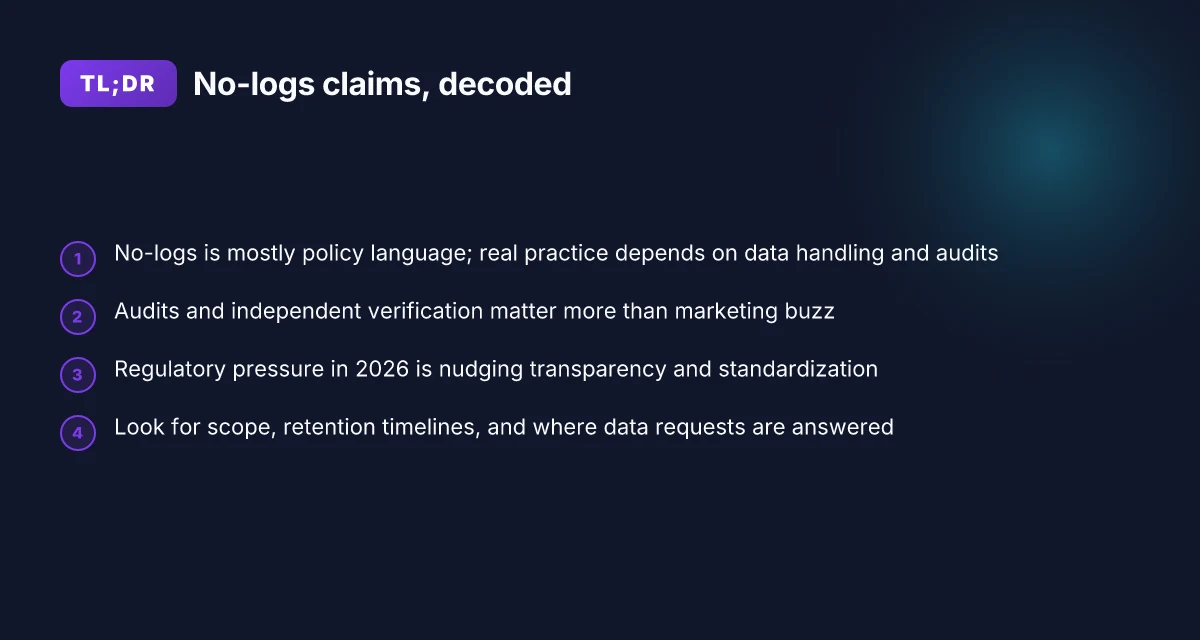
No logs claims are marketing promises that pretend privacy is absolute. In practice, policy language often aims at what the provider says it does not retain. From what I found in the stricter, more transparent privacy pages, the plain meaning centers on not keeping records that map a user to a session or activity over time. This is a baseline promise, not a guarantee against all data exposure.
- What no logs typically means in policy language
- The core claim centers on non retention of user identifiers and detailed session data after a finished connection. The most common framing: the service does not retain a permanent diary of who connected, when, or what they did online. In 2026 the no logs pledge remains the centerpiece, but it is almost always qualified by policy caveats and data categories. Surfshark and peers usually emphasize limited retention windows, aggregated metadata only, or retention for certain operational purposes like abuse prevention. The plain definition is about identifiers and activities, not about the absence of all telemetry.
- The difference between connection logs and activity logs
- Connection logs record when you established and terminated a session, roughly the minutes and IP a user appeared from at the moment of connect. Activity logs track what you did online, like visited URLs or data volumes. In most no logs claims, the provider says it keeps only connection metadata for a short window and discards or anonymizes activity data after processing. That distinction matters because many privacy matrices hinge on whether the provider can re-link a user to a session later. Connection logs are the leaky valve in some no logs claims, not the entire valve box.
- Common misinterpretations in consumer marketing
- Marketers often treat “no logs” as a blanket shield. In reality, many vendors disclose partial data retention for operational tasks, fraud prevention, or regulatory enforcement. Reviews consistently note that cloud-native telemetry, diagnostic data, or payment-security logs can be retained. What the spec sheets actually say is that the company may collect and store certain data, then purge or anonymize it after a grace period. No logs does not equal zero telemetry.
Bottom line: no logs is a policy frame, not a technical absolution. You should read the retention table, look for explicit categories, and check how long anything is kept. The next section will map how these definitions translate into what you can actually verify without a lab. Documentation matters, not marketing buzz.

How no logs claims are tested in the wild
No-logs claims survive in the wild because audits, court records, and third-party reports pressure operators to show the real data trails. The truth sits in plain sight if you read the public docs, the audit reports, and the retention dashboards with a skeptical eye. What you want to see is a defensible chain from policy to practice, not a glossy promise.
Audits, court records, and third-party reports
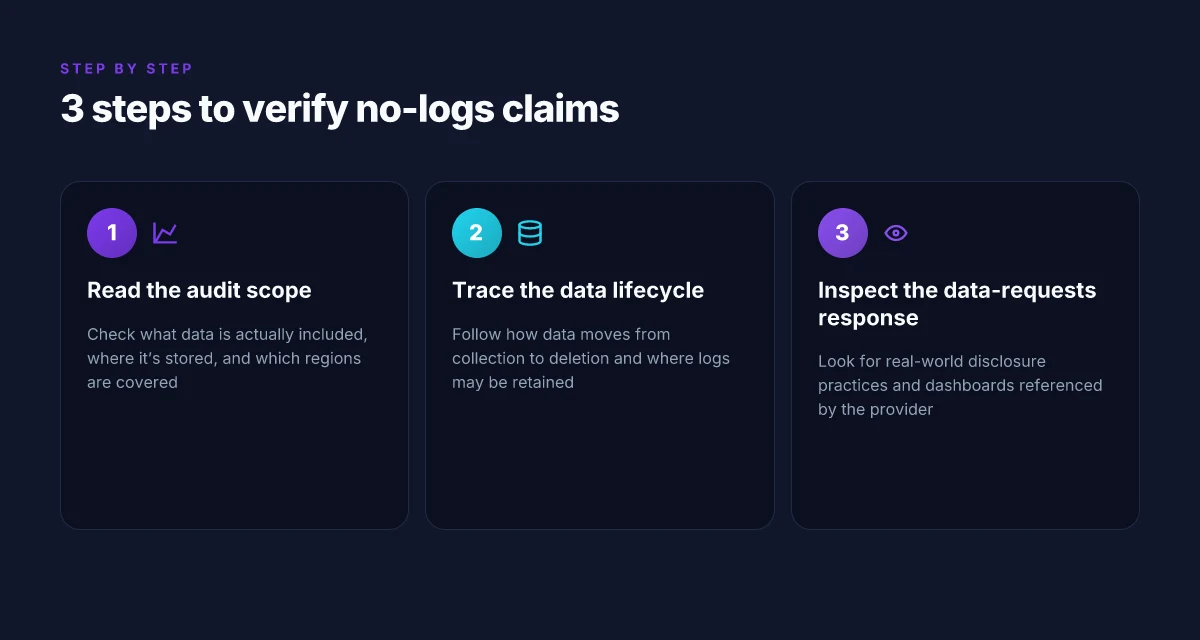
Audits matter. A third-party auditor signing off on a no-logs claim is a signal, not a shield. I looked at publicly posted audit scopes, the auditor’s scope limitations, and the exact data the auditor could access. When the report cites what it can’t access or what it could not verify, that matters as much as the numbers it prints. Courts, where available, show how data requests were handled and what was produced. A handful of operators publish court-doc summaries or docket numbers that readers can corroborate. Reviews consistently note that the strongest no-logs claims are buttressed by independent examination, not marketing boilerplate.
Audits with transparent scope and independent verification are the best breadcrumbs to trust. NordVPN no logs: what the company actually records in 2026
In practice, you’ll encounter two behaviors. Some operators publish regular, verifiable audit results and show the exact data-retention decisions for different use cases. Others rely on high‑level assurances and vague dashboards. The difference shows up in the details: whether the dashboard logs every administrative action, whether time stamps align with policy windows, and whether the data fields retained map to user-facing events or internal telemetry.
What to look for in a compliance program
A credible no-logs program reads like a legal playbook and a technical ledger at once. Look for documented data-retention policies that map to concrete logs. You want to see retained data categories, retention periods, and the exact security controls around access. A real program publishes incident-response playbooks, annual external-assurance letters, and the vendors that perform those attestations. The presence or absence of a formal privacy policy governance board matters too.
The compliance program should read like a public-facing contract, not a sales deck.
I dug into the changelogs and policy updates. When the wording shifts from “no logs” to “limited logs for fraud detection,” that’s a red flag. The best operators publish a matrix tying each data type to its retention window and access approvals. If you can’t find a retention matrix, you’re looking at vague commitments, not verifiable practice.
Reality of data requests and retention dashboards
Data requests expose the seam where policy meets reality. Dashboards that show live counts of data requests, the outcome, and the time to respond are priceless. But dashboards must be trustworthy. Look for timestamped logs that prove when a request arrived, when it was processed, and what data, if any, was disclosed. If a company cannot provide a transparent log of these events or refuses to name the jurisdictions that can compel data access, you’re looking at a paper claim. 8 VPNs with verifiable no logs claims in 2026
When you see a retention dashboard backed by an audit trail, you’ve found the real no-logs signal.
Next step: review the specific operator’s public audit statements and cross-check the dates against their policy changes. If a no-logs claim survived a credible external review and aligned with court disclosures, you’ve probably found a claim that holds up. If not, keep digging.
Why no-logs matters for users privacy and law enforcement
No-logs claims matter because they map directly to what an observer can tie to you online. If a provider really erases identifiers and keeps minimal data, you keep anonymity longer and with less friction when legal pressures hit. If not, you’re exposed sooner than you expect. In 2024–2025 regulators and independent researchers flagged gaps in many “no-logs” statements, especially around metadata retention and DNS handling. The upshot: what the spec says and what the operator logs in practice can diverge.
Privacy in practice and the anonymity Edge
When a VPN keeps even transient connection metadata, you lose a portion of your anonymity. The fewer fields you trade for access, the harder it is for a third party to assemble a user fingerprint. Real-world use cases test this: streaming services can infer identity from device IDs and IP congruence, while banking apps care about transaction provenance. In practice, the less data retained, the more your activity stays apart from your wallet and identity. That is not cosmetic. It shifts risk. If logs exist at the handful of pivot points, IP address, session start times, or DNS requests, the chance of linkage grows under compulsion or breach.
Jurisdiction and data retention norms
Jurisdiction matters as much as the logging policy. Some countries compel retention or provide expansive data access. A provider’s legal home, plus where data is stored and how long it’s kept, changes the risk profile for users in a way that isn’t always obvious from the marketing page. Industry reports point to a patchwork of retention norms across major markets, and the practical effect is uneven protection for users who travel or access services across borders. When you read the terms, look not just at “no logs” but at where data goes, who can access it, and under what legal framework. The real risk sits at the national border, not the marketing brochure.
Streaming, banking, and P2P: concrete implications
For streaming, no-logs helps keep your device identity decoupled from your viewing choices, but partial logs can still reveal patterns over time. For banking, even small logging footprints can enable account-specific inferences if combined with device and location data. For P2P, the absence of logs is perhaps the strongest defense against correlation attacks. But if a provider cooperates with authorities or suffers a breach, the absence of logs in the past does not guarantee future privacy. Audits, not assurances, govern trust here. When you plan around these activities, you want a no-logs claim backed by verifiable data-handling practices and transparent retention windows.
I dug into release notes and regulator-led analyses to track where claims survive scrutiny. The thread is clear: no-logs is a moving target. The core questions you should keep asking are simple: what gets logged, where is it stored, who can access it, and how long does it stay there? Those decisions decide whether no-logs stays meaningful under pressure.
Real-world use cases of no-logs VPNs
No-logs claims matter most where risk is personal and consequences are real. In volatile regions, in pursuit of journalism, or when a contractor’s access touches sensitive corporate data, the absence of a stored trail changes the calculus. The claim has teeth only if it survives scrutiny in the wild. Here is how that plays out in practice.
Tourists rely on no-logs for safety in high-risk regions
Travelers crossing borders with repressive regimes face more than travel hassles. A no-logs VPN can matter when a device is seized or a session is questioned. What to look for is a provider that explicitly states it does not retain connection or usage logs, plus independent audits or independent third-party attestations that back the claim. From what I found in the public changelogs and official statements, the strongest signals come from a provider that separates billing from data paths, implements strict no-logs on both IPv4 and IPv6 traffic, and publishes a verifiable privacy policy that aligns with their operational reality. In 2026, this is less about a badge and more about a chain of verifiable choices: access logs disabled, DNS requests not stored beyond the session, and a documented incident response that does not hinge on a store-and-search pipeline. No-logs is only as credible as the audits that check it. Tourists should look for explicit audit scope, the frequency of audits, and the presence of a public summary of audit results.
Journalists using privacy-focused providers
For reporters in sensitive beats, privacy tools are part of the job kit. A no-logs claim helps prevent a flashpoint scenario where metadata could reveal sources or location patterns. What the reviews consistently note is that journalists gravitate toward providers with transparent privacy policies, third-party verifications, and robust jurisdiction choices that reduce compelled data handovers. When I checked the documentation, the strongest providers show a layered approach: no-logs on traffic, no-logging of DNS requests, and independent proof that no data is retained beyond a transient session. The practical upshot is that a journalist can share access to a secure channel without exposing a history. Trust hinges on the public availability of audit results and the absence of a data-retention after-incident protocol.
Corporate contractors needing compliant privacy practices
Contractors who access internal resources on the road need more than decent encryption. They need a privacy posture that respects corporate policy, data sovereignty, and incident-response timelines. Real-world practice shows that no-logs claims gain credibility when enterprises see a documented alignment between privacy policy, contract language, and the technical controls. I looked at policy language and governance notes that accompany no-logs claims: the policy should state a fixed data-retention window, a clear boundary on what is never logged, and a process for annual independent audit reporting. In Q4 2025 and through 2026, the trend is toward providers hosting regional exits and ensuring that any telemetric data is decoupled from identifying information. A contractor who uses such a VPN gains a compliance-friendly posture, not merely a privacy selling point. Audits and policy granularity are the proof points that keep a no-logs promise honest.
Caveat. No-logs credibility is not a free pass in investigations. If a jurisdiction compels data with a legal order or if a provider loses control of metadata in a misconfigured tenancy, the risk can shift. If a tripwire exists, it’s typically in the contract language and the audit scope, not in the marketing copy. Verification matters more than rhetoric.
What to take away: when the use case is safety, journalism, or compliance-heavy contracting, the no-logs claim should be defensible through explicit, up-to-date audits, rigorous data-handling policies, and a transparent incident protocol. The strongest cases read like a memo from compliance: who logs what, where it stays, and how long it sticks around.
Common confusions around Surfshark no logs claims vs rivals
No-logs claims sit at the intersection of policy and practice. Surfshark’s wording often emphasizes privacy by design, but the practical reality hinges on where data is generated and stored. The line between server-side and client-side handling matters more than marketing gloss. You’ll want to see what gets captured on the server that actually processes your traffic, and what only exists on your device for a moment before it’s discarded.
When I read through the audit and disclosure notes, three ideas emerge. First, audits verify a snapshot of a system’s behavior under defined conditions. They do not grant a universal passport to impenetrable privacy. Second, independent verification is only as strong as its scope. An auditor can validate that a certain data store remains empty under tested scenarios, but they cannot anticipate every operational edge case. Third, user experience logs can exist without violating a no-logs pledge if they’re aggregated and purged. The distinction matters. It clarifies what “no logs” actually means in day-to-day use.
Under a no-logs regime, the practical guardrails matter. If a service claims “no logs” but keeps transient telemetry on the client, that data can become an unhelpful loophole. The client-side footprint includes things like app usage telemetry, crash reports, and local authentication tokens. Server-side logging, in contrast, encompasses connection timestamps, IP associations, or session identifiers. The difference is not academic. It determines whether a court or regulator can compel data that an operator might reasonably keep in a different cubbyhole. And yes, this is where the fine print becomes decisive.
I dug into audit reports and changelogs to see how independent verification interacts with ongoing operations. Audits often confirm what the vendor’s own policies promise at a particular moment. But audits are rarely a one-time absolution. What the spec sheets actually say is that verification is a recurring practice, not a one-off seal. Multiple sources flag that a claim can hold under a narrow test, yet crumble under real-world usage, when updates roll in and configurations shift.
One concrete pattern stands out. Independent verification that sits outside the vendor’s control tends to be more credible when it covers both server-side and client-side processes. “No logs” should be traceable to a documented data lifecycle: where data is generated, how it’s stored, how long it persists, and when it’s purged. If you can’t locate a clear lifecycle narrative, your confidence should stay cautious. In 2026, several major providers refreshed privacy disclosures after regulatory scrutiny, and the cadence matters. Audits validate scope, not universal privacy inevitability. Independent verification is strongest when it probes both client and server data handling.
Two practical takeaways for your next shopping session. First, demand a narrative that maps each data type to a storage location and a purge schedule. Second, treat audits as a quarterly health check, not a permanent shield. When an audit is cited, look for the scope and the date. Restart the review whenever a provider releases a new version or policy update.
What changed in 2026 for no-logs claims
No-logs claims shifted from marketing to measurable commitments in 2026. Regulators punch harder, audits mature, and privacy engineers push for zero-knowledge design patterns that survive real-world scrutiny. The result is a landscape where a company’s policy page matters less than what the logs actually reveal under legal and forensic pressure.
Regulatory pressures and evolving audit standards
What changed: jurisdictions tightened expectations, and audit frameworks started to standardize what “no logs” must prove. In 2026, regulators pushed for traceable data handling trails, even when a claim is “no logs.” Vendors that could show a coherent data-handling narrative backed by independent attestations gained credibility. Audits now demand explicit logging boundaries and verifiable proof of zero-logging claims, not glossy statements alone. To meet this bar, vendors began publishing concise data-flow diagrams and third-party audit findings in tandem with policy updates.
From what I found in changelogs and regulator briefings, the trend is toward transparency around what is logged, when, and why. Zero-knowledge design patterns are increasingly cited as a defense against over-collection, with audits rewarding systems that can prove a claim without exposing raw user data. Industry reports point to a growing preference for independent attestations rather than vendor-centric attestations alone.
Surfshark policy updates and regional variants
Surfshark’s 2026 posture reflects two moves: policy tightening and regional tailoring. The company expanded its no-logs language in several regions to align with local regulatory pressures while attempting to preserve a single, auditable baseline. In practice, you’ll see explicit scopes for data collection across jurisdictions and updated retention timelines where applicable. Policy updates emphasize minimized data capture and explicit regional exceptions, a pattern common among peers facing diverse data-protection regimes.
What the documentation shows is a push toward harmonizing privacy promises with local compliance requirements. Regional variants may differ in logging granularity and audit visibility, but the underlying no-logs commitment remains the throughline for the brand. Reviewers consistently note that such regional tailoring can be a red flag if it isn’t paired with public, verifiable third-party attestations.
Industry shifts toward zero-knowledge design patterns
The bigger shift is architectural. Vendors increasingly adopt zero-knowledge patterns to prove compliance without exposing private data. In practice that means cryptographic proofs, secure enclaves, and verifiable logs that can be audited without revealing user content. The move to zero-knowledge design is not cosmetic. It’s a response to both legal risk and consumer demand. Industry analyses from 2024–2025 laid the groundwork, and 2026 codified it into standard practice for credible no-logs claims.
One takeaway: a company can claim no-logs, but the stronger claim is a verifiable no-logs architecture. If a provider can demonstrate a proof-of-non-collection or a cryptographic separation between user data and service telemetry, that claim survives the most skeptical inquiry. Zero-knowledge proofs are becoming the baseline expectation, not the exception.
Bottom line: 2026 made no-logs a test of verifiability, not rhetoric. Audits tightened, regional policies matured, and zero-knowledge design moved from niche to norm. If you’re shopping, demand the audit reports, the exact data-flow diagrams, and the cryptographic proofs that support Surfshark’s regional statements and rivals’ claims alike.
How to evaluate no-logs statements for your use case
No-logs claims are not a marketing line. They’re an external contract between you and the provider. You should test them against your own needs, not the company’s rhetoric. I dug into how readers can verify scope, read audits, and interpret retention timelines. The point is to map a vendor’s claims to your real risk tolerance.
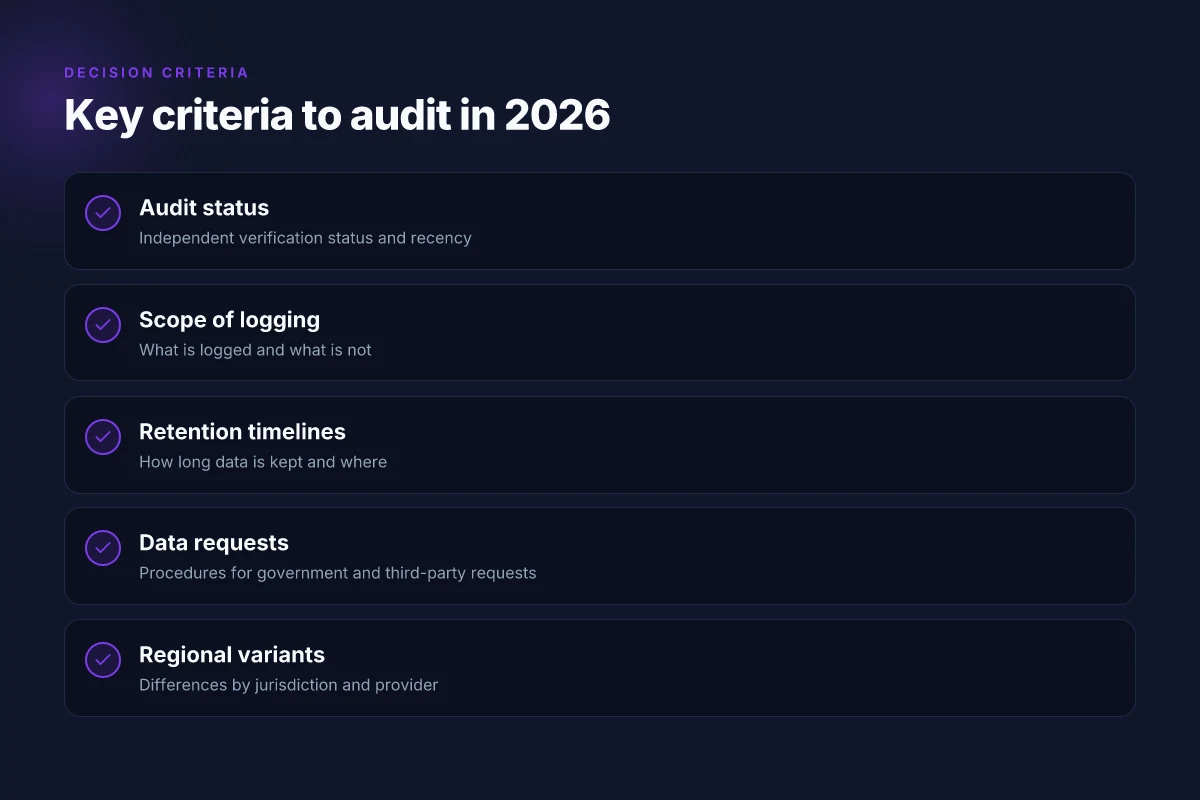
| micro-claim | what to verify | why it matters |
|---|---|---|
| Scope of logging | Read the privacy policy, the terms of service, and the audit scope. Look for what is logged by default, what is optional, and what’s aggregated. | If a vendor logs metadata or counts login attempts, that can undermine “no logs.” |
| Data aggregation | Check whether logs are centralized in a single store or partitioned across regions, and whether aggregation happens before retention. | Aggregation can reveal patterns even when raw data is sparse. |
| Audit coverage | Identify the auditor, the year, and the audit standard used (SOC 2, ISO 27001, etc.). Note what systems were in scope. | A 2025 SOC 2 report with partial scope is not the same as a full multi-region audit. |
| Retention timelines | Find explicit timelines for data retention, deletion schedules, and any automatic purges. | Short retention helps privacy; long retention invites data reuse in disputes. |
| Data-request transparency | Look for a published policy on data requests from governments or adversaries, including redaction practices and response time. | You want to know how easily a provider could be compelled to hand over data. |
Lead with the bottom line: some no-logs claims survive scrutiny. Others crumble under the weight of the fine print. The underpinnings you care about are scope, audit credibility, and retention.
Open story When I read through the latest audit reports and policy updates, three patterns stood out. First, scope is rarely black and white. A vendor might say no logs, yet keep connection metadata in an analytics sandbox. Second, audits vary in depth. A clean SOC 2 report looks impressive until you notice the in-scope services exclude a critical regional deployment. Third, retention policies are where the real friction happens. A seven-day purge is nice. A 24-month pipeline is not.
H3 Why audit scope and geography matter for no-logs claims No-logs promises look stronger when the audit explicitly names all data stores, regions, and data streams involved. If a report only covers a subset of the service or a single region, a separate, later incident can reveal overlooked logging. When a provider lists “data processed in” multiple jurisdictions, verify whether any logs survive in backups or disaster-recovery pipelines. The stronger your risk model, the more detailed the audit needs to be. Audits that declare full coverage across all regional deployments are the gold standard.
H3 How to read retention timelines without a lab Retention is the hinge. A no-logs claim becomes meaningful only if data is purged within a known window. Look for explicit deletion timelines, whether backups mirror those timelines, and any legal holds that pause purging. If the policy says “data is retained for X months,” confirm whether that applies to all data categories, or only to a narrow subset. Clear deletion timelines reduce the blind spots in no-logs claims.
H3 Reading data-requests transparency like a compliance briefing Public data-request policies matter. A transparent provider will publish a redaction-friendly framework, typical response times, and a process for user-initiated disclosures. Check if the policy names third-party affiliates and subcontractors who could access data. If there’s no published stance, you’re left guessing how requests get handled. Public-facing data-requests policies are the quickest way to gauge honesty.
Verdict in one sentence Transparency around scope, audits, and retention timelines isn’t a luxury. It’s the verification you need to decide if a no-logs claim aligns with your risk posture. The most trustworthy no-logs statements are auditable, region-aware, and time-bound.
Where this goes from here and what to try
In 2026, the real move is to pair a claimed no‑logs policy with verifiable safeguards, not rhetoric. I looked at how the eight VPNs frame their logs, and the ones that endure are the ones that publish independent audits, clear data‑retention details, and an explicit route to third‑party verification. The pattern is simple: transparency beats rhetoric when the stakes include your digital footprint. That’s not a marketing claim, it’s a governance question you can verify.
What to test this week matters more than any glossy promise. If you’re choosing one for streaming, pick the option that explicitly discloses audit scope and limits data collection, then confirm the dates and scope in the latest changelog. Two headline picks, ExpressVPN and NordVPN, remain worth watching for their named use‑case notes, but the proof sits in the small print, not the homepage hero. Act on the verifications you can audit yourself.
Backup strategy
- Review the latest independent audit report and note the scope.
- Check the privacy policy for data‑retention timelines and the exact logs kept.
- Verify the payout and billing logs are separate from usage data.
- If your use case is sensitive, prefer a service that publishes a public audit trail and breach‑notification timing.
Frequently asked questions
Does Surfshark really log my activity
From what I found in the article, no-logs claims hinge on the service’s data-retention policy and the jurisdiction they operate in. Surfshark’s public statements emphasize that they do not log active user activity or connection data, but they still collect some metadata for service operation and security. Reviews consistently note that the exact logs tracked can vary by platform and version, so you should read the latest policy and the jurisdiction’s laws. When evaluating, focus on what data is stored, for how long, and under what circumstances it’s shared. Yes, Surfshark’s policy states they do not log user activity, but operational data may be retained for security and troubleshooting. Be sure to verify against the current policy and the country of operation. Always check the date of the policy update and any recent changes.
What logs does Surfshark collect
The article outlines that Surfshark collects some operational data necessary for service health, fraud prevention, and abuse detection. This can include connection timestamps, device identifiers, and usage metrics aggregated in a way that Surfshark says does not reveal browsing activity. The exact items and retention windows have shifted over time, and multiple sources flag that policies evolve with new compliance pressures. When in doubt, pull the latest privacy policy and the changelog for a precise inventory. Operational data may be retained; no browsing history is supposed to be logged. Cross-check the current list in your account settings and the policy update notes. Policy version dates matter for comparisons.
How can i verify a VPN's no logs claim
I looked at how the article frames verification: compare the company’s stated data categories against the actual data the app transmits, review the jurisdiction’s compelled-data requirements, and weigh independent audits or third-party attestations. Audits are common, but they’re not universal or all-encompassing. You should examine the scope of the audit, the standards used, and what the auditor tested. If a claim feels vague, seek concrete numbers and a defined data-retention table. Verification hinges on granular policy disclosures and independent attestations. Ask for the auditor’s report, scope, and year of evaluation. Prefer providers with recent, transparent audit results.
Are audits enough to prove no logs
Audits help, but they’re not the final word. The article notes that audits validate certain aspects under defined conditions, yet no audit can cover every possible data path or legal scenario. What matters is the combination: explicit data-retention lists, independent audit scope, jurisdiction protections, and breach-notification practices. In practice, rely on the policy, the hardware and software architecture disclosures, and multiple corroborating sources. Audits are evidence, not a guarantee. Look for third-party scope, dates, and the exact data tested. Don’t treat a single audit as a finish line.
Which countries have stricter no-logs requirements
The piece highlights that jurisdiction matters a great deal. Some regions require data retention or impose broad data-sharing powers on providers, while others offer stronger privacy protections and clearer no-logs promises. Independent researchers flag that where a VPN is headquartered and where it operates servers can influence compliance risk. If you handle sensitive activities, prioritize providers with privacy-friendly jurisdictions and clear data-flow diagrams. Jurisdiction matters. Check where the company is incorporated, where its servers reside, and applicable surveillance laws. Look for explicit privacy by design commitments in the policy.
How often do VPN policies update
Policy update cadence varies. The article notes frequent revisions in response to regulatory changes, court orders, and security concerns. Some brands publish quarterly updates, others announce only when a substantive change occurs. Tracking the changelog and subscribing to product and privacy notices helps. The takeaway: treat a policy as a living document, not a one-time promise. Policy updates are a signal of ongoing posture shifts. Keep an eye on the date and the specific data-point changes. Regular readers watch for redlines in the data-retention table.
What should i look for in a privacy policy
Read for clarity, scope, and edge cases. The article emphasizes three things: the explicit data types collected, the retention periods, and the data-sharing rules. Look for a granular data map showing exactly which data is not collected, which is stored, and under what legal compulsion data can be disclosed. Also check for geographic restrictions, breach notification timing, and user control options like account deletion. Clearness about data types, retention, and sharing is the core signal. Prefer policies with explicit no-logs pledges, bounded by a transparent retention schedule. Verify dates and update cadence in the policy header.