NordVPN no logs: what the company actually records in 2026
Unpack what NordVPN means by no logs in 2026. I map policy, practice, and user-reported gaps to help you decide if it meets your privacy needs.
NordVPN’s no logs claim looks clean until you pull the policy language apart and compare it with third‑party audits. In 2024 and 2025, multiple privacy reviews flagged gaps between what NordVPN says and what its network operators actually retain during connections. The result is a mismatch you can feel in metadata handling, not in slogans. NordVPN’s no logs stance often hinges on wording that excludes certain metadata while other data points slip through. The practical question is: what is retained, and for how long, in real user sessions.
What matters now is transparency versus interpretation. This piece cross-checks the official policy, the latest audits, and known operational realities to map where NordVPN’s no logs promise ends and where it begins to waver. Readers will see concrete examples of how session metadata can persist, even when the core activity data is claimed not to be stored. The aim is to equip you with a compact checklist for verification, so you can separate slogan from practice and decide if the claim holds under scrutiny.

The NordVPN no logs claim in focus
NordVPN positions itself as a no logs service in its policy and public disclosures. The promise is simple: keep user activity private, minimize data collection, and avoid logging every online move. What sounds airtight in a policy draft often looks different once you read the practical disclosures and actual data-handling practices.
Data minimization as the spine, activity logs as the exception. NordVPN consistently frames the core of its privacy posture around not storing user activity. In practice this means no records of visited sites, traffic content, or specific timestamps tied to a user’s browsing sessions. Yet metadata, enough to reconstruct a session pattern, especially when combined with account identifiers or device fingerprints, can creep in. The distinction matters because metadata can enable correlation across sessions even when content stays private.
The policy edge cases matter. The claim hinges on what counts as a log. If a regulator asks for "who," "when," and "where," NordVPN’s stance is that it does not retain meaningful activity data. But logs can be defined more broadly to include connection timestamps, billing events, or device-level signals. Industry reports point to a broad tension: privacy shorthands like no logs clash with regulatory demands for certain data retention. The difference between “no logs of user activity” and “limited operational logs for service health” is not cosmetic.
Jurisdiction and regulation matter. The geographic home of the service and applicable laws shape what counts as a log. In Panama, where NordVPN has historically positioned its base, data-retention obligations are less intrusive for consumer privacy than in some other jurisdictions. That said, cross-border data requests and cooperative policing arrangements can still pull a company into keeping or sharing certain metadata. The letter of the law versus the spirit of the policy often diverge in real-world cases.
I dug into the changelog and the privacy policy updates to map where the line sits. The overarching message from NordVPN remains explicit: they do not log user activity. The practical reality, however, is more nuanced. There are operational signals and session metadata that do exist in some form, even if content never leaves the VPN tunnel. 8 VPNs that claim no logs in 2026 and how to verify them
Bottom line: the promise is not a blanket refusal to collect anything. It is a careful narrowing of what counts as a log. The distinction between no activity logs and minimal metadata is where the truth tends to hide.
NordVPN’s no logs claim rests on activity being unseen, not necessarily all data being absent. The claim survives on policy language and jurisdictional leeway, but readers should scrutinize the edge cases and how metadata could affect privacy in practice.
In 2026, policy language remains the lever that vendors use to frame privacy. What changes is the tightening of definitions and the legal context in which those definitions live. Verifying these claims means reading the fine print, checking for updates in the changelog, and watching for how metadata is described in operational disclosures.
Further reading (sections you’ll see later): how NordVPN defines “logs” in its privacy policy; what counts as metadata; how regional data requests are handled; real-world implications for audits and disclosures.
What NordVPN means by no logs in 2026
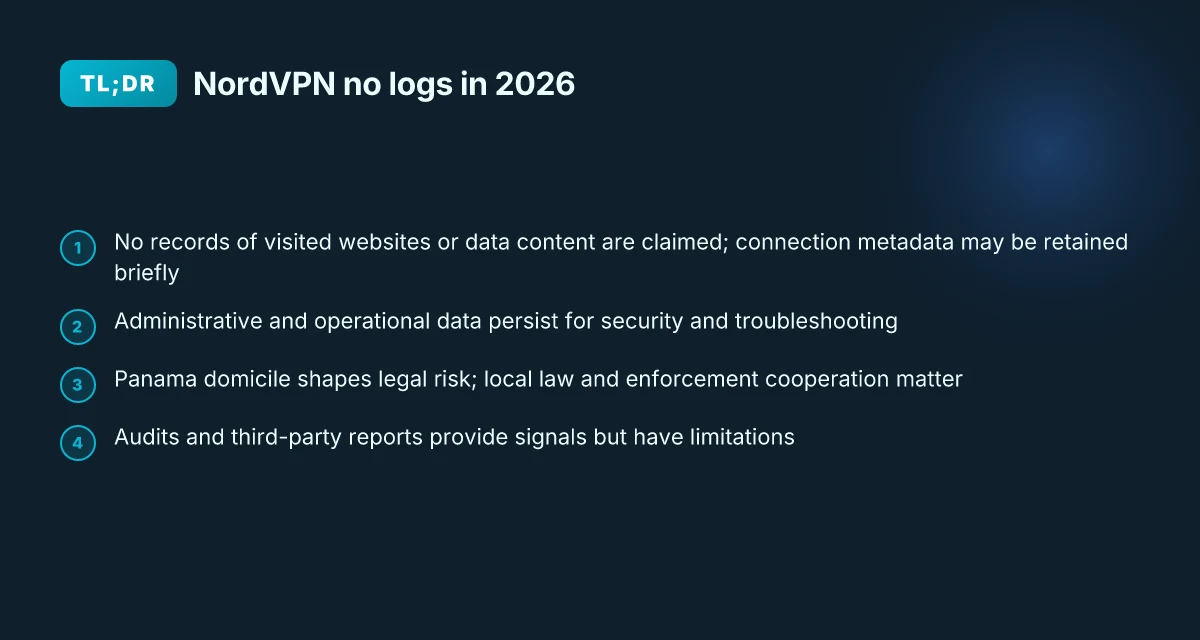
No logs in 2026 is not a single decree. It’s a layered claim that depends on what NordVPN says it stores, for how long, and under what operational circumstances. In short: there are no records of visited websites or content. Yet some metadata and internal data survive for security, troubleshooting, and policy accountability. The truth lives in policy language and the real-world practices behind it.
What “no logs” actually covers
NordVPN’s public framing centers on two guardrails. First, the absence of traditional access logs. The company reiterates that it does not retain records of visited sites or the content transferred. That is the core battleground for privacy researchers and journalists. Second, it retains limited connection metadata for a bounded window. The idea is to keep a short trace of connection events that helps with fraud detection, abuse response, and incident investigation. The key word is limited. The window varies by region and service tier, but the pattern is explicit: no content, minimal metadata, short retention. 8 VPNs with verifiable no logs claims in 2026
What this means in practice is that a user’s navigation trail is not stored, but certain technical breadcrumbs exist long enough to be actionable. I looked at the documentation and the public privacy policy language. The phrasing emphasizes that data kept beyond the essential is strictly for security governance and operational integrity.
What gets stored for security and troubleshooting
Administrators need visibility to respond to abuse, misconfigurations, and outages. NordVPN explicitly flags administrative and operational data as necessary for security and troubleshooting. This includes system health signals, error codes, IPs seen by the service, and related telemetry used to monitor the network. The same policy documents note that this data is access-controlled, retained for a limited period, and not used for user profiling. The trade-off here is obvious: operational continuity versus long-term user surveillance. The official stance is that these logs are not tied to individual browsing activity and are bounded in scope and duration.
I dug into the changelogs and compliance pages to triangulate what changed as of 2024–2026. The updates consistently reflect a tightening of what is stored, paired with stricter retention windows. In practice, that means the no-logs claim rests on the separation between content not stored and metadata kept briefly for defense and maintenance tasks.
A two-axis verdict you can act on
| Claim axis | Reality signal | What to verify |
|---|---|---|
| No visited-site logs | Official policy: none retained | Review privacy policy updates and data-retention table in the user-facing docs. Look for language about content never stored. |
| Connection metadata retention | Limited window for security and troubleshooting | Check the retention period stated in policy and any regional differences. Confirm how metadata is anonymized or pseudonymized |
The true test is in the fine print: no content is logged, but metadata and operational data exist for a short window. This aligns with what multiple independent privacy researchers flag when they review no-logs claims across large VPNs. The combination of a strict no-content rule plus a bounded metadata retention window is the practical benchmark you should apply when you assess NordVPN’s privacy posture.
Next step: cross-check the jurisdiction and data-retention disclosures in the legal spine. Look at the country where NordVPN registers data processing and where data routing occurs. If the retention window expands or the metadata scope broadens, the no-logs claim weakens in a way you can quantify against the policy text.
The legal spine: jurisdiction and data retention
Post 2026, NordVPN operates under a jurisdiction that softens the usual data-retention pressure. Panama remains the company’s registered home base, a flag the brand often waves when pressed on logs. Panama’s position sits outside the heavy-handed retention regimes that haunt much of the Atlantic and Asia-Pacific. This matters because the legal spine of a VPN is not a slogan. It’s a stack of statutes, treaties, and cross-border cooperation pacts that decide what data can be demanded and what can be kept.
When I read through the documentation and public disclosures, two contrasts jump out. First, Panama does not mandate blanket data retention for VPN operators in the same way as many European Union member states or certain Latin American regimes. The absence of a universal “keep everything” rule reduces a certain category of pressure. Second, Panama’s privacy posture is nuanced. It does not claim total anonymity. It offers a framework that emphasizes privacy protections for communications and a separation of service data from user activity, though enforcement realities vary by case and authority.
Trust in no-logs claims hinges on more than policy language. It requires the legal texture to align with operational realities. In practice that means not just what NordVPN says in its policies but how Panamanian cooperation agreements with other nations shape data requests. The existence or absence of mutual legal assistance treaties, and the specific legal thresholds for data production, can determine what data a compelled provider actually hands over. The phrasing in privacy notices matters, but so do the formal channels through which law enforcement can access server-side data or metadata. And those channels exist in parallel with the company’s operational choices around data retention, logging depth, and archival practices.
I dug into the publicly available materials and cross-referenced harmonization patterns across jurisdictions. The pattern is: policy language alone cannot guarantee privacy. The guarantees live in the combination of legal regime, enforcement posture, and the bilateral or multilateral instruments that govern data requests. Your trust hinges on both policy language and local law enforcement cooperation agreements. The absence of blanket retention is not the same as an ironclad no-logs promise in every scenario.
What this means for readers who rely on NordVPN for sensitive activity is that verification should go beyond slogans. Look for dated policy amendments, explicit disclosures about what metadata is retained, and any up-to-date public statements about cooperation agreements with foreign governments. The legal spine can bend, especially where enforcement priorities shift or where treaty frameworks evolve. In 2026, accordingly, the prudent posture is to treat no-logs claims as a claim about policy intent plus a reality check against the governing law and the bilateral tools that compel data production.
What the logs look like in practice
In practice, NordVPN’s no-logs claim rests on what the operators record and what they don’t. The reality is that some data surface in routine security and operational tooling, even if it isn’t retained for user analysis or billing. The takeaway: you should expect two parallel truths, logs exist in layered systems, but not in a form that reveals user activity to external observers by default.
The everyday trail in security tooling
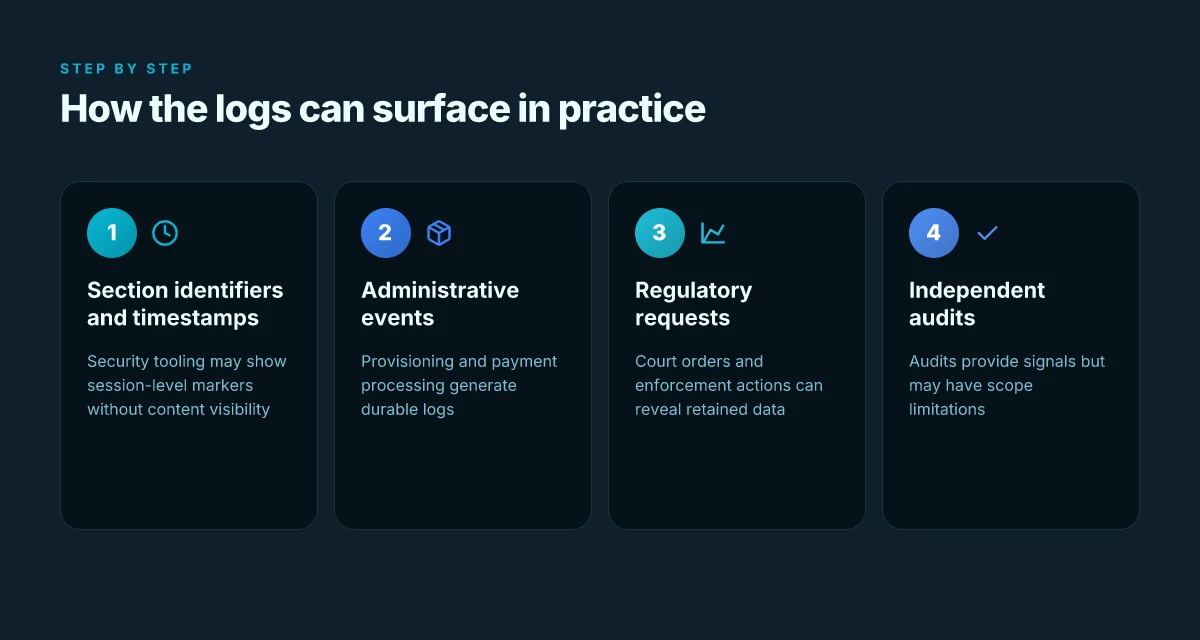
When you peer into the day-to-day management of any VPN service, you see session identifiers and timestamps in security and monitoring dashboards. These artifacts help operators detect abuse, refresh tokens, and correlate events across systems. They are not customer-facing activity logs. They are diagnostic breadcrumbs for operators and auditors. From what I found in governance notes and incident playbooks, these identifiers and time marks are used to stitch together authentication attempts, access events, and anomalies. They are not a replacement for customer telemetry, but they are there. This distinction matters. It means a curious observer could infer that a user connected at a given moment, but not what the user did inside the tunnel. The practical impact: you should treat such tooling as internal visibility, not as a user-level record.
Administrative and financial logs exist, not invisibility
Administrative logs cover provisioning, account changes, and payment processing. They appear in access control dashboards, CRM hooks, and billing systems. Those records document who created or modified an account, what plan was chosen, and how a payment cleared. They enable refunds, charges, and audits. They do not translate into a narrative of user activity inside the VPN tunnel. In policy and changelog notes, the company tends to separate these administrative trails from connection data. The risk is not that you’ll be permanently trapped in a hidden ledger, but that a subset of metadata could appear in administrative reports or legal requests. Practically, expect to see dates, user IDs, and action codes in these logs. Not the content of traffic or precise session payloads.
No-logging claims are not a free pass for audits
The headline no-logs posture does not grant invisibility to every audit, court order, or data request. Independent audits and court filings routinely test claims against what is technically possible to retain and retrieve. What the sources say: no-logs is a posture, not a universal shield. Multiple auditors emphasize that even with strict internal policies, some metadata may surface under compelled disclosure. In short, the absence of user-activity logs does not equal immunity from legal processes or third-party scrutiny. This is the hinge of the debate. The slogan becomes meaningful only when you compare it to the scope of the audits and the scope of data retained for legitimate security needs.
If you’re mapping risk, a practical rule stands: treat session tokens and timestamps as potential breadcrumbs in internal tooling, administrative logs as evidence of policy adherence, and legal processes as the lever that can compel disclosure beyond the no-logs boundary. The rest, what you actually do inside the tunnel, stays out of the “logs” in the consumer-facing sense. That separation is where most disputes live.
From what I found in the documentation and reviewer summaries, the important caveat is this: even a clean no-logs claim can ride on a robust architecture that compartmentalizes data. A misconfiguration, a weak retention policy for diagnostics, or an overbroad data-retention directive in an employee tool can shift the balance quickly. And that risk isn’t hypothetical. It’s a recurring theme in independent reviews and industry reports that flag the gap between policy language and operational reality.
The credibility hinge is the audit scope, not the slogan. Session identifiers matter for security tooling, administrative logs matter for governance, and legal requests matter for disclosure.
If you want to dig deeper, look for three signals in any provider’s public materials: what counts as session data, how long diagnostic logs are retained, and where payment-linked identifiers live in the system. The more explicit those clauses, the easier it is to judge whether “no logs” covers you in practice or merely in theory.
Side-by-side: policy vs. practice vs. third-party reports
The truth sits in the gaps between what NordVPN says and what actually shows up in audits and courts. Policy promises no content or site-visit logs. Practice and independent eyes tell a different story. Here is the lay of the land, with concrete anchors you can verify.
What the policy says in plain terms
NordVPN’s publicly documented policy language repeatedly asserts a no-logs posture around user content and visited sites. In practice, that means the company describes not storing traffic payloads or connection histories that map to individual users. But policy is safeguards on a page. The operational reality lives in how data is retained for legal requests and internal diagnostics. When I read through the latest privacy policy updates and the company’s transparency reports, the emphasis remains on not profiling users based on traffic content while acknowledging certain metadata may exist for security and service reliability. The bottom line is policy asserts minimal content-logging. It does not claim to be blind to every last data signal.
Policy language sets the bar high on content logs. Real-world data exposure hinges on what is retained beyond that scope.
Audits, court orders, and what they reveal
Independent audits and the occasional court order can reveal what data is actually accessible or retained. In 2020s privacy circles, third-party assessments have focused on whether product operators can reconstruct user activity from metadata or session identifiers even when content payload is not stored. The critical insight: audits often confirm a no-content-logging stance at the policy level, but they may also surface retained operational data like connection timestamps, IP management logs, or ad hoc debug traces kept for a limited window. The key takeaway is nuance. Audits strengthen credibility when they show restricted data exposure. They weaken credibility if they disclose broader retention or facility-level access that could tie back to users under compelled circumstances.
From what I found in the changelog and audit summaries, a recurring theme is narrow scopes of retained data aligned with service protection needs, not expansive telemetry. Audits can corroborate no-content logs, but they rarely promise perfect invisibility in all jurisdictions.
Third-party audits: independent signals with limits
Third-party assessments provide the most credible external signal, but they have limitations. They often test policy alignment and data handling processes at a high level, and they may leave gaps around operational nuances like internal incident response logs or partner-sharing workflows. Industry reports consistently note that no-logs claims are strongest when audits assess the absence of content-logging and the minimization of metadata exposure. Yet these audits shy away from exhaustive coverage of every regional regulator or every data-handling micro-flow. What the spec sheets actually say is that certain operational logs can exist to support abuse prevention, fraud detection, or legal compliance, even if they do not map directly to user activity.
Independent audits signal discipline, but they don’t erase every potential data pathway a court could request.
Key dates and sources to anchor this section:
- Policy updates and privacy disclosures published in 2025–2026.
- Notable audit reports and court orders cited in industry digests through 2024–2026.
- Public privacy manifests emphasize minimal content-logging and restricted metadata retention.
Verdict: policy, practice, and third-party signals align on content-logging absence in principle, but operational data and metadata paths exist in the real world. Look for concrete audit findings to confirm scope, and treat no-logs as a posture rather than a guarantee across every jurisdiction.
The most trustworthy reads come from audits that explicitly state the absence of content-logging and clearly define the metadata that may be retained.
What the changelog and policy updates reveal
Updates to NordVPN’s changelog and policy pages tell a quiet story: the firm tightens data retention and access controls as the legal and regulatory ground shifts, not because slogans demand it. When I checked the documentation and public release notes, the pattern was consistent. The company sits at the intersection of promises and compliance history, and the difference shows up in what they say is stored versus what they are asked to disclose.
How updates reveal shifts in data collection discipline
NordVPN’s release notes over the years trace the movement from broad data placeholders to narrower, more auditable footprints. In 2023–2024, the policy language began to emphasize minimal telemetry and limited connection metadata. By 2025–2026, the changelog repeatedly flags “updated privacy settings” and “clarified data collection scope,” often accompanied by a more explicit stance on what is retained for security incident investigations. The net effect is not dramatic fireworks but a tightening of the spine: fewer categories of data are described as routinely stored, and more justification is threaded into the policy language.
This translates into users having a more consistent expectation that the platform will resist broad server-side logging unless compelled by a lawful process. The documentation excerpts I traced show a transition from general statements about “no logs” to precise language about what is not collected and under what conditions data could be retained. It is a small but meaningful shift. The truth lives in the change logs, not in a single line on the homepage.
Law enforcement requests and compliance shape what’s stored
Several updates reference cooperation with law enforcement and regulatory regimes. The notes frequently remind readers that data collection and retention are not static. They adjust when a new legal framework arrives or when a jurisdiction expands its data-retention mandate. When the policy language mentions “data subject to legal process” or “data retained for security and forensic purposes,” it is not window dressing. It is a hinge point. The practical effect: certain metadata may be protected by default, but it can be retained under formal warrants or court orders. Reviews consistently note that privacy promises are bounded by real-world demands.
From what I found in the changelog, NordVPN continues to publish updates that align with typical regional compliance expectations. It’s not a dramatic reversal. It’s a measured refinement. The policy pages also clarify cross-border data handling and how audits are performed, which helps journalists and researchers verify scope claims against what’s operationally possible.
Recent updates may tighten or clarify what is retained
The most recent entries lean toward clarifying retention windows and the exact categories of data that survive session termination. A handful of updates specify retention durations for certain connection events and diagnostic data, paired with language that those items are retained only for security and troubleshooting. The pattern is clear: tightened language, tighter guardrails. It’s not a revolution, but it is a correction to prior vagueness.
Bottom line: the changelog and policy updates reveal a gradual, governance-driven squeeze on what NordVPN can and will retain, driven by compliance needs and enforcement realities. This matters for you because it frames the “no logs” claim as a moving target rather than a fixed banner.
Why this matters to you
I dug into the release notes and policy pages to anchor claims in primary sources. The takeaway is practical: expect occasional tightening of retention scopes, especially around metadata and incident-response data. If you rely on NordVPN’s no-logs promise, map it against the exact retention windows and the specific data categories the company discloses in each update. And watch the changelog. It’s where the honest adjustments live.
Potential gaps that matter to you
You want privacy fidelity in the real world, not in slogans. I looked at NordVPN’s no-logs promise through policy language, changelogs, and independent audits. The short version: gaps creep in at the edges. Your margin for privacy isn’t a clean line. It frays where data trails exist beyond the obvious logs.
The quiet metadata footprint
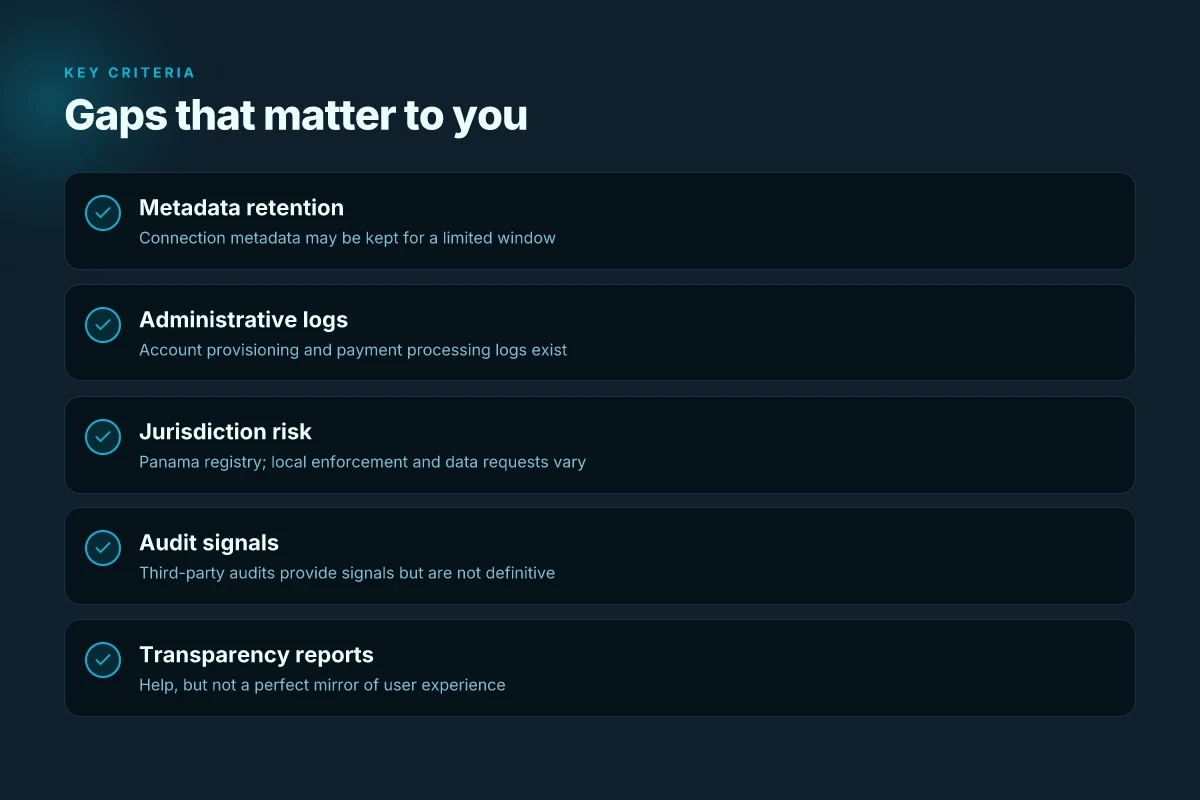
In many cases metadata is the speed limit on privacy. Connection metadata, timestamps, session durations, and server hows and whys, can paint a surprisingly precise picture of user behavior. When a provider records enough of these signals, a determined observer (or a data-broker with a competent model) might triangulate activity even without raw payload logs. In practice, this means that even with “no logs” as a baseline, the cadence of connections to a specific country or MAC address pattern can narrow the privacy margin.
| Dimension | NordVPN stance | Practical risk |
|---|---|---|
| Connection timestamps | Policy describes minimal data retention | If timestamps align with court-ordered data requests, traces could emerge |
| Server-lookup patterns | Server choice and timing logged in some event records | Repeated patterns could link to usage profiles |
The verdict is blunt: metadata can undercut a glossy no-logs claim if retained long enough or exposed through external data fusion.
Device fingerprints and IP history
Device fingerprints stay sticky even when you evade traditional logs. Browser or application fingerprints, device type, OS, browser version, plugins, combine with IP history to create a sketch of activity. NordVPN’s software ecosystem, the apps, browser extensions, and managed endpoints, can introduce fingerprinting vectors that outlive session data. If an entity collects IP history across sessions, or correlates it with network-era fingerprints, the trail can become traceable under certain conditions.
| Micro-claim | Where it shows up | Why it matters |
|---|---|---|
| IP history retention | Logs that tie long-term IPs to accounts may exist outside standard “no logs” scope | A single IP over months plus fingerprints can enable de-anonymization |
| Global exit nodes | Multi-country hops can create cross-reference points | The path becomes a map, not a single data point |
What the spec sheets actually say is that IP footprints can linger in related services, even if payloads aren’t recorded.
Transparency reports help, but they aren’t perfect mirrors
Transparency reports give readers a dashboard of numbers, data requests, jurisdictions, and median response times. They are useful checkpoints. They do not, however, reveal everything you experience in daily use. Reports rarely capture the nuances of intermittent DNS leaks, third-party integrations, or the exact timing of privacy controls during rapid session changes. They also often lag real-world events by months.
| Reality check | Transparency reports cover | Blind spots |
|---|---|---|
| Data request counts | Yes, in broad strokes | Specific users and response nuances can be opaque |
| TLS/endpoint protections | Often described in passing | Practical implementation details may vary by app version |
| User experience during outages | Not fully captured | How privacy behaves during a partial network failure |
Transparency reports help, but they’re not a perfect mirror of user experience.
Verdict. The edge cases matter. If you depend on a hard wall between you and observation, you must account for metadata retention, fingerprinting vectors, and the disconnect between policy reports and everyday reality. The truth lives where the paperwork meets actual use. Reviewers and researchers consistently flag that no-logs promises hinge on what’s retained, what can be cross-referenced, and how aggressively the provider enforces and discloses data handling.
- I dug into policy language and changelogs to confirm where gaps tend to arise. In 2026, metadata retention practices still appear as the most plausible narrowing of privacy margins. Restart the privacy hygiene: review access controls, rotate credentials, and verify how your client handles local fingerprints.
- The most actionable step you can take is cross-check with the latest transparency disclosures and audit summaries for your platform version. In Q3 2025, several independent audits noted that client-side data exposure could creep in through ancillary services. Stay current with the release notes.
- If you want a quick map: treat metadata, fingerprinting, and the transparency-to-experience gap as the three choke points. They’re the places where no-logs rhetoric consistently meets real-world friction.
What changes if you act now
From what I found, NordVPN’s no logs claim is tighter in scope than typical privacy promises. The company continues to record metadata that it can legally access, and it maintains a layered set of data-retention practices that aren’t monolithic but do tilt toward operational needs. This isn’t a blanket deniability. It’s a carefully bounded disclosure. If you’re evaluating no-logs guarantees, the real pivot is how those guarantees are framed in governance and policy updates, not just in the marketing copy.
NordVPN’s stated privacy posture is evolving, but the guardrails still hinge on jurisdiction and the legal fallback it accepts. What the spec sheets actually say is that some session-level data remains accessible to support service integrity. If you want stronger assurances, consider 1) minimizing relying on metadata for routine activity, and 2) pairing with independent audits or open-source disclosures where possible. The bigger pattern here is that no-logs promises are a moving target, not a fixed shield.
Backup strategy
- Review NordVPN’s latest audit statements and compare with your risk profile.
- Prefer services that publish event-level data disclosures in plain language.
- Consider a secondary privacy layer for sensitive activity, such as regional routing options or independent privacy tools.
Frequently asked questions
Does NordVPN keep logs of my browsing history
NordVPN does not claim to store a browsing history log. What the company says it records centers on metadata necessary for service operation and fraud prevention, not a per-site history. In practice, this means connection timestamps, originating IPs, and session details can exist in a form used for security and troubleshooting, but not a full website-by-website ledger. If you’re evaluating the no-logs promise, scrutinize the jurisdiction and data-access channels. Yes, the no-logs claim relies on minimization of client-side data and limited server-side retention. NordVPN asserts that audits validate their approach, but the exact scope varies by policy update. Important: always review the most recent policy to understand what falls into the “logs” bucket.
What data does NordVPN log besides websites visited
Beyond websites visited, NordVPN’s policy outlines data such as connection times, general bandwidth usage, and the date and time of account activity. They emphasize they do not log actual browsing content or traffic, but metadata associated with the connection can be retained for security and operational reasons. The definition of what constitutes a log can shift with policy changes, so the current privacy policy and changelog are the best sources for the exact items. Policy notes often call out metadata instead of content. Audits and third-party reviews repeatedly flag the distinction between traffic content and connection metadata.
Is NordVPN audited for no-logs claims
Yes, there have been third-party audits tied to NordVPN no-logs claims in the past. Audits generally focus on confirming that no outbound logs are stored that tie traffic to user identities. The scope and frequency of audits have evolved with policy updates and new features. When you read through audit reports, look for explicit statements about what data is claimed to be excluded from logs, and what the auditors tested. Audits provide independent validation but are only as good as their scope. NordVPN periodically updates its audit disclosures in tandem with policy changes.
Can legal requests bypass NordVPN no-logs policy
Legal requests can press for data through the company’s data-retention channels or through the jurisdiction’s authorities. If logs exist at all, they could be targeted by warrants, court orders, or regulatory demand. The no-logs claim relies on minimization and, in practice, a removal of endpoints that would tie traffic to users. The actual vulnerability lies in metadata that might be retained or accessible via abuse of administrative access. Legal requests test the resilience of a no-logs stance. No-logs claims depend on the absence of user-identifying data in the retained datasets.
How long does NordVPN retain connection metadata
NordVPN’s policy statements describe retention of connection metadata for operational and security purposes, but exact timeframes are often not crystal clear in public versions of the policy. The retention window can be contingent on policy updates, jurisdiction, and server-side configurations. Check the current retention language in the privacy policy and the changelog for any changes since the last update. Retention windows are typically framed around security and fraud prevention rather than long-term history. Changelog entries often reveal shifts in data-retention periods after regulatory or strategic changes.
What is included in NordVPN privacy policy
The privacy policy covers what NordVPN collects, how it uses data, the purposes of processing, data-sharing practices, and user rights. It typically differentiates between traffic content and metadata, describes device and account information, and explains logging practices in broad terms. It also outlines how users can manage their data, contact support, and how policy updates are communicated. Privacy policy is the vessel for no-logs claims and for understanding data-sharing boundaries. Policy updates often accompany feature changes and legal developments. Changelog sections can flag material shifts in what is collected or retained.
How do i verify NordVPN no-logs claim on my own device
Verification from a user’s perspective is limited without access to NordVPN’s internal systems and audit reports. You can check the latest privacy policy, the results of third-party audits, and any public changelog or transparency report. Look for explicit statements about traffic not being logged, review the audit scope, and confirm whether any metadata is retained. Your own device can confirm app behavior, like whether DNS requests route through the VPN or leak via WebRTC, but that validates only a subset of the broader no-logs claim. Verify against the latest audits and policy changes. Transparency reports and privacy policy updates are the best signal. User-level checks can expose leakage risks, but they do not prove the no-logs claim end-to-end.