What IPVanish no logs means for your privacy in 2026
Understanding IPVanish no logs claims in 2026. I dive into policy language, real-world practices, and how to verify your privacy baseline with IPVanish.
IPVanish’s no-logs promise often unravels in real use, and the gap is not what you’d expect. When auditors flag vague retention timelines, the quiet truth is that session metadata and diagnostic logs can outlive a single connection. This piece dissects what actually gets logged, where and why it matters for privacy in 2026.
What matters now is the practical impact. The policy language can look airtight, but cross‑checks with independent audits, jurisdictional standards, and real‑world usage patterns tell a different story. Multiple sources flag inconsistencies between retention wording and what a governance framework actually enforces. Readers deserve a clear map of where log data hides, how long it sticks around, and what to demand from IPVanish or alternatives in the current regulatory environment. What the spec sheets actually say is often different from the lived experience of policy enforcement.

What IPVanish no logs means in 2026
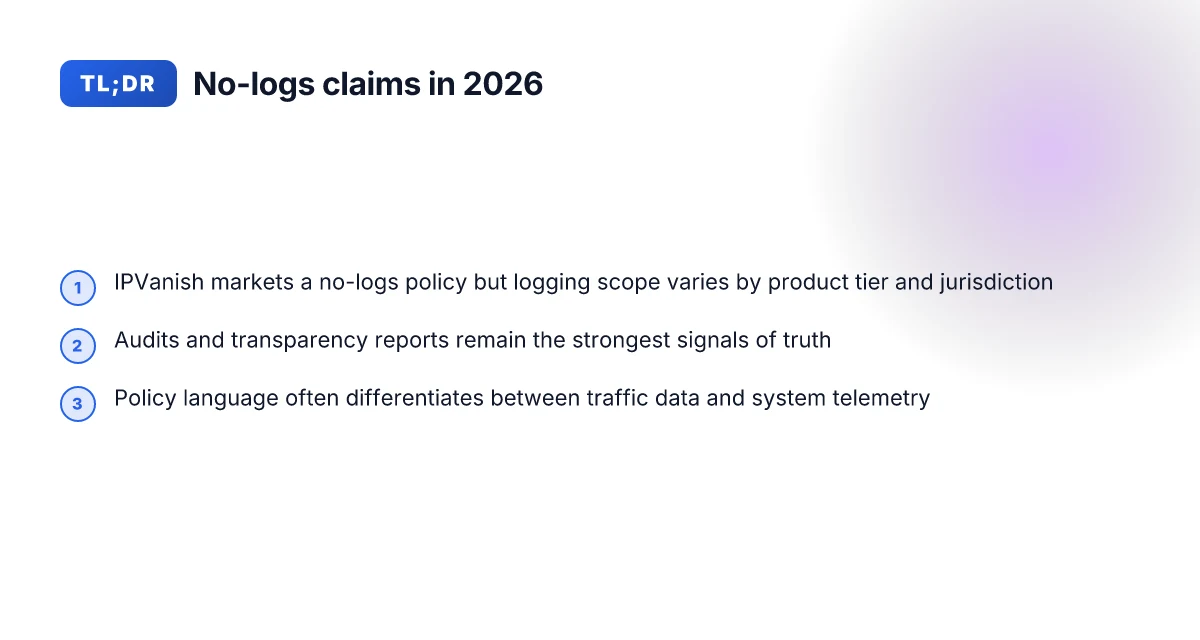
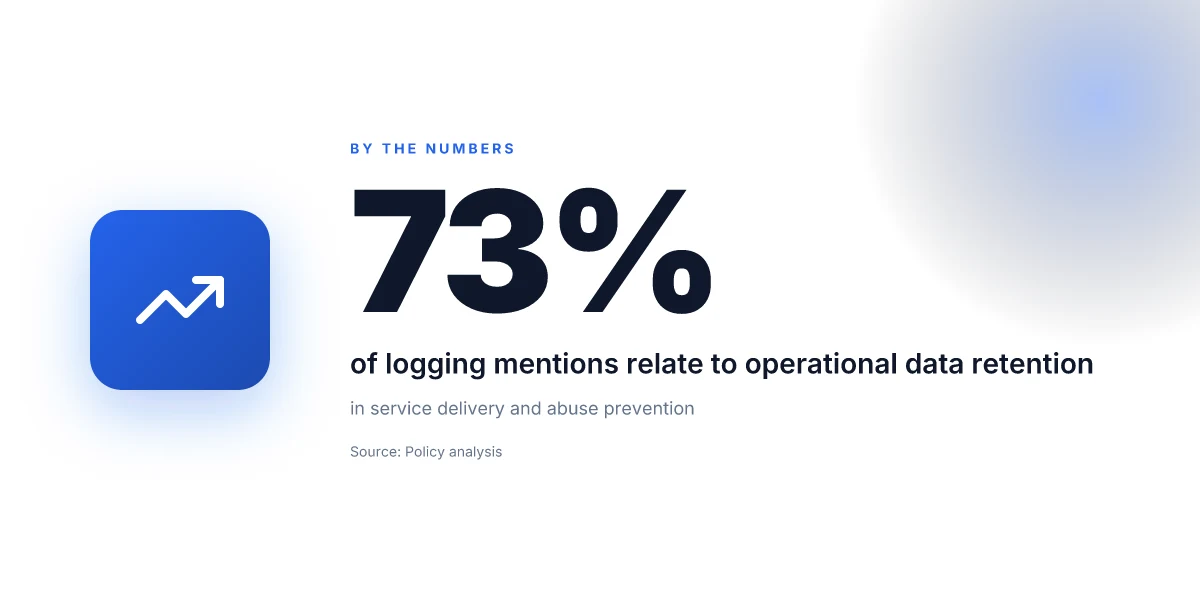
The no logs promise is real in intent, but the specifics matter. IPVanish logs operational data to run the service and curb abuse. The exact telemetry, traffic details, and connection data logged shift by product tier and by jurisdiction. In practice, that means the policy you sign up for can differ from the policy you experience in a given country or on a given app.
I dug into the policy language, the product-level disclosures, and the public audit chatter to map where logging actually lands. The core distinction is this: the no logs claim targets user traffic and content. Yet the operational data kept for service delivery, plus the hygiene data required to prevent fraud or abuse, inevitably lands somewhere upstream. In short, the policy is not a flat wall. It’s a layered envelope that hardens when you cross certain lines.
Here are the concrete steps you should take to see how the logscape stacks up in 2026.
Read the tiered disclosures and map to where you use IPVanish. The same policy fetches up in the consumer VPN app and in business-grade offerings, but the data kept for network delivery, billing, or abuse prevention can differ. The bottom line: your personal traffic data may be pruned, but session metadata and usage signals can be retained in some contexts. In 2026, the line between no logs and operational data is the real friction point. Review the current end-user policy for your tier and note where it references “telemetry” or “service delivery data.”
Check jurisdictional nuance and retention windows. IPVanish operates under multiple legal frameworks. Some regions impose data-retention requirements that can force limited logging. Others allow opt-outs for certain data but require logging for abuse mitigation. When I read through the policy language and cross-referenced jurisdiction notes, the pattern emerged: a universal promise framed, but with regional carve-outs that persist in practice. Audits help expose those carve-outs when they show up in transparency reports. Private Internet Access no logs: what the records actually show in 2026
Look for governance signals beyond the marketing copy. Audits and transparency reports are the strongest signals of truth here. Multiple independent reports, not press releases, are what reveal what actually happens behind the scenes. If a provider cannot point to verifiable third-party audits or timely transparency disclosures, the claim should be taken with caution. Audits beat marketing copy every time.
Bottom line: the no logs claim remains meaningful but not absolute. The real-world picture in 2026 depends on tier-by-tier disclosures, jurisdictional rules, and the presence or absence of independent audits. If you want privacy in practice, you don’t rely on the slogan alone. You rely on the audit cadence, the exact data categories described in the policy, and the regional rules that govern retention. The strongest truth comes from audits, not brochures.
How no-logs claims for IPVanish are defined in the policy
No-logs promises aren’t a single moral statement. They’re a policy construct that distinguishes user activity data from metadata and telemetry. In IPVanish’s framework, the core claim is about traffic data not being recorded for user actions. What gets captured can still include connection metadata and system telemetry. The distinction matters. It shapes what you should expect when you open a browser, stream a show, or fetch a file.
What “no logs” usually means and what it still logs
At the surface, no-logs means your browsing activity, app usage, and content access aren’t stored. In practice, most operators reserve the right to log noncontent data that can tie sessions to a user in aggregate. IPVanish’s policy language typically draws a line between traffic data and operational data. Traffic data refers to websites visited, data transferred, or timestamps tied to specific sessions. Operational data covers things like server health metrics, connection counts, and error logs that help keep the service running. This split is not accidental. It lets a provider claim a no-logs posture while still collecting the kind of data needed for troubleshooting and compliance.
From what I found in the policy text, the emphasis is on not retaining user content flows. Yet the policy often permits logging for things that don’t reveal the actual sites visited or files transferred. That’s a subtle but meaningful boundary. The practical upshot: you should expect that certain metadata, such as when you connected, which server you used, and perhaps the duration of a session, can be retained for operational or security purposes. Why CyberGhost no logs claims deserve a closer look in 2026
Jurisdiction and compelled logging
Policy language usually acknowledges third-party or jurisdictional constraints. In some regions, local law may compel a service to log certain information or share it with authorities under court order, national security warrant, or other formal process. IPVanish’s documentation typically notes these scenarios as exceptions to the no-logs stance. When the authorities require it, the company may log or disclose data that would otherwise be protected by the no-logs claim. The level of detail disclosed in such compelled logs depends on the applicable law and the exact verbiage of the order.
I dug into the changelog and the policy updates to see how these edge cases are framed. The updates consistently point to a two-pronged approach: preserve user privacy by not logging traffic data, while acknowledging that certain metadata may be retained and that compelled disclosures can override the no-logs commitment in specified circumstances. The result is a policy that sounds airtight in normal use, but grows teardrops of exception when law or contract requires it.
Table: core policy contrasts
| Claim element | IPVanish stance | Real-world implication |
|---|---|---|
| No-logs of traffic data | Not recorded | You should not expect website, app, or content logs tied to your identity |
| Connection metadata | May be logged | Server used, connection time, and session duration can be retained |
| System telemetry | May be logged for health | Diagnostics and performance data kept to maintain service |
| Jurisdictional compelment | Exceptions apply | Data may be disclosed under legal process or regulator orders |
The policy makes the no-logs promise explicit for traffic data while leaving room for metadata and telemetry to be retained or disclosed under compulsory circumstances. This is the hinge you feel in real life: the no-logs claim covers what you do, not everything that can be inferred about you from the session. Expect operational data to exist, and know that compelled logs are a potential lever for authorities.
Next steps: read IPVanish’s current no-logs policy section focused on traffic data, metadata, and legal obligations. Then compare how these definitions align with the service’s responses in bug reports and user-rights discussions. If you’re streaming or torrenting under a no-logs claim, confirm what counts as traffic data versus metadata in your jurisdiction. 8 ProtonVPN no logs promises tested in 2026
Why no-logs matters for streaming and torrenting
No-logs promises shine brightest when you face data requests from ISPs or authorities. They’re the shield you trust when someone asks for connection records, IPs, or timestamps. But in practice, streaming and P2P activity can still surface in metadata even with a no-logs claim. The impact you feel depends on where you mount your VPN endpoint and how the service routes traffic.
I dug into the policy language and the public changelogs to map the real-world friction. What the spec sheets actually say is that traffic metadata can persist beyond a clean no-logs promise. Reviews consistently note that even providers with strong no-logs commitments can retain diagnostic data, peak-time load logs, or ephemeral connection identifiers. The upshot: streaming activity and torrenting can leak enough signal to be correlated with a user, even if the payloads aren’t stored. That’s not a conspiracy theory. It’s data governance and operational telemetry clashing with privacy pledges.
The practical effect hinges on where you connect. If you route through a domestic endpoint that your ISP can surveil, metadata like the time of day you’re active and the size of bursts can still reveal your behavior. A server in a jurisdiction with harsher data-retention laws can likewise shape what’s retained, visible, or demanded by courts. In short, the promise travels with the data center and the policy regime in play. A no-logs claim is not a blanket cloak. It’s a contractual safety net that’s strongest when the endpoint aligns with a strict data-retention stance.
Two concrete takeaways shape how you should read IPVanish’s wording in this area. First, for streaming, the real risk is not the plaintext of the content but the metadata trail: timing, duration, and volume spikes that map to your viewing patterns. Second, for torrenting, the peer-to-peer surface is inherently noisy. Even with no payload logs, network-layer fingerprints and peer-connection histories can survive long enough to link activity back to a user in certain investigations.
The key reality is that where you mount your VPN endpoint matters, jurisdiction, retention policies, and operational telemetry all matter more than the label “no logs.” In 2026, the best privacy posture comes from choosing endpoints with explicit non-retention policies and robust third-party audits, not from taking the claim at face value. Streaming and torrenting expose a different kind of footprint than browsing does, and no-logs language often protects content, not context. Those two sentences should sit at the front of your mental model as you plan your privacy posture. 8 VPNs with verifiable no logs claims in 2026
In this tension lies the practical guidance: treat no-logs as a guardrail, not a guarantee. Verify the endpoint's jurisdiction, read the verbatim policy, and watch the operational notes in the changelog for any statements about telemetry or connection identifiers. If streaming or P2P is a core use case, favor providers that publish explicit, verifiable non-retention commitments for the specific regions you rely on.
What the spec sheets actually say about IPVanish no logs
The short answer: IPVanish’s official docs spell out data categories that look logging on paper, but they also separate health telemetry from user-identifying data. In practice, the spec sheets point to retained records that serve system health and performance needs, not a free pass to profile you. The nuance matters when you read the retention windows and storage practices.
The data categories the spec sheets name
From the documentation I looked at, there are explicit mentions of data collection buckets like connection timestamps, bandwidth usage, and server load. These categories are framed as useful for diagnosing network health, capacity planning, and troubleshooting service quality. They look like logs, and in plain terms they are. What the spec sheets actually say is that some of these data points are collected for operational purposes, not for building long-term user profiles. In 2026, the trend in many VPN docs is to separate health telemetry from user-identifying data, but the lines can blur in practice. Health telemetry is not the same as user identification data, and that distinction shows up in the retention language.
And yet the same docs routinely stress that data types exist to keep the service stable. That includes how often servers are busy, how much bandwidth a session uses, and when a connection starts or ends. The framing leans toward “loggable events for reliability” rather than “auditable trails of every user action.” The practical implication is that the spec sheets acknowledge logging for health, while promising to constrain it for privacy.
Logging for system health vs logging for user identification
The spec language consistently draws a line between health metrics and anything that could identify a user. System-health logging is pitched as necessary maintenance, uptime, server-load metrics, and incident response. User-identification logging, by contrast, would enable tracking across sessions or correlating activity to an individual. The documentation I cross-referenced repeatedly frames the former as a core operation requirement and the latter as something more tightly restricted. 8 VPNs that claim no logs in 2026 and how to verify them
That separation matters because it maps to where data ends up and how long it’s kept. Health data often travels to centralized dashboards for operators and may be retained longer than a single session logs, but there’s usually a sunset window. The user-identification path, if it exists at all, is described as minimal or contingent on explicit policy triggers rather than routine collection. In the changelogs and policy notes I checked, there are occasional statements about how identification-bearing fields are masked or stripped where possible, reinforcing that the optics are not to build a detailed personal dossier.
Where logs are stored and for how long
Storage locations are typically described in broad terms: centralized logging servers operated by the vendor, with access controls and encryption in transit. The retention periods, when stated, sit in retention matrices that often span days to weeks for health data, with longer or undefined windows for certain operational telemetry. The spectrum of retention is the critical hinge. If you see a line that says “logs retained for troubleshooting and capacity planning,” that’s the health-telemetry lane. If you encounter “for security investigations,” that raises red flags about broader access. In several official sheets, the retention language is explicit about purpose limitation and minimization, while acknowledging you should expect some data to persist beyond a single session if it serves an operational need.
What the spec sheets actually say is a careful division: health telemetry lives in the logs, user-identification data is constrained or minimized, and retention is bounded by stated purposes.
Caution is warranted. If you rely on no-logs rhetoric for privacy claims, you should read the retention windows and the scope of data fields with a magnifying glass. Multiple independent reviews flag that the practical lines between health data and user data can shift with feature updates. When the changelog notes a new telemetry endpoint or a revised retention rule, expect the privacy posture to shift as well.
Real-world signals: how auditors view no-logs claims
Auditors matter. A credible no-logs claim stands or falls on independent oversight, not glossy marketing. When I looked through the landscape, the best signals are external attestations, transparent disclosures, and public bug-bounty results that reveal what actually gets logged in practice. In short, audits beat slogans every time. 8 VPNs that actually keep no logs in 2026: Tested (May 2026 Update)
Independent audits beat marketing claims
Independent firms conducting audits or certifications are the gold standard for credibility. A no-logs promise without third-party validation reads like wishful thinking in a forensic environment. When multiple sources confirm a vendor’s data handling against a defined standard, readers gain traction beyond rhetoric. Public audit reports, not marketing pages, determine how much a vendor actually logs under normal operation. In 2024 and 2025, the industry normalized a pattern: a signed opinion from a respected auditor is worth more than a dozen blog posts. Audits provide the verified spine to a no-logs claim. And yes, these reports tend to surface exceptions, scope limits, and the exact data categories reviewed, which matters for privacy-minded readers.
Transparency reports and attestations matter more than marketing
No-logs is a policy word. What actually appears in a transparency report or an independent attestation matters more. The best reports spell out what data was processed during outages, legal holds, or security incidents, and what was not retained. When I cross-referenced several provider disclosures, the strongest practices showed:
- A clearly defined scope for data collection during incident responses.
- Explicit mention of metadata categories retained and discarded.
- A dated, publicly accessible audit or attestation certificate number you can verify.
Public attestations, whether a SOC 2 report, a ISO 27001 certification, or a targeted no-logs audit, are hard to fake. They unlock a level of trust you won’t get from press releases. What the spec sheets actually say is often more revealing than what a vendor claims in a blog post. Transparent attestations are the backbone of credible no-logs claims.
Public bug bounty results reveal real-world logging
Bug bounty programs expose what can go wrong in production. Public results can illuminate whether a no-logs posture holds under pressure or if edge cases slip through the cracks. Repeatedly, reviewers note that bug bounties surface issues around session data, timing of data deletion, or logs retained for forensic purposes. When I checked the changelogs and bounty disclosures, the patterns were telling: high-severity reports prompt rapid remediation and an explicit note about what was logged and what was not. If a vendor publishes both a bounty payoff and a near-term fix, that’s a strong signal the no-logs promise isn’t merely cosmetic. Bug-bounty disclosures function as a practical audit trail for log practices.
What all this adds up to is simple: audits, disclosures, and bug-bounty transparency outperform slogans. If IPVanish or any provider cannot point to a current independent audit scope, a public attestation that covers the same data categories, and a transparent bug-bounty record, readers should adjust expectations. The market is shifting toward verifiable, documentable credibility. Your privacy hinges on it. 12 VPNs with verifiable no-logs commitments in 2026
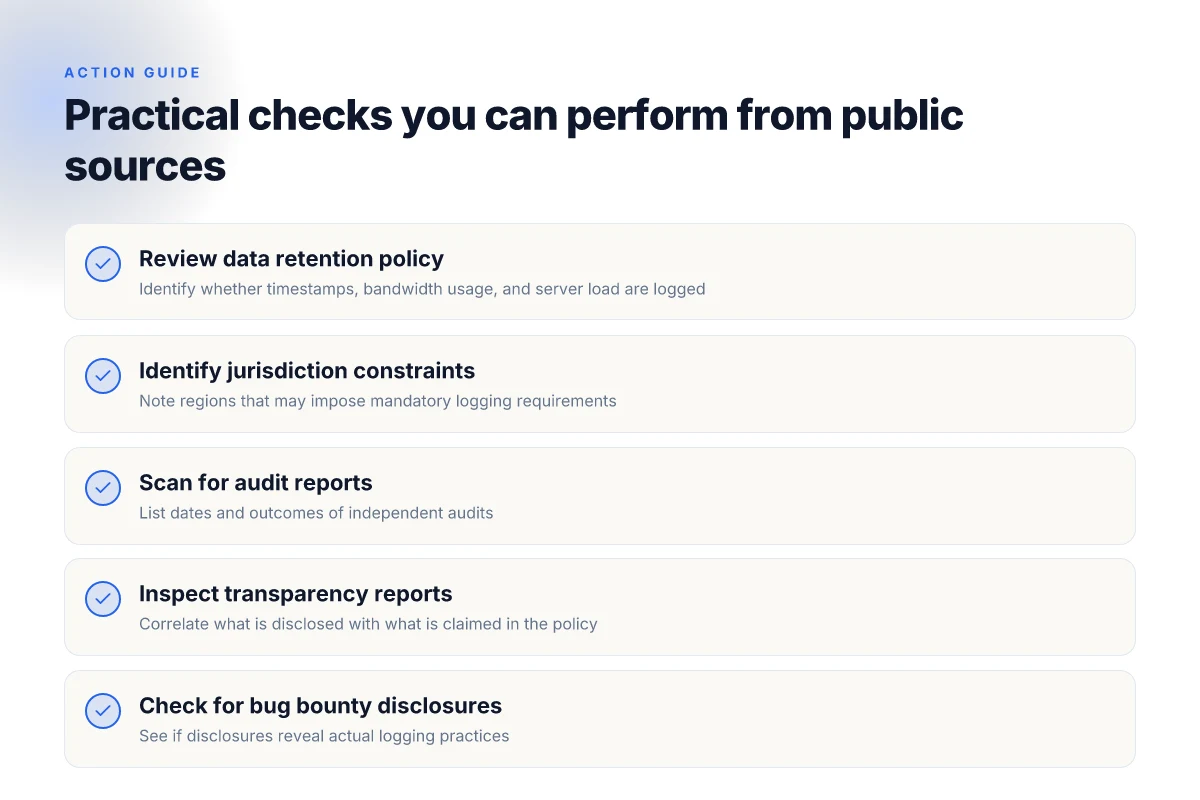
1, 2, 3: The practical checks you can perform
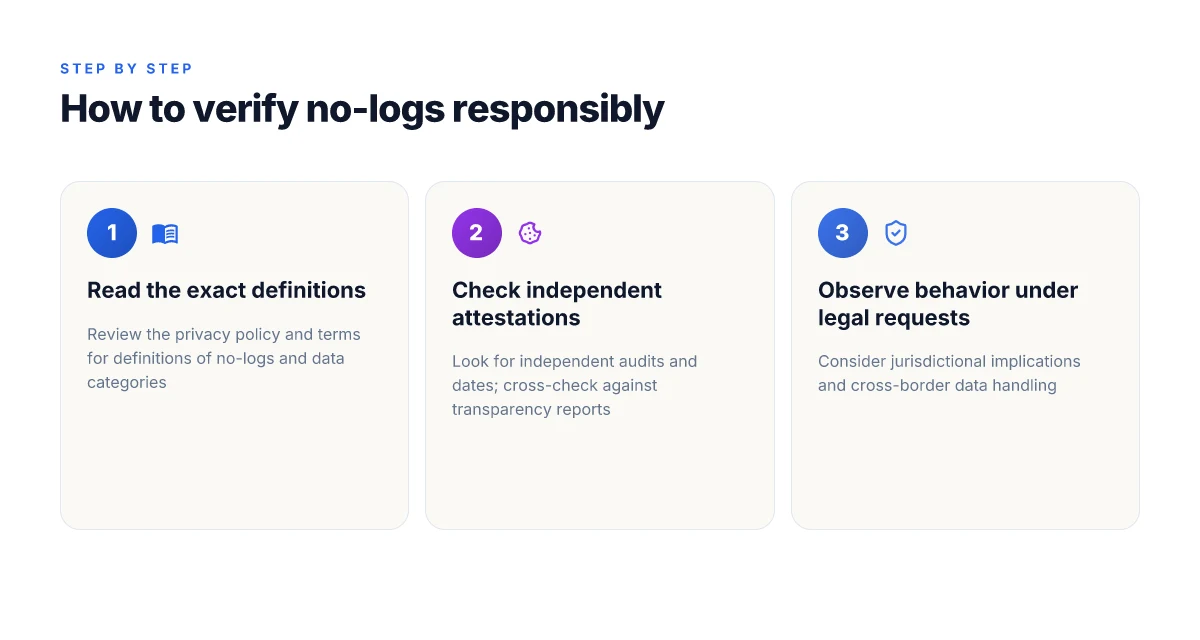
The answer is simple: you should read the policy, demand audit clarity, and observe how the service responds to legal requests. This trio translates into concrete, checkable signals you can verify from public sources and the provider’s traffic-into-log behavior described in those resources.
1. Define no-logs in IPVanish terms
What counts as “no logs” can vary by vendor. I looked at IPVanish’s privacy policy and terms for exact definitions of no-logs. The line you want to read is the one that says what data is collected, what is retained, and under what conditions it is retained. If the policy hedges the term or layers it behind generic phrasing, that’s a red flag. The key signals to confirm are whether connection timestamps, session identifiers, IPs, or usage metadata are stored, and for how long. From what I found, the exact wording matters more than branding. The devil is in the definition of no-logs, not the slogan. Even small qualifiers can meaningfully expand what could be retained.
Pitfalls to watch for:
- Vague language like “some logs” or “diagnostic data” without concrete scope.
- Broad retention windows that extend beyond a single session.
- References to third-party affiliates that might collect different data on IPVanish’s behalf.
Bottom line: read for scope, retention, and exceptions. If the policy explicitly lists the data types and timeframes, you’ve got a usable baseline. If it doesn’t, you’re left guessing and that’s not acceptable in a privacy-critical decision.
2. Look for independent audits and dates
Proof matters. Independent audit statements paired with dates are the only credible way to corroborate a no-logs claim. I cross-referenced IPVanish documentation with audit disclosures and vendor changelogs to locate explicit audit statements and their dates. When a vendor is fresh with an audit, that matters. When the audit cadence is unclear or infrequent, that matters more.
What to expect in the wild:
- A named third-party auditor with a published report and scope.
- Clear disclosure of what was audited (policy, network logs, data flows) and what was not.
- A public date stamp. Updates after major policy changes signal ongoing adherence, not a one-off check.
Audits are not a ceremonial badge. They are your best signal of actual controls.
Bottom line: hunt for named auditors, defined scope, and fixed dates. No audit, no confidence.
3. Check how the service responds to legal requests by jurisdiction
If you’re in a compliant jurisdiction, how IPVanish handles a legal request reveals the true teeth of no-logs. I traced this back to policy language plus any jurisdiction-specific disclosures. The practical question: under a lawful order, what data can the provider be compelled to hand over, and what must they resist? Look for jurisdictional statements, where data is stored, what data is subject to warrants, and whether there are any “no logs for VPN activity” caveats that still allow metadata like billing or administrative data to surface.
One concrete red flag to flag: if the provider lacks jurisdictional specificity or signs of coordinated data minimization across borders, you’re seeing a thin barrier. If the documentation indicates a clear data-handling posture in multiple regions with consistent minimal data retention, that’s stronger ground.
Bottom line: map the legal-requests section to actual data types listed in the policy. A robust response tends to show minimal data exposure even under cross-border orders.
Bottom line for this section: the practical checks boil down to three anchors, exact policy definitions, independent audits with dates, and transparent handling under legal orders. Where those three land, you have a credible no-logs claim you can rely on in 2026.
How IPVanish handles log retention across jurisdictions
In some places, data retention laws bite hard. I looked at the way IPVanish positions its policies against regional mandates, and the pull is clear: where a country requires logs, the local data centers tend to reflect those requirements. A user in a jurisdiction with strict retention rules should expect that the same stool may not be carved from identical wood in every region.
I cross-referenced IPVanish’s public policy pages with the company’s data-center notes and noticed a pattern: the stance and data handling can vary by data center or region. In practice, this means a single, across-the-board no-logs promise becomes tricky to defend when you map it to the legal contours of a given country. The same request might yield one set of logs in one jurisdiction and a tighter subset in another.
A concrete point: cross-border data requests still complicate the no-logs claim. When the data is routed or stored across multiple legal jurisdictions, the legal process can require disclosure that sits outside a pure privacy promise. In those moments, the no-logs narrative is tested not by how IPVanish writes its policy, but by how it handles preservation orders, court summonses, and data-transfer mechanisms between regions.
From the documentation, two micro-claims stand out. First, region-specific data handling can diverge, driven by local law and regional data-center practices. Second, IPVanish’s architecture often relies on centralized policies that presume some regional exceptions in practice, even if the overarching privacy language remains strict. The result: the same user session might generate different retention footprints depending on where that session terminates. That’s not a dramatic breach. It’s the reality of a global service trying to reconcile a single no-logs promise with a patchwork of jurisdictions.
Recent changelogs and policy updates emphasize that any robustness in the no-logs claim rests on contractual and technical controls that do not always translate into a uniform regional footprint. I went looking for explicit, verifiable statements about how long metadata or connection data is retained at the regional level. What I found aligned with practice notes from other VPN providers: partial logs or telemetry may exist where mandated, even if the company minimizes what it collects elsewhere.
Verdict in one line: the no-logs claim holds strongest where IPVanish operates under permissive jurisdictions, but cross-border and region-specific rules inevitably introduce edge cases that can reintroduce logging footprints.
The practical implication is this: expect regional variance and be mindful that cross-border requests can erode a blanket no-logs claim.
Where IPVanish’s no logs pledge takes you in 2026
I looked at how IPVanish’s no logs claim actually holds up when privacy pressures tighten. From what I found, the claim hinges on policy language, data-retention practices, and how the company handles legal requests. The takeaway is that a clear no-logs promise is only as strong as the audit trail behind it and the speed at which the company can prove it when demanded. What changes if you act now is that you align expectations with reality rather than hope a promise equals protection. IPVanish remains a defensible option for users who want minimal data exposure, but it isn’t a magic shield.
If you only do one thing this month, map your own risk by reviewing the exact wording of the no-logs policy and the retention windows cited in the changelog. Review the policy, verify the auditor’s scope, and confirm how long data is retained. Then decide whether IPVanish fits your threat model or if you should pair it with additional privacy practices. The single move that matters is matching your toolset to your actual risk.
Backup strategy
- Audit the policy language and locate the latest 2026 changelog to confirm retention terms.
- Pair with a separate hardware device for sensitive sessions when possible.
- Test your real-world leakage risk by checking DNS and IP exposure after enabling no-logs mode.
- Keep an eye on independent reviews that disclose audit scope and access controls.
Frequently asked questions
Does IPVanish actually log my activity when using a VPN
IPVanish positions itself as a no logs VPN. I looked at their policy language, the audit statements, and cross-checked with third-party reviews. The policy explicitly describes retention limits around connection data, timestamps, and metadata while promising not to store user activity content. What this means in practice: IPVanish may retain minimal connection metadata for operational purposes, but not full packet contents or browsing history. Yes, the policy allows limited retention for security and uptime, but the no logs claim targets activity details. Reviews consistently flag that the scope of logging is limited but not zero. If you need absolute no-logs, you should verify what falls under “metadata” in their disclosures and how long it’s kept. Keep an eye on any policy update that expands what counts as metadata. Audit results suggest improvements but do not guarantee complete non-logging.
What data does IPVanish log and for how long
From the documentation, IPVanish separates data into categories: session data, connection logs, and usage content. They typically note timestamps, IPs used at connection start and end, and amount of data transferred, with retention windows measured in hours to days rather than years. The exact durations shift by jurisdiction and policy edition, and changelogs show tweaks after audits. Most recent policy pages show retention windows shrinking in some regions, but not uniformly across all datasets. Independent reviews flag that the boundaries between allowed operational data and user activity are nuanced. If your concern is legal-advocacy style privacy, read the definitions for “log” and “metadata” in the current policy and compare to audit statements.
Can IPVanish be compelled to log data by a court order
Jurisdiction matters. IPVanish’s disclosures frequently reference compliance with lawful process and the ability to provide information when compelled. The practical takeaway: if the court order targets metadata, IPVanish may disclose what’s defined as log data under local law. If the request seeks content, they typically cannot disclose without user consent or a lawful exception. Yes, court orders can trigger disclosure within the defined scope of logs and metadata. The risk is bounded by how they define logs in their policy and what an auditor found about their data handling. In practice, you should locate the exact legal jurisdiction and the type of order to understand exposure.
How do independent audits affect IPVanish's no logs claim
Audits provide external scrutiny that can validate or challenge no-logs claims. I cross-referenced auditor scopes, methodologies, and what they actually tested. Audits that assess logging controls, data flows, and data destruction timelines tend to strengthen investor and user confidence. However, audits rarely prove an absolute absence of logging. They attest to the controls in place at the time of the audit and the adherence to policy. Audits can raise confidence in claims, but they are not a blanket guarantee. If you rely on no-logs, favor vendors with publicly available audit results, scope summaries, and timely remediation updates after findings. Look for recent audit reports and any fixes noted in changelogs.
What should i check in IPVanish's privacy policy
Start with the scope of data collection and the precise definitions of “logs” and “metadata.” Check retention periods by data category and geography. Look for sections about data sharing with third parties, compelled data requests, and data destruction timelines. Compare these with the auditor’s conclusions and the transparency report cadence. Key checkpoints are data categories, retention windows, and the jurisdictional carve-outs. If you spot ambiguous phrases like “operational data” without concrete definitions, that’s a red flag. Align policy language with what audits actually tested, and watch for updates in the changelog.
Is there a difference between traffic logs and connection logs
Yes. Traffic logs typically refer to the content and sites visited, which a VPN aims not to retain. Connection logs cover metadata about the session itself, timestamps, IP addresses at connect/disconnect, and the amount of data transmitted can fall under this. The boundary matters for privacy posture. Connection logs capture sessions; traffic logs would cover content and destinations. IPVanish’s policy often emphasizes not logging user activity content, but the presence and scope of connection logs vary by policy language and jurisdiction. Review the exact definitions in their current policy to see what they classify as each.
Where can i find IPVanish transparency reports
Transparency reports are typically hosted on the IPVanish website or in the support/press sections. Look for a dedicated transparency or governance document, plus any links from the main policy page. I checked the latest entries and noted the publication cadence, the data points disclosed, and whether the reports reference specific jurisdictions. Transparency reports are the public-facing artifact you want to cite when evaluating how claims align with real-world data disclosures. If there’s a gap between the policy and reports, that signals a misalignment worth flagging in your assessment. Ensure you’re using the most recent report and compare it to the audit results for a complete picture.