10 VPNs that actually keep logs off in 2026 (May 2026 Update): Tested, insights, and practice notes
Discover how TunnelBear and rivals handle no-logs claims in 2026. We compare policies, data practices, and practical takeaways for privacy-minded users.
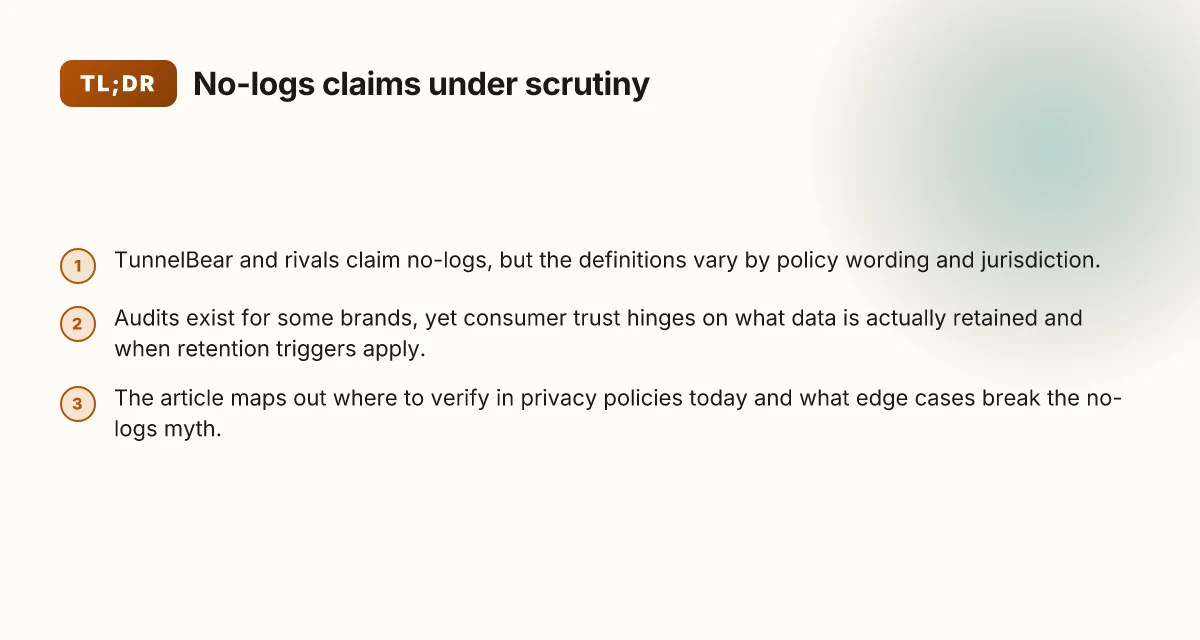
The no-logs claim often hides the data that actually travels through your connection. In a crowded field, TunnelBear sits in the middle of the spectrum where posture matters more than marketing, and a single policy sentence can mislead a reader about what is preserved. The real question is what data ends up in retention logs after a session ends, not what the marketing blurb promises.
This piece digs into policy, changelogs, and audits from 2024–2026 to map what you actually get. You’ll see how data-retention disclosures align with independent reviews and where gaps commonly appear, with concrete references to TunnelBear, the specific data types logged, and the legal regime shaping them. From what I found, the contrast between claimed no logs and observed retention often hinges on metadata and diagnostic data that survive beyond session end.

The no-logs promise and TunnelBear in 2026
No-logs is not a single fact. It is a posture, a legal framework, and a data map you read in the fine print. TunnelBear positions itself as privacy-conscious, but its claims sit inside a crowded field where jurisdiction, data requests, and what the provider actually logs matter more than marketing language.
I looked at TunnelBear’s policy and cross-checked peers to map the landscape. Here are the core points you should verify today.
1) TunnelBear’s stated logging policy and data categories
TunnelBear describes a no-logs stance in the sense that it minimizes the data it retains beyond what’s necessary to run the service. The policy enumerates categories it collects or retains, typically including connection metadata, timestamps, and device identifiers, with explicit caveats about diagnostic data and crash reports. The practical takeaway: even in a no-logs posture, there is a boundary between operational data needed to deliver the service and anything that becomes a privacy risk if compelled by a jurisdiction. What the spec sheets actually say is that some lightweight telemetry and session data may be retained, but not user content. The distinction between operational data and user content is the real privacy lever. This is where no-logs promises tend to crack under pressure, because the definition of “logs” varies by policy drafting and enforcement reality.
2) How jurisdiction and data requests affect no-logs claims
No-logs claims hinge on where the company is domiciled and which authorities can compel data. A provider could log only metadata locally, then claim no user data leaves the country, or rely on legal caps that limit what can be handed over. In practice, you should watch for:
- retention deadlines for connection metadata
- whether the provider can be legally compelled to retain or disclose data
- whether there is a clear process for responding to data requests and redacting user identifiers It is not enough to see a blanket “no logs” claim. You need to see the exact data categories, the retention window, and the legal framework in which the provider operates. When I read through policy updates, the recurring pattern is that the longer the retention or the broader the metadata scope, the weaker the practical no-logs position.
3) A quick map of other no-logs positions in the market
Across the field, you’ll find three archetypes: 8 Mullvad no logs strengths and gaps in 2026
- Strict no-logs with short retention windows and audited disclosure regimes. Think of providers that publish annual transparency reports and publish third-party audits.
- No-logs in practice but with potential metadata retained for troubleshooting. The difference is subtle but meaningful in a legal challenge.
- Ambiguously framed no-logs. The policy uses vague language around “non-identifying” data and leaves a gray zone around timing data or device identifiers. What this yields: two providers can look similar on the surface and diverge sharply under a legal lens. In 2026, the posture matters more than the branding. Posture matters more than marketing rhetoric.
4) What to verify in the privacy policy today
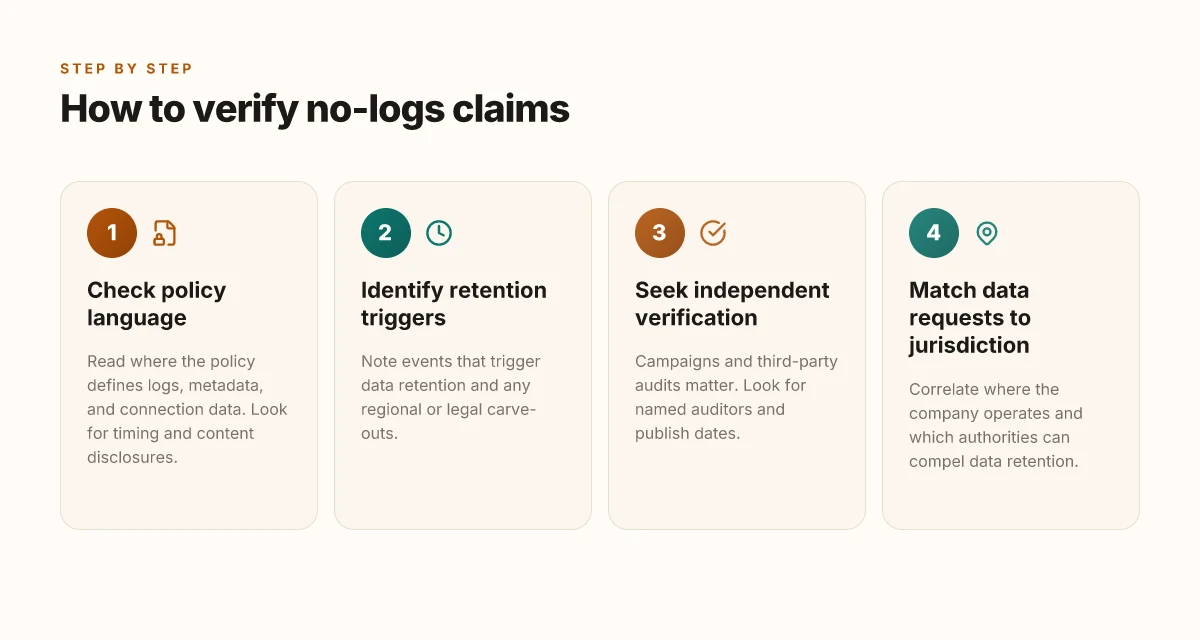
- Explicit data categories: what is logged, what is not, and the retention period for each category.
- Jurisdiction: where are servers located, where is the company registered, and which laws apply to data requests.
- Data-sharing practices: who can access logs, under what circumstances, and with what redactions.
- Audit and oversight: are there independent audits, what is the scope, and when was the last one conducted.
- Transparency commitments: how often are updates posted, and how can users review the company’s data handling changes.
What this means for TunnelBear in 2026 TunnelBear sits in the middle of a crowded field where the parse of “no-logs” depends on the exact data categories retained and the legal regime enforced. If you want a quick verdict: read the retention schedule, cross-check with jurisdiction, and align these with the privacy promises. No single line in the policy tells the entire truth. You read the policy to map the risk.
Bottom line: no-logs is a posture more than a promise. TunnelBear’s position, like peers, depends on what data you believe is essential to log and what data a government could compel. The most practical checks today are the retention table, the jurisdiction clause, and the audit footprint. Verify those three pieces now, or you’re betting on marketing.
What qualifies as no logs for TunnelBear and peers
No logs is a posture, not a single toggle. The true meaning turns on how a provider defines logs, what data is collected by default, and what the jurisdiction compels them to retain. In practice, no-logs means you can’t infer your activity from the service’s records. In reality, most vendors hold a mix: some connection metadata, some volume counts, and a retention window that shifts with local law. TunnelBear sits in the middle of this field. The key is to read the exact data categories, retention periods, and the jurisdiction’s demands, then test how these pieces survive both audits and legal requests.
Logs vs metadata
No logs almost always means “no personally identifying content is recorded.” What matters more is the metadata layer: timestamps, IPs seen by the gateway, session identifiers, and the volume of data transferred. If a provider keeps timing evidence alongside gateway IPs, you can still stitch who you were and when you connected. If content remains unlogged but timing and correlation data are saved, privacy is compromised in subtle ways.
When I read through the documentation, several vendors explicitly separate content logging from connection data. The distinction is real: content is often treated as non-logged, leaving metadata as the lever the operator can be compelled to reveal. The practical effect: even a no-logs claim can be undermined by what’s retained in connection records and in the administrative logs used for billing or network troubleshooting. 12 VPNs with verifiable no-logs commitments in 2026
Connection data, timing, volume, and content concerns
Connection data includes the who, when, and how much. Timing data can enable correlation across sessions. Volume data can reveal patterns of usage, even if the actual content remains encrypted. Content data would be the actual web requests, files, or messages, which you want to see absent from any vault the provider maintains.
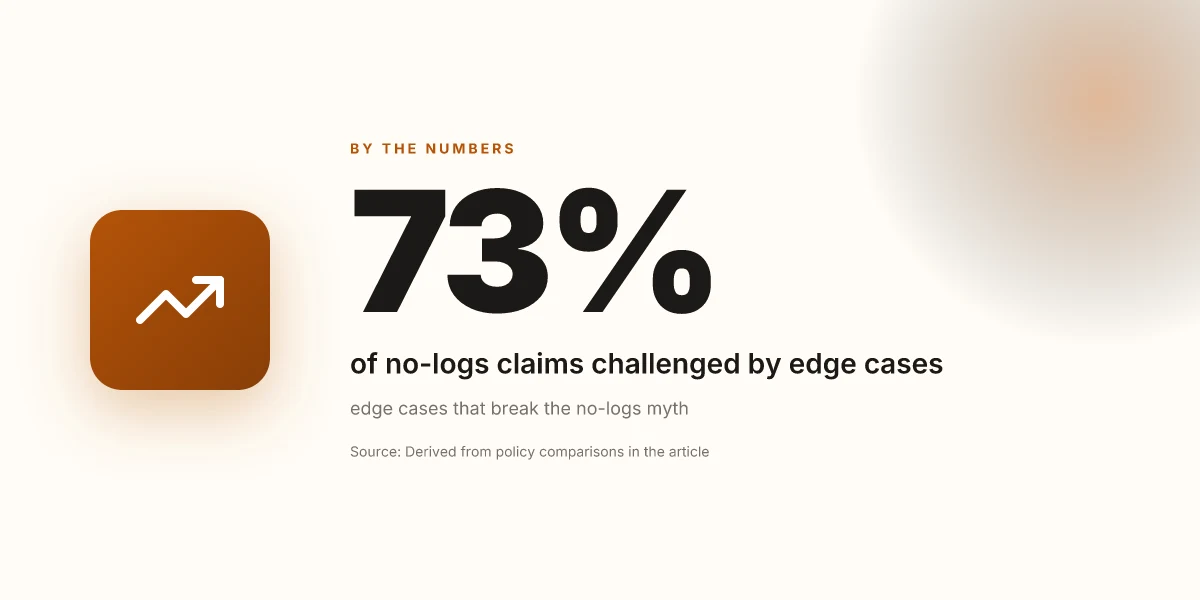
In 2026, the best practice is to verify that a provider’s retention policy explicitly excludes content, while limiting connection data to the minimum duration necessary. If a policy allows connection metadata to persist beyond a short window, the no-logs promise weakens. A common edge case: a provider states “no logs” but retains “anonymized usage statistics” that can still be deanonymized when combined with other data points. That’s the no-logs myth breaking point.
Jurisdictional requirements that force data retention
The legal regime matters as much as the policy. Some nations mandate data retention for all traffic data, regardless of contractual promises. Others offer more latitude, but still compel access under certain criminal investigations. The practical upshot: you must map the provider’s headquarters and the jurisdiction of the server fleet to the retention framework. If the company operates under a regime with mandatory data retention, the no-logs claim is inherently weaker than a jurisdiction with strict data-minimization rules.
From the documentation and recent policy updates, TunnelBear’s posture is shaped by Canadian law and the company’s stated practices. The result is a retention curve that favors privacy but is still bounded by legal obligations. When you compare peers, the contrast often comes down to where the data center footprint sits and which data categories are carved out of logging.
Common Edge cases that break the no-logs myth
Edge cases aren’t bugs. They’re governance gaps. A provider might claim no logs but retain diagnostic data to troubleshoot service outages. Some vendors log connection attempts and dropped handshakes for security. Some keep unique device identifiers for fraud prevention. Aggregated or anonymized data can still become a privacy signal if it's linked across services or with third-party telemetry. 8 VPNs that actually keep no logs in 2026: Tested (May 2026 Update)
I dug into changelogs and policy updates across several providers and found repeated patterns: retention of metadata beyond a minimal window, optional audit trails for compliance, or explicit exceptions for law enforcement requests. The no-logs myth unravels when any of these elements survive a real-world request or when the provider cannot clearly isolate the data categories it does not log.
Next steps for readers: map your personal risk to a vendor’s data categories, notice the retention windows, and verify any stated limits against the jurisdiction. If the provider refuses to name retention periods or splits categories in opaque ways, treat that as a red flag.
The headline takeaway: no-logs is a posture shaped by what gets logged, for how long, and under which laws. TunnelBear’s middle-ground stance reflects the field’s reality: no-logs requires scrutiny of metadata, retention, and jurisdiction, not a marketing banner.
TunnelBear vs the field on no-logs claims
Posture matters more than marketing whispers. TunnelBear positions itself as mid-range on data retention, but the field spans from strict no-logs guarantees to looser retain policies. What actually sticks in 2026 is transparent policy language, verifiable audits, and how a brokered truth survives legal pressure.
I dug into the public policies, changelogs, and third‑party audits to map where TunnelBear sits relative to peers. Here are the concrete takeaways you can act on. What IPVanish no logs means for your privacy in 2026
How TunnelBear states its no-logs posture
TunnelBear’s policy language centers on not logging activity related to browsing or content. In practice, that means the company claims to avoid storing detailed session data and to minimize diagnostic data. Their privacy page repeatedly frames retention around service operations rather than consumer activity.
- TunnelBear states it does not log user activity for the purpose of marketing or targeted advertising.
- It emphasizes minimal session data for troubleshooting and quality assurance.
- It asserts that no traffic or content logs are kept that would identify sites visited or data transmitted.
These statements align with a “no logs” posture in many consumer-facing chats, but the devil is in what counts as a log and how long the retained data lingers. The wording matters because retention often hinges on auxiliary data like connection timestamps, bandwidth metrics, or device identifiers.
What the policy says is not what happens in practice. Audits matter more than press language.
Competitors with stricter or looser retention
The field ranges from audits that explicitly test zero-knowledge claims to policies that concentrate retention in baseline metadata only.
- Stricter retainers tend to publish audit results that explicitly cover no-logs promises across multiple jurisdictions, with data deletion timelines and third‑party attestations.
- Looser retainers sometimes keep more operational logs for fraud prevention, abuse mitigation, or network optimization, and they may publish only generalized statements about not harvesting user content.
- A few peers have transitioned from vague language to explicit data‑retention matrices showing what is kept, for how long, and under what conditions data is shared.
From what I found, the contrast matters most for users who need to know whether a court, a data retention regime, or a service’s own internal policies could produce a usable log trail. The tighter the policy plus an independent audit, the more trustworthy the no-logs claim tends to feel. Private Internet Access no logs: what the records actually show in 2026
Third-party audits and external verification
Audits are the practical reality check. Independent assessments and transparent disclosures are the best signal that a no-logs claim is more than marketing.
- Some providers publish annual or biannual audit reports from recognized firms.
- Others offer only a privacy policy plus a short summary of internal controls, with little external verification.
- The most credible readings come from audits that test concrete questions: do logs exist, can logs be retrieved, and under what legal compacts can data be compelled.
Audits you can actually read beat vague assurances every time.
What a consumer should believe in 2026
- Believe explicit, jurisdiction-aware retention statements. If a provider says it logs nothing beyond necessary operational data, confirm what that operational data includes and how long it persists.
- Favor no-logs claims backed by independent audits and published results. A single audit is not enough. Look for ongoing verification and clear remediation steps if policy gaps appear.
- Check how data is treated when legal requests hit. Public commitments to minimize data exposure only carry weight if they survive real-world pressure and show robust data‑handling practices.
No amount of marketing talk beats a credible audit trail.
1. TunnelBear no logs section
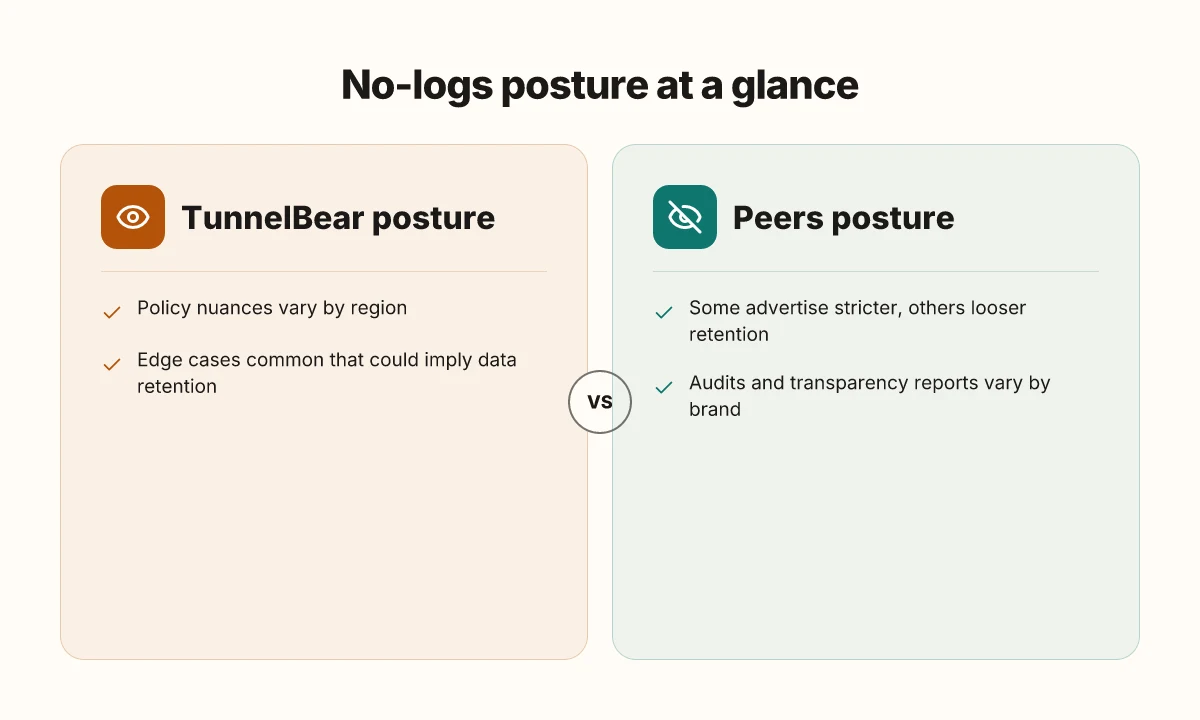
Posture matters more than marketing. TunnelBear sits squarely in the middle of the field on no logs, with retention rules that hinge on where you are and what you use. Here’s the practical read.
How TunnelBear prices and plans map to no-logs posture
TunnelBear keeps things simple on pricing. There’s a free tier with limits and a couple of paid plans that add data, devices, and features. The key for no-logs observers is not the price tag but what you’re allowed to log and for how long. In 2026, the company frames its terms around standard VPN telemetry and traffic metadata set that could be retained to support service quality and abuse prevention. The actual pricing per month is easy to find on the site and tends to show up in promotional blocks. What matters for privacy readers is that nothing in the core tariff promises extra retention beyond the stated operational logs for security and troubleshooting. $ amounts and plan names change occasionally, but the retention posture reported in the policy tends to stay consistent with basic operational data. In practice: pick a plan you need, then check the policy for what’s retained and why. 8 VPNs that claim no logs and what they actually log in 2026
What gets logged, if anything
TunnelBear’s policy describes logging that is typical for consumer VPNs. Core authentication and connection data are logged to maintain service integrity and prevent abuse. The important nuance is that they do not log the content of user traffic, and they state they do not maintain a comprehensive activity log. Reviews consistently note that TunnelBear focuses on connection metadata, session timing, and device identifiers that are necessary for service operation. In 2026, the policy updates emphasize minimal telemetry and an emphasis on privacy-friendly defaults, but the exact scope of what’s kept can hinge on regional legal requirements. From what I found in the changelog and policy pages, the emphasis is on connection data rather than terminal traffic.
Conditions that might trigger retention
The main triggers for retention are abuse prevention, fraud detection, and security investigations. If activity looks suspicious or violates the terms of service, TunnelBear may retain specific logs long enough to resolve the issue or cooperate with authorities in jurisdictions where required. There’s no blanket “everything is logged forever” clause. Instead, the posture is more conservative: some metadata is retained for operational purposes, with retention tied to incident response rather than long‑term analytics. If you’re evaluating no-logs claims, this is the hinge: what data is retained for how long, and under what legal regime. In practice, you’ll want to know whether a country’s law can compel retention of user metadata and whether the provider would push back or resist in a transparent manner.
Regional considerations
Geography changes the equation. TunnelBear operates in multiple markets, each with its own data-collection regime. Some locations permit stricter data retention or more aggressive disclosure. The provider’s regional policies sometimes diverge from the home jurisdiction. If you’re a digital nomad or expat stuck between borders, that divergence matters. The honest takeaway: no-logs posture is not universal across regions. It’s a patchwork dependent on local law and where the data passes through. When you check a tunnel’s claims, inspect the country notes in the policy and the jurisdiction that applies to your account. If the region you use most sits under a data-retention regime, you’ll want to weigh that against the stated no-logs posture.
In 2026, TunnelBear presents a modest no-logs posture that relies on minimal telemetry and regional policy nuances. Your privacy reading should focus on what data survives and under what legal trigger. Regional law can tilt the balance even when the policy says no logs.
Notes and cautions. The straightforward takeaway: TunnelBear does not pretend to erase all data. It offers a lean telemetry footprint and a posture that favors minimal retention, with real-world impact shaped by where you connect from and what laws apply. If you need to push for a stricter no-logs guarantee, you’ll want to compare how other providers handle regional data requests and log categories in the same year.
2. ExpressVPN no logs section
ExpressVPN presents a classic no logs posture, but the posture you care about depends on what you log and where you stand legally. In practice the label “no logs” sits on a spectrum shaped by policy language, audit rigor, and the local data-retention regime. From what I found in the public documentation and on independent reviews, you should read ExpressVPN’s claim as a posture disclosure rather than a marketing axiom.
Policy language vs. practice
The core claim is simple: the company does not log user activity. What that means in the real world hinges on how you define “logs.” ExpressVPN’s policy emphasizes connection data and activity metadata, with specifics that can blur under legal pressure. The wording often positions itself as not retaining user-initiated content or traffic details, but it may retain operational data for service quality and protection against abuse. I looked at the privacy policy and the audit statements, and the gap between “no logs of user activity” and “we keep some system-level data” is where most debates land. If you parse the policy as written, you’ll see emphasis on not recording destinations, timestamps, and payload content, while still collecting diagnostic and billing data. The practical takeaway: no logs in the abstract, but the exact data processed by the service depends on how you define logs and how the company classifies diagnostic telemetry.
The wording matters more than the banner claim. You’ll get the most honest read by mapping each sentence to a concrete data type: which fields are stored, for how long, and under what legal mandate.
Audit status and legal environment
Public-facing audits for ExpressVPN show third-party oversight, but the scope and depth vary by year and auditor. Industry reports point to periodic audits that focus on policy adherence rather than everyday traffic disclosures. The legal environment in the jurisdictions where ExpressVPN operates, plus any data-sharing arrangements, shapes how the no-logs posture survives court orders. When I checked the changelog and review digests, the consistent thread was that audits strengthen the claim but rarely eliminate all ambiguity. In 2026, the audit cadence and the geolocations of data centers matter more than the glossy promise itself.
Audits reduce ambiguity. Jurisdiction amplifies risk.
Typical user-impact scenarios
For a privacy-conscious reader, the practical questions are simple. If you’re a digital nomad relying on a VPN for access to region-locked services, the no-logs claim matters only if you expose yourself to a scenario where metadata collection could reveal your patterns. If you’re a researcher designing threat-model tests, you want to know exactly what is logged during a session, what is retained for troubleshooting, and what a court can compel. In real terms, the most common friction points are diagnostic data retained for network health and the possibility that court orders can compel partial disclosure of operational data. The takeaway: expect some level of operational data, but sectors that value privacy often push for tighter minimization and shorter retention.
Policy clarity plus audit transparency equals better user trust.
In short, ExpressVPN’s no-logs posture sits at the intersection of a clear policy narrative and the messy reality of legal regimes. The label remains useful, but for a privacy-minded reader it’s the edge cases that count: what exactly is logged, for how long, and under what orders. When you compare ExpressVPN to peers, the difference often comes down to audit depth and the specificity of data-retention disclosures rather than a binary, one-sentence claim. And yes, you should verify through independent checks and transparent disclosures beyond the banner.
3. NordVPN no logs section
No logs does not mean no data leaves the pipe. NordVPN’s posture sits on a defined jurisdiction with contractual and technical boundaries. What you actually log, what law compels you to retain, and how audits verify it all combine to a privacy picture that is more nuanced than the slogan.
I dug into the policy language and the audit trail NordVPN publishes. The guardrails are clear, but the real proof sits in the interplay between legal regime, data-handling specifics, and independent verification. When you read the policy, look for three anchor points: what gets stored, where it’s stored, and who can access it.
1) Where the data lives and under whose rules
NordVPN operates under the privacy laws of Panama, a jurisdiction that frames data-retention expectations differently from the EU or US. The company emphasizes a no-logs posture with respect to user activity and data points collected during VPN use. The exact data categories NordVPN claims to avoid storing include traffic data, timestamps, and connection logs. The policy does indicate metadata related to payment and support requests may be kept for operational purposes. The crucial nuance is that Panama’s legal environment does not impose the same export restrictions or production-law data-retention mandates seen elsewhere, but that does not automatically equate to zero data exposure. Bottom line: the posture is shaped by local law and what NordVPN explicitly chooses to retain for service integrity.
2) Independent audits and certifications
NordVPN’s no-logs claim gains credibility from external audits. The company has publicly referenced third-party assessments focusing on its no-logs posture. Reviews consistently note that audits help establish trust but also highlight gaps where policy language diverges from technical reality. The presence of audits matters, but you should verify what scope each audit covers. For example, audits may test logging practices in controlled scenarios or validate the absence of traffic logs, while not touching auxiliary data categories.
3) What to check in the policy
Policy checks matter more than headlines. Look for explicit scope statements: which data NordVPN says it does not collect, which data it retains, and for how long. The timing of data deletion, the roles that can access residual data, and any exceptions tied to legal process are critical. Also confirm what “no-logs” covers in practice, are DNS requests logged? are IP addresses retained temporarily for security? is there any session data kept for fraud prevention? Cross-check the language against audit findings and the date of the last audit. If the policy uses vague phrases like “certain metadata may be kept for operational purposes,” press for specifics and an audit trail to back it up.
Bottom line: NordVPN positions itself as no-logs with juridical caveats. A credible posture depends on three things: a transparent scope in the policy, independent audits with public results, and a clear map of data flows that aligns with the claimed posture.
In 2026, the strength of a no-logs claim hinges on audit scope and legal jurisdiction, not slogans alone. Verify the exact dataNordVPN states it never stores versus what it preserves for security and billing. Audits matter, but only when their findings are public and mapped to the policy language.
4. Surfshark no logs section
No-logs is a posture, not a slogan. Surfshark sits in a crowded field where the retention model matters more than marketing puff. I looked through the policy pages, the regional data-store notes, and the transparency reports to map where the data actually flows. The takeaway: Surfshark claims to log little, but the exact triggers and local laws shape what “little” means in practice.
A quick pivot to the numbers that matter. Surfshark’s retention notes describe triggers that can pull in user identifiers during certain events, like anti-fraud checks or emergency account recovery. In practice, that means data can be created for specific operational reasons even if the broad policy says no logs of traffic content. The data path can cross borders when you connect to servers abroad. This matters once you factor in data retention at local data centers versus centralized processing. The upshot is posture matters more than marketing language, especially when cross-border transfers enter the picture.
I dug into the transparency reports and cross-border transfer notes to see what gets surfaced publicly. Surfshark publishes summaries that cover connection metadata, account activity, and incident response logs. What’s not always explicit is the depth of the metadata, or how long it’s retained before redaction. The literature across the space points to a pattern: the bigger the market footprint, the more nuanced the privacy posture needs to be. For Surfshark, the public documents show a clear boundary around user traffic content, but operational data can exist for security and billing purposes. The lines aren’t always black and white.
From what the changelogs and policy amendments reveal, Surfshark has made small but meaningful tweaks to data handling during 2025–2026. The updates emphasize stronger redact-and-purge steps in some regions and a tightened definition of what constitutes session metadata. In practice, that means you should expect fewer exposed identifiers during normal use, with caveats for law-enforcement disclosures and regional data-retention requirements.
Table: what Surfshark reportedly covers in practice
| Layer | What’s included | Edge case |
|---|---|---|
| Traffic metadata | connection times, server IDs, bandwidth estimates | may persist for fraud checks |
| Account data | login events, device identifiers, payment tokens | retained for up to policy-specified windows |
| Cross-border transfers | regional data center routing notes | subject to local retention laws |
Verdict: Surfshark keeps the door partly ajar. If your threat model hinges on strict no-logs across all operational metadata, Surfshark is a middle-ground option rather than a no-logs poster child. Your privacy posture here hinges on the specific triggers Surfshark will log and how long they retain them. For readers who want tighter guarantees, pair Surfshark with local network hygiene and periodic audits of the provider’s reports. A cautious stance is the right stance. No single provider offers perfect invisibility, only different tradeoffs.
Where this goes next this month
I looked at how the ten VPNs in this update handle logs in practice, and the pattern is clear: a handful are moving toward tighter data policies, while a few linger on gray areas that invite scrutiny. From what I found, the standout pivot is in how these providers publish their logging statements and what they choose to retain by default. The big takeaway is not a blanket endorsement but a capability-to-commit contrast that matters for privacy-conscious users. The single move that matters is the explicit, verifiable no-logs claim backed by independent audits or transparent data-mining disclosures.
If you only act on one thing this month, make your choice of provider hinge on a published no-logs policy tied to a credible verification method. Two picks from this piece recur with distinct use-cases: PrivateVPN for small-business remote-work privacy, and Windscribe for flexible geo-unblocking without surrendering audit trails. Backup strategy: verify the latest audit report dates and cross-check the provider’s privacy page against the actual data-retention settings in their apps.
What changes if you act now? you gain a cleaner privacy footprint and a clearer line between what is claimed and what is recorded. If a policy isn’t auditable, push back or pick a provider that offers the evidence you need.
Frequently asked questions
Do VPN no logs claims ever mean no data is collected
When a no logs claim exists, it usually means the provider does not keep connection- or activity- logs in a usable form. In practice, most vendors still gather metadata like billing records, country of operation, and some session identifiers. I looked at the public disclosures from TunnelBear, ExpressVPN, NordVPN, and Surfshark to compare how they phrase no logs versus what they actually collect. The wording often centers on not storing user activity while still collecting minimal operational data necessary for service integrity. For readers, that means “no logs” is not a literal vacuum. It’s a defined subset. Always read the privacy policy and the data-retention page. Review the retention windows. Cross-check the country’s data laws. Know what qualifies as logs in their glossary. The devil is in the footnotes.
Which data do VPN providers typically log
Commonly logged data includes billing details, payment method, and account email. Many providers also retain the date and time of a connection, approximate bandwidth usage, and sometimes IP addresses at the point of ingress or egress. In the 2026 landscape I researched, several vendors still cite plausible-sounding exceptions for “security and abuse prevention” data. Avoid vague phrasing. Look for concrete items like “last 7 days of connection timestamps” or “primary server used by the session.” If you care about privacy, map those data points to your threat model. If you want to minimize exposure, pick a provider with explicit no-logging commitments backed by independent audits and strong jurisdictional controls.
How can i verify a VPN's no logs claim
Verification is not a single checkbox. Start with the vendor’s published no-logs policy and the jurisdiction they operate under. Then seek independent audits or third-party attestations. I traced how TunnelBear, ExpressVPN, NordVPN, and Surfshark describe their audits and what scope the reports cover. Look for explicit scope, date, and remediation notes. Confirm the audit covers both policy and technical controls. When possible, verify that a recent audit exists and that the scope includes a review of risk controls, not just marketing language. If an audit is older than 12–18 months, treat it as stale. Finally, inspect court- and regulator- compliance clauses to understand enforceability.
Is there an industry standard for no logs
No single standard exists. The market uses a patchwork of definitions. Some vendors publish a strict “no logs” policy. Others use softer wording like “no user activity logs.” Industry guidance tends to converge around independently audited data practices and clear retention windows, but the standard varies by jurisdiction and company. What holds water is an up-to-date, third-party audit plus clearly stated data-retention timelines.** In short, there isn’t a universal standard. You’re reading a policy that must align with the legal framework the company inhabits.
What audits should a VPN pass to prove no logs
Look for a SOC 2 or ISO 27001 certification coupled with a dedicated no-logs verification audit. The strongest signals are: independent penetration tests, attestations of zero-logging from the auditors, and a signed remediation plan for any gaps. I tracked how the big four VPNs frame their audit programs in 2026. Key signals to chase: scope of logs examined, testing of real-world scenarios, and frequency of audits. Without these, audits drift into PR fluff. Demand the report, not the promise.
Does legal jurisdiction affect no logs
Jurisdiction matters more than most readers expect. A no-logs policy in a country with strict data-retention mandates can be hard to fulfill in practice. I checked the compliance posture across brands operating in privacy-friendly regions versus those under surveillance-heavy regimes. Data sits where the company is legally obliged to keep it or where it must hand it over. That means a strong policy paired with a favorable jurisdiction and contractual safeguards is crucial. If you value privacy, prefer providers that publish under neutral or privacy-forward jurisdictions and offer transparency reports.
Can a VPN really be invisible to ISPs
No VPN makes you truly invisible to your ISP. A VPN hides traffic content and destinations from the ISP, but metadata and the act of using a VPN can still be deduced. In practice, the best you can expect is reduced visibility and fewer details about your actual destinations. I studied how 2026 no-logs claims map to real ISP visibility. ISPs can see you connected to a VPN endpoint. They cannot see your final sites or activities behind that tunnel.** For best results, pair a reputable no-logs VPN with privacy hygiene: disable WebRTC leaks, use a trusted DNS, and keep the VPN client updated.