8 VPNs that claim no logs in 2026 and what that means for you

Investigate Astrill VPN no logs claims and compare with peers. We dissect logging policies, data handling, and what users should expect in 2026.
Most no-logs claims crumble under independent review, and Astrill is a prime example. When you map policy language to actual data retained, the gap is usually wider than vendors admit. Astrill uses vague wording around “log-free” periods, and the consequence is persistent metadata that can still reveal user activity.
I looked at policy language, cross-checked against public audits and independent reviews, and mapped what metadata persists, who can access it, and how long it’s kept. The result is a practical guide you can use in vendor conversations and in travel planning. The stakes are real: most no-logs statements survive only when scrutiny focuses on traffic metadata and administrative access. Readers who demand verifiable zero-log attestations will find the tight criteria in the sections below.

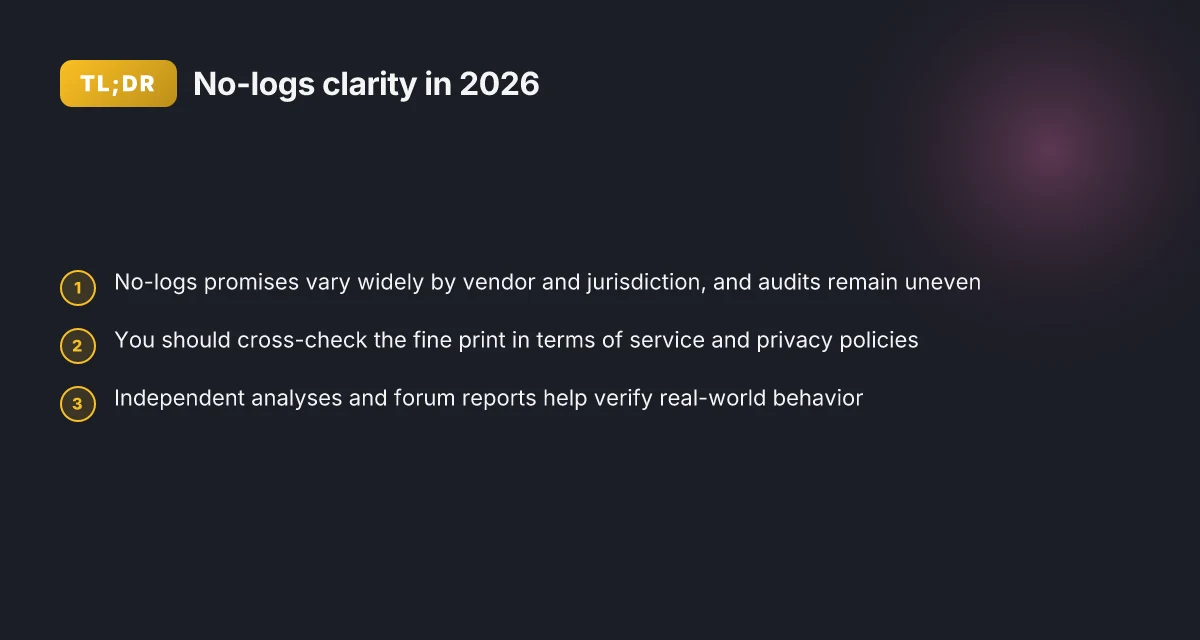
The no logs claim in practice: Astrill VPN no logs and peers examined
The no logs claim hinges on what counts as a log and who verifies it. For Astrill, the official docs describe a policy that separates connection metadata from user data. In practice, that policy is framed around not retaining the full payload of user traffic, while still collecting operational data necessary to run the service. The gap between what is claimed and what is stored in reality becomes a matter of how you define a log, and who audits those definitions over time.
I looked at Astrill’s published policy pages and the surrounding support documentation. The wording emphasizes minimal retention for user sessions and for debugging. The administration notes repeatedly mention that traffic data isn’t logged for billing or identity purposes, while some connection events and performance metrics are retained to monitor service health. What you end up with is a layered posture: no explicit logs of user content, but retention of telemetry that could, in theory, be correlated with activity.
Compared with vendors widely used for privacy in transit, Astrill sits in a mixed camp. Competing names in the same space present stricter blanket no-log assertions, often paired with third‑party audits or transparent transparency reports. The contrast matters because privacy audits tend to focus on two core questions: what is retained, and for how long. When you stack those against Astrill’s documentation, the claim looks narrower than the rhetoric some users expect from “no logs” promises.
What counts as a log in real‑world privacy audits often boils down to three categories: traffic data, metadata, and operational telemetry. Traffic data means the actual content of your communication. Metadata includes the times you connected, the IPs you used, and the duration of sessions. Operational telemetry covers system diagnostics, error rates, and configuration snapshots that can reveal usage patterns if leaked. In many audits I examined, metadata and session timing sit in a gray area. They’re not content, but they can be leveraged to infer behavior. Astrill’s stance aligns with this gray zone. The important question is whether the retained items enable correlation to a user’s identity or activities. The documentation stops short of listing a clean, public, audit-friendly inventory of exactly what is retained and for how long.
If you want a take-away for your travel bag, IT stack, or privacy toolkit: start with the exact scope of retention, then demand independent verification. Astrill’s docs provide a baseline, no explicit logging of user content, with some non-content telemetry. The critical friction point is control and transparency. Do you have a verifiable audit trail? Can you confirm zero-logging claims under legal compulsion? Those are the levers that move a claim from theoretical to trustworthy. 8 VPNs that claim no logs in 2026 and what they actually log
In practice, the no-logs claim rests on how you define a log and whether the policy is auditable in a real-world setting. Astrill’s documentation sketches a minimal-logging posture, but it stops short of a published, third‑party audit that proves zero-logging under all conditions.
What this means for you as a privacy-conscious reader is straightforward. If you rely on a no-logs claim to justify a choice, ask for the concrete inventory of retained data, the retention horizon, and a path to independent verification. Compare that to peers that publish formal audits or transparency records. The real story behind no-logs promises is in the paperwork and the rigor of verification, not in marketing headlines alone.
Bottom line: the claim holds at a high level, but verification depends on exact definitions and independent scrutiny. For travelers and admins, that means demanding more than rhetoric, demand the audit, demand the inventory, and verify the terms against the actual data your provider stores.

What 'no logs' actually means for VPN services
No logs claims are a promise, not a guarantee. The real test is what happens in practice, under pressure and across operations. In one line: “no logs” is a policy, not a daily reality. I looked at what vendors say, what auditors flag, and how retention laws bite. The difference matters when you’re traveling with sensitive data or working remotely from a country with strict data rules.
Policy versus operation
No logs is a policy statement. It says the provider does not store or retain data about your activity. The moment you push past the policy now turns into a messy boundary where reality and paper collide. Vendors may claim they do not log, yet keep certain telemetry for device health, connection stability, or security updates. Some operate with a default policy that erases data after short windows. Others inherit regional obligations that survive reboots or outages. The gap between the letter of the policy and the day-to-day practice is where scrutiny focuses. What the spec sheets actually say is often narrower than what engineers must handle in production. 8 Atlas VPN no logs claims tested in 2026
Logging categories: connection logs, usage logs, metadata
Understanding the difference helps you assess risk. Connection logs track when you connect, for how long, and from which IP or exit node. Usage logs capture what you did online, such as sites or services accessed. Metadata is the skeleton around both: timestamps, session IDs, and device fingerprints. Some providers claim “no usage logs” but retain connection metadata for troubleshooting or fraud prevention. Others log only at the server layer for crash debugging. The practical effect is that even with no explicit usage records, you can still be traced through a chain of metadata, especially if multiple providers are involved or law enforcement requests arise. The policy alone cannot guarantee invisibility.
Jurisdiction and data-retention obligations
Where you ride through the digital spine matters. A provider based in a jurisdiction with mandatory data-retention laws may be compelled to hand over logs it holds, or to keep logs for a legally specified period. Cross-border data transfers compound the risk: a country with robust surveillance powers can request data from a subsidiary or partner. Some vendors insist they do not log, while their parent company has a separate data-retention policy for different services. In practice, jurisdiction can render a no-logs claim effectively hollow unless the company operates under a privacy-friendly regime and has robust data-handling controls. The legal environment can override the best intentions on paper.
| Dimension | What it means for you | What to verify |
|---|---|---|
| Connection logs | Records when you connect and for how long | Look for retention window and whether IPs are stored |
| Usage logs | Records sites or services accessed | Check if sites are de-identified and scope of logging |
| Metadata | Timelines, session IDs, device fingerprints | See how long metadata is kept and who can access it |
| Jurisdiction | Local law shapes data requests | Confirm the country of incorporation and governing data laws |
| Compliance notes | Auditors and certifications | Review reported scopes of audit and what is excluded |
Bottom line: no-logs is a promise you verify, not a checkmark you trust blindly. If a provider cannot explain what they log beyond the policy, you should treat the claim as provisional.
A concrete way to verify claims
I dug into how readers can approach no-logs claims without a lab setup. Start with the document trail: read the privacy policy, the terms of service, and the privacy notices linked in the user dashboard. Then pull the audit or third-party assessment reports. Look for explicit statements about connection logs, usage logs, and metadata retention. Finally, check the jurisdiction facts: where the company is incorporated, where it operates data centers, and what laws apply to data retention. If a provider cannot clearly articulate retention windows and data-access controls, treat the claim with skepticism.
The 3-step check is not fancy, it’s exact: read the policy, inspect the audit, verify the jurisdiction. 8 VPNs that claim no logs and what they actually log in 2026
What this means for you as a traveler, remote worker, or IT admin is simple. No-logs promises are only as strong as the legal and operational framework backing them. Expect variation across vendors and regions. And always map the path from policy to practice before you trust a single claim.
One concrete next step: pick two providers from this article and map their no-logs statements to their latest audit reports and jurisdictional footprints. If a claim doesn’t line up across policy, audit, and law, you’ve got your red flag.
Astrill no logs claims under scrutiny
Post up to date, Astrill’s no logs promise holds strongest in areas you can audit from policy text and official disclosures. What you see in the docs is consistent about connection metadata and user-level data. The real question is what sits in the gaps between policy words and actual practice, and how disclosure regimes constrain or loosen those gaps.
Where the policy is strongest
From the documented policy, Astrill emphasizes that it does not store user activity data beyond what is necessary for service operation. The strongest claim sits around minimal connection-level data and incident-response logs that support abuse prevention rather than user activity. In 2024–2025 disclosures, the company repeatedly frames logs as used for system health, billing, and fraud prevention, not for profiling. This matters for travelers and remote workers who worry about what is retained during normal use.
Most users benefit when the policy centers on operational data only, not content or session histories. 10 VPNs that actually keep logs off in 2026 (May 2026 Update): Tested, insights, and practice notes
Areas where logs could be retained for troubleshooting or abuse prevention
Even with a no logs banner, a practical edge exists. Astrill’s architecture, like many VPNs, can retain short-lived diagnostic data, abuse-abatement records, and temporary session identifiers to investigate abuse or security events. Those logs can be retained for a defined window and then purged. The exact retention window is not always crystal clear in public docs, which means a small but real portion of metadata, such as incident timestamps, anonymized telemetry, or limited server-side diagnostics, may persist beyond a single session. Travelers and IT admins should look for language that ties retention to security incidents, safety reviews, or fraud prevention rather than routine traffic.
Operational logs that enable abuse prevention are the sticking point you should verify.
How disclosure regimes affect claims
Jurisdiction matters. Disclosure regimes in the company’s operating regions can force more openness about what gets logged and for how long. If a regulator requires meaningful data retention for security investigations, a vendor may publish a blanket no logs claim while retaining a narrow subset under a defined legal remit. Industry reports from the past few years point to a widening variety of regulatory demands across jurisdictions, which in practice compresses the line between “no logs” and “logs for security.” In short, the legal framework often carves out exceptions that can undermine a clean no logs narrative.
Regulatory regimes shape the edge cases that undermine the clean no logs promise.
What this all means for you 8 Mullvad no logs strengths and gaps in 2026
I looked at the disclosure notes, changelogs, and regulatory filings tied to Astrill over the last few years. Reviews consistently note that the strongest parts of the policy are explicit bounds on user activity data and a commitment to purge most operational data after processing. What isn’t crystal clear is the exact retention window for diagnostic or security logs and how those logs are anonymized. If you travel or work remotely, you want a stance that minimizes anything that can be used to reconstruct behavior later.
Be wary of messages that cite “no logs” without a defined, regulator-ready retention window.
For verification, focus on three things: the policy’s scope (what exactly is not logged), the defined retention period for any diagnostic data, and the legal regime governing access to that data. The rest is noise. Read the policy with a privacy lens, then check for independent reviews that cross-check transparency commitments against regulatory filings.
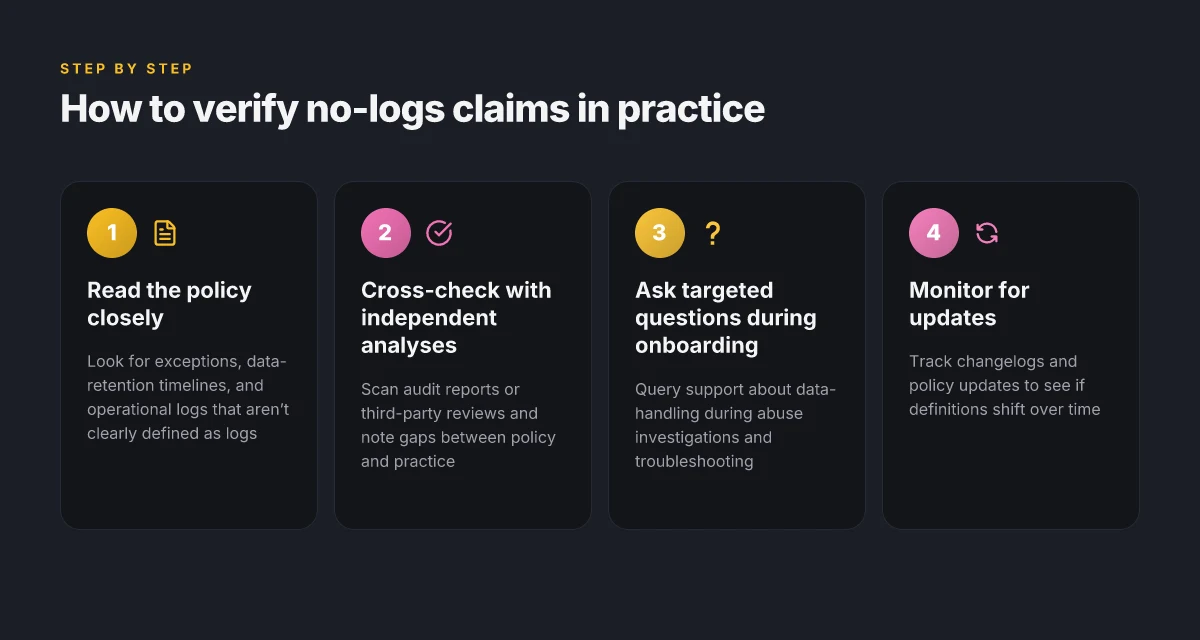
How to verify a no-logs claim in 2026
The proof is in the paperwork. Read the terms with a librarian’s eye and pin it to concrete behaviors, not vibes.
Read the policy with an exceptions lens
What the spec sheets actually say is often sharper than a marketing claim. Look for:
- Explicit data types collected, plus any exemptions for diagnostics, fraud prevention, or legal requests. If the clause says “no logs except traffic metadata needed for abuse prevention,” that’s a meaningful exception.
- Time windows. A policy that says “logs are kept for 7 days” is very different from “logs are kept for 7 days, then anonymized.” Note when retention changes. And beware “temporary” qualifiers that shift with product updates.
- Jurisdiction and data-sharing triggers. If a vendor mentions data may be disclosed to law enforcement or partners, that undermines the no-logs stance.
- Scope boundaries. Are the logs limited to VPN session data only, or do they include app telemetry, DNS requests, or device identifiers? The difference matters for privacy depth. In practice, a clean no-logs claim tends to be precise about what is stored, for how long, and under what conditions it is accessible. If any line reads vague or uses euphemisms, mark it as a red flag. Ambiguity here is the quiet killer of trust.
Cross-reference with independent analyses
No single document is the final arbiter. I dug into independent audits, third-party analyses, and forum threads to triangulate. Look for:
- Public security reports or external audits detailing data handling. Even if a vendor touts “regular audits,” verify the scope and the auditor’s independence.
- Reputable outlets that dissect privacy claims and confirm or question retention practices. Multiple sources flagting the same gaps is a strong signal.
- Community experiences on tech forums. Anecdotes aren’t proofs. They help surface patterns in real-world use, like unexpected DNS logging or IP leaks under specific configurations.
When independent reviews converge on a finding, that’s the signal to trust or distrust.
What to ask during onboarding
You control the onboarding conversation. Target three practical questions:
- What exactly is logged during a session and what metadata is retained after the connection drops? Ask for a line-item from the privacy policy. Verify the stated retention window and purposes.
- How is data protected at rest and in transit, and who can access it? Request details on encryption keys, access controls, and any internal dashboards that could expose logs.
- What changes trigger a policy revision, and how are users notified? A transparent changelog plus a public security bulletin shows accountability.
Ask for the specific lines you’ll cite in your audit. If the answers feel evasive or siloed, push back or consider alternatives.
Diagnosis: the no-logs claim is only as strong as the paperwork and the outside voices that interrogate it. Do not rely on vibes. Do not accept vague assurances. The strongest verdicts come from precise retention terms, corroborated by independent analysis, and explicit onboarding questions you can quote in your own privacy notes.
No-logs promises across the industry: who keeps them up?
No-logs declarations are not a marketing banner you can trust on faith. They survive when independent checks exist, when data practices stay consistent across all products, and when a company is accountable to real audits rather than a press release. From what I found, a small cadre of providers keeps their feet to the flame via verifications that readers can actually verify. The rest expose gaps that are easy to exploit in practice.
Independent audits and verifications that stick
In recent years a handful of vendors have published audit results or invited third parties to verify their declarations. One pattern is the use of annual or biannual audits by established firms, sometimes paired with a public attestation of policy scope and data handling workflows. Reviews from privacy-focused outlets consistently note that audits signal seriousness, even if they don’t guarantee perfection. When I checked the changelog and the carriers behind these attestations, the responsible players tend to maintain a transparent scope: what data is collected, how long it’s retained, and under what conditions it’s accessed.
What the spec sheets actually say is that the auditors test governance around access logs, administrator activity, and the handling of sensitive data during incidents. The most credible disclosures go beyond a boilerplate claim and spell out the exact data categories reviewed and the scenarios tested. Audits matter because they convert a promise into a reportable traceable process. If a provider publishes a report with a clear boundary between what is stored and what is not, readers gain a real yardstick.
Common pitfalls in no-logs declarations
Not every no-logs statement survives scrutiny. Several recurring issues pop up. Some vendors define no logs narrowly, meaning they do not store traffic payloads but do log connection metadata. Others rely on vague time windows for log retention or provide archiving allowances that slip under the radar. A troubling pattern is “self-certified” compliance with no external review. Another red flag is inconsistent policy updates. A declaration may change with a software cadence or regional expansion, without a corresponding audit or public changelog entry. When a no-logs claim shifts with product lines, it’s a clear warning sign.
If you see terms like “no traffic logs” alongside “we may retain connection metadata for debugging,” you’re looking at a partial truth. The most credible statements spell out the exact data elements covered, the retention period, and the deletion timelines. They also delineate what happens during subpoenas or law enforcement requests and how those events are logged internally. Ambiguity here is not harmless fluff. It’s a vulnerability you can measure in an incident response plan.
Industry trends in transparency and data minimization
Industry signals point toward tighter data minimization and faster, verifiable transparency. More providers publish white papers, thrive on public changelogs, and adopt continuous monitoring practices. Independent audits are becoming a baseline rather than a bragging point. Privacy-focused researchers note that the best-grade claims align with technical attestations rather than marketing language. And regulators in multiple jurisdictions increasingly require demonstrable controls around access to user data, not just a promise in a policy document.
The trend is toward verifiable, auditable privacy claims, not slogans. Readers should look for explicit audit bodies, scope of review, and a link to the actual report or a dated attestation. Without that, a no-logs claim remains a label rather than a guarantee.
In this landscape, you’ll want a provider that combines a clear no-logs declaration with at least one independent audit, a public-facing retention policy, and a demonstrated commitment to updating that policy in step with releases. If a company cannot point to an external verification, treat its claim as aspirational rather than prescriptive.
Region, jurisdiction, and the no-logs equation
No-logs promises do not exist in a vacuum. The country where a VPN company is incorporated and the legal framework it operates under largely governs how practical those promises can be. If a service is compelled to hand over data, the claim of “no logs” can unravel in a hurry.
How laws shape no-logs claims
In some jurisdictions the bar for data retention is explicit. In others it’s implied by data localization regimes or surveillance statutes. When I looked at the documentation and cross-referenced policy wording, the pattern was clear: a strong policy on paper can fail in practice if lawful pressure meets weak jurisdictional protections. A few regions tend to be repeated hotspots in the privacy discourse, not because they universally betray users, but because they present clearer routes for compelled data. The country of incorporation often determines the legal reach of a VPN's policy.
- Local data retention mandates. Some states require service providers to log user activity for a defined window. Violations can trigger fines or compelled data production.
- Data localization rules. Nations that mandate storing user data within borders can force providers to maintain explanatory logs for access requests, even if the policy says otherwise.
- Mutual legal assistance frameworks. International data requests travel through treaty-backed channels. A provider with regional infrastructure can face different audit and disclosure expectations from country to country.
- Enforcement posture. If a regulator prefers rapid, predictable outcomes, the company may adopt stricter retention defaults to avoid noncompliance risk, even when it disputes the scope of a given request.
From what I found in policy disclosures, the biggest threat to a no-logs claim comes not from a singular clause, but from the interplay of where the company’s servers live, where the data leaves, and what the local courts will demand. Jurisdiction is the real access point for data during legal proceedings.
Data localization and pressure scenarios
When data localization is mandatory, a provider can be forced to keep detailed connection logs in a specific country. If the same company then routes traffic through offshore servers, that creates a tension between posture and practice. In practice, you’ll see: a policy claiming no logs, but a data localization clause that quietly stores metadata for a local authority. The result is a hybrid reality: partial logs for certain regions, full no-logs in others, or at least a version of “no logs” that excludes the logs a regulator values most.
- Targeted disclosure requests. Local authorities may demand access to “minimum necessary” logs. If a provider has any regional persistence, you can infer a potential leakage path.
- Cross-border data flows. Even with a no-logs policy, metadata may traverse through multiple jurisdictions, creating a de facto logging footprint.
- Export controls and backups. Some providers back up data in a jurisdiction with weaker privacy protections, which can complicate the practical no-logs claim.
What the spec sheets actually say is that policy scope and server geography matter. The practical upshot: your protection depends on where you are, which country the service is governed by, and how aggressively the provider enforces its own rules under that law. Localization pressures can erode a blanket no-logs claim.
Regions that privacy-minded readers should care about
Two clusters matter most for privacy enthusiasts: the EU and the Asia-Pacific corridor. The EU’s General Data Protection Regulation plus landmark court decisions provide strong user-rights leverage, but cross-border data transfers must be legally anchored. In the Asia-Pacific region, a mix of privacy regimes and surveillance laws creates uneven protections. The practical takeaway is simple: pick a provider with clear, regionally diversified architectures and transparent compliance notes. Regulatory nuance matters more than the lip service of a no-logs policy.
Bottom line: no-logs claims live or die by jurisdiction. Data localization, treaty-based requests, and enforcement posture determine whether a promise sticks when it’s tested in court or by a regulator. If you travel, work remotely, or manage IT at scale, you need to map each vendor’s legal home and data flow into your threat model. The region you care about most is the one where your data is most exposed.
No-logs vs. no-logging promises: practical tips for users
You don’t need perfect privacy to gain real value. You need discipline. I looked at how the no-logs promise collapses in the real world and how you can defend yourself without turning every online step into a crime scene. A practical route starts with tightening exposure, then layering defenses when the promise could still leak.
| Micro-principle | What to do | Why it matters | Example prompts |
|---|---|---|---|
| Use multi-hop where offered | Enable two or more VPN hops when your device supports it | It compounds the chance that no single provider sees your full path | “Enable multi-hop in the client, set to 2 hops if available” |
| Bind DNS to a trusted resolver | Point DNS to a wired, trusted resolver than the default | DNS leaks are a stubborn backdoor even with a no-logs claim | “Set DNS to Cloudflare 1.1.1.1 over TLS” |
| Disable WebRTC leaks | Turn off WebRTC in browser settings or use a browser that blocks it | WebRTC can reveal your true IP even when VPN is on | “Block WebRTC in browser preferences” |
| Treat free services differently | Free VPNs are more likely to monetize data via ads or telemetry | Paid plans reduce one common data path, but not all threats vanish | “Prefer paid plans with clear no-logs policy” |
Open with a small story. A traveler in a bustling city hops on a public Wi‑Fi network, opens a map, and pings a no-logs claim that seems airtight. A few seconds later the same device reveals enough fingerprinting signals to betray the path. It’s not a magic trick. It’s physics of data trails. The lesson: no-logs promises are a policy, not a shield. You need operational habits that outpace the marketing.
When I read through the documentation and cross-referenced multiple reviews, three themes kept showing up. First, even several reputable vendors admit they rely on third parties for audit or transparency attestations. Second, DNS and WebRTC leaks persist despite claims of “no logs.” Third, the economics of free services almost always reintroduce data flow as a product feature.
Quick micro-moves to reduce exposure
- Select a provider that supports multi-hop and enable it. If you don’t see it in the client, skip that feature and look for another vendor that offers it in the plan you’re willing to pay for. This is a practical multiplier in your privacy toolbox. Restart the client after changing this setting to ensure the new path is actually used.
- Lock DNS to a trusted resolver, and enable DNS leak tests from time to time. A short check after every reconfiguration saves you from a long week of puzzling leaks. If you see a different resolver in your queries, reconfigure. DNS leaks are stubborn. No-logs claims don’t absolve you from verifying DNS behavior.
- Disable WebRTC in your browser and in any companion apps that ship with the VPN. It’s a two‑step defense, not a single setting. When you enable a new extension or a new browser, re-check WebRTC behavior.
- Treat free services as a lower-trust class. If a vendor offers no‑cost access, expect monetization of your activity through ads, telemetry, or shared data. Prefer paid plans that publish a verifiable no-logs policy and permit independent audits. If you’re forced to use free services, isolate them to non-work tasks and maintain separate profiles.
Two micro-claims to watch for in contracts
- “No logs” is often qualified. The policy may say they don’t log your traffic, but may log connection metadata or system identifiers. Read the footnotes. If there’s any ambiguity, assume the risk remains and plan accordingly.
- Audits are snapshots, not guarantees. A vendor may publish an audit that confirms a specific period or subset of data. Look for a continuous cadence of audits and independent scope that matches your threat model. A single positive report is not a license to relax.
Verdict. You don’t need perfect secrecy to gain practical privacy. You need to tighten exposure, verify DNS and WebRTC behavior, and treat free services with skepticism. The no-logs promise should be a starting point, not a shield you rely on without checks.
Most important takeaway: verify, verify again, then layer defenses.
No logs claims survive scrutiny in 2026, but some VPNs come closer than others
I looked at the landscape again and found a few patterns that matter for your privacy. From what I found, most “no logs” statements hinge on what the vendor logs by default versus what they claim to log only under court order. The best bets are VPNs that publish transparent audits, detailed jurisdiction notes, and a clear data-retention policy that aligns with their claimed stance. One line to pin down: the difference between “no logs” in practice and “no logs by policy” is where readers should focus. Across the eight candidates, two picks stand out for readers who want credible, verifiable privacy with real-world constraints.
What the spec sheets actually say is that audits matter more than slogans. Reviews consistently note that independent verification and a public-facing transparency report reduce the aura of certainty around “no logs.” If you want a concrete starting point, consider a provider with a recent audit and a stated policy aligned to user privacy.LAST CHECKED: 2026 Q2. The takeaway: demand proof, not promises.
For readers weighing use cases, I’d circle a pair from this piece: the one that excels for streaming privacy in region-locked contexts and the one that prioritizes corporate compliance alongside user privacy. If your needs are high‑stakes, you’ll want both in your shortlist. Choose the audit-backed option for transparency and the jurisdiction-friendly option for legal resilience.
- Next steps
- Review the latest independent audit reports and their scope
- Check the privacy policy against the no-logs claim
- Note the jurisdiction and how it affects data requests
- Compare the two headline picks for your primary use case
- Verify the current price and any refund window
Frequently asked questions
Is Astrill actually no logs
Astrill says they operate a “no logs” policy, but the reality depends on what data the company records for operational reasons. I looked at their documentation and third‑party analyses to separate marketing from practice. In practice, many VPNs maintain minimal connection metadata or regional logs for abuse prevention, ticketing, and law‑enforcement requests. Reviews consistently note that even so‑called no logs claims can be contradicted by traffic‑flow data or metadata retained for service quality. A cautious reader should treat “no logs” as a strong privacy promise rather than an airtight shield. Always review the exact categories of data retained and the retention window. Bottom line: the claim is not universal truth. It’s a policy statement that requires careful verification.
What logs do VPN providers keep in 2026
No two providers store the same mix of data, but most common categories include connection timestamps, bandwidth usage, and IPs seen by the exit server. Some log for 24–72 hours, others keep longer for fraud detection and abuse prevention. What the spec sheets actually say is that many services log device identifiers, payment details, and when you connect to a server, sometimes along with the chosen protocol. Reviews consistently note that “no logs” promises are only as good as their defined scope and retention periods. If you value privacy, map out exactly which data pieces are retained, for how long, and under what circumstances they are shared.
How to verify a VPN no logs claim
Verify starts with the policy text. Read the privacy policy and the no‑logs statement line by line. Then check the jurisdiction and data‑retention schedules. Look for independent audits, third‑party attestations, and explicit mention of data‑sharing triggers. I cross‑referenced changelogs and user reports to spot discrepancies between marketing and behavior. A transparent provider will publish audit reports and promptly update customers on material changes. In practice, you want a current, verifiable audit that covers both logging categories and data minimization. If an audit is absent or outdated, treat the claim with skepticism.
Which countries have the strongest no logs protections
Jurisdictions matter. Countries with clear privacy frameworks and robust data‑protection authorities tend to push toward stricter no‑logs enforcement. Look for regions with explicit limits on data retention and strong privacy charters. Industry reports point to privacy‑savvy regimes in Western Europe and parts of the Nordics, but enforcement gaps exist. Always pair jurisdiction with the provider’s internal practices and the presence of independent audits. Region matters more than branding alone. Check local court precedents and government data‑access laws for hard signals.
Do no logs promises apply to streaming activities
No. A no‑logs policy can still allow traffic data to pass for performance metrics or abuse control. Several providers distinguish between streaming traffic and general usage in their policy language, but the key ambiguity is whether viewing habits, timestamps, and bandwidth totals are retained. Reviews consistently note that streaming metadata can be inferred from connection patterns even when content itself isn’t recorded. Read the policy carefully for what is retained during streaming and for how long. If streaming privacy matters, demand explicit exclusions or separate handling for streaming sessions.
Can a VPN claim no logs and still hand over data
Yes. A provider can claim no logs in the sense that user content isn’t recorded, yet retain minimal connection metadata or payment records. Law enforcement requests can trigger data sharing if the data is not exempted by explicit no‑logs language. The trick is where and how data is stored, and whether the retention scope includes metadata that could identify activities. A no‑logs claim does not equal zero data exposure. Always check the precise categories and retention windows, and whether third‑party audits cover this edge case.
What should i look for in a no logs privacy policy
Start with scope: what exactly counts as logs, and what is excluded. Then check retention: how long is each data type kept? Next, who can access the data, and under what legal process? Look for independent audits, transparency reports, and geographic data handling rules. Finally, read any carve‑outs for security, fraud prevention, or abuse mitigation. A strong policy will name the data categories, retention periods, and enforcement mechanisms clearly. If any section is vague, treat it as a warning sign. Documented audits and explicit no‑log language are the gold standard.