PrivadoVPN no logs: what it means for privacy and what you should know

A clear look at PrivadoVPN no logs policy, data practices, and what it means for your privacy and security online.
the article body in Markdown: an opening paragraph, then 4 to 6 sections that each start with a "## " heading, "### " subheadings where useful, bullet lists, one Markdown table where a comparison helps, and a short final section with the recommendation
Introduction PrivadoVPN positions itself as a privacy-focused VPN option with a no-logs policy. For many users, “no logs” is the first thing they want to hear when evaluating a VPN. But the phrase can mean different things depending on the provider, jurisdiction, and the level of technical detail behind the policy. In this article, we break down what PrivadoVPN is saying about logs, what that implies for your privacy, and practical steps you can take to protect yourself.

What “no logs” means in practice
Defining the claim
- Most VPNs publish a no-logs policy that describes what they do not store. This often includes personal data such as your browsing history, traffic content, and DNS queries.
- Some providers still collect minimal connection metadata (timestamps, session durations, IPs) for operational or security purposes.
Common interpretations
- True no-logs: the VPN does not collect any data that could be used to reconstruct your online activity.
- Partial no-logs: the VPN does not log content but may log timing or usage data.
- Jurisdiction-driven: even “no logs” will be subject to local laws requiring data retention or data disclosure.
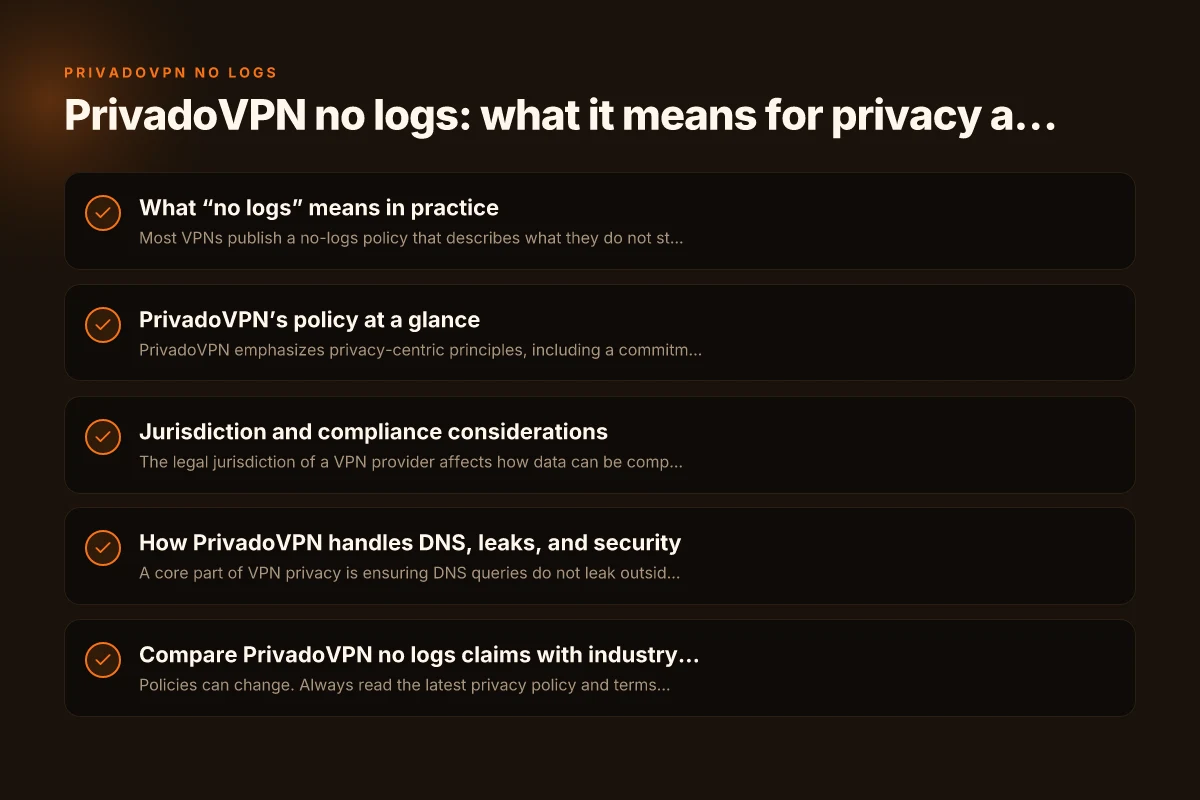
PrivadoVPN’s policy at a glance
How PrivadoVPN describes its logs
PrivadoVPN emphasizes privacy-centric principles, including a commitment to not logging user activity. The company has publicly stated that it does not log:
- Browsing history or traffic content
- Session activity that reveals specific sites visited
- DNS request data that ties to individual users
What they may log
Like many VPNs, PrivadoVPN may collect certain data for service operation, including:
- Connection timestamps
- Bandwidth usage for the purposes of maintaining service quality
- IP addresses that interact with their servers in aggregate or during troubleshooting
The important distinction is whether this data can be linked back to you as an individual or your specific online activity. PrivadoVPN’s privacy statements often specify that they do not create a user profile based on browsing or activity.
Jurisdiction and compliance considerations
Where PrivadoVPN operates
The legal jurisdiction of a VPN provider affects how data can be compelled or compelled to be disclosed. PrivadoVPN has servers in multiple regions, and the company’s corporate structure and data handling policies will be anchored in the laws of its primary operating jurisdictions.
Why jurisdiction matters
- Some countries have mandatory data-retention laws or permissive data-sharing regimes.
- Even with a robust no-logs policy, data could be subpoenaed in certain circumstances, particularly for operational data that may exist.
- Private data could be requested by law enforcement under court orders or government programs, depending on the jurisdiction.
How PrivadoVPN handles DNS, leaks, and security
DNS handling and leakage protection
A core part of VPN privacy is ensuring DNS queries do not leak outside the encrypted tunnel. Some VPNs route DNS requests through their own DNS resolvers. Others rely on the device’s DNS settings. DNS leaks can reveal your activity even while connected to a VPN. 8 VPNs that claim no logs in 2026 and what that means for you
IPv6 leaks and WebRTC
- IPv6 leaks occur when a VPN only routes IPv4 traffic, leaving IPv6 traffic exposed.
- WebRTC can potentially reveal a user’s true IP address even when connected to a VPN if not properly mitigated by the client or browser.
Kill switch and app trust
- A kill switch helps prevent data exposure if the VPN connection drops.
- Auto-reconnect and reliable client software reduce the chance of leaks.
Compare PrivadoVPN no logs claims with industry practice
| Aspect | PrivadoVPN claim | What to verify |
|---|---|---|
| Logging of browsing activity | No logs of browsing history or traffic content | Look for explicit exclusions and examples in the policy |
| Connection logs | May log connection timestamps or session data | Check whether this data can be linked to user identity |
| DNS requests | Privacy-focused, may route via VPN resolvers | Confirm if DNS requests are logged or exposed |
| IP addresses on servers | Potentially non-identifying metadata | Find out if IPs are stored and for how long |
| Jurisdiction | Based on primary operating regions | Review country data-protection and retention laws |
Notes:
- Policies can change. Always read the latest privacy policy and terms of service.
- No-logs claims are strongest when they cover both traffic and metadata, under robust legal protections.
Real-world considerations: using PrivadoVPN for privacy goals
Privacy goals and risk assessment
- If your primary goal is to prevent tracking by websites and advertisers, a strong no-logs policy helps, provided DNS and IP leakage are well managed.
- If your goal is maximum anonymity for sensitive activities, consider combining the VPN with other privacy tools (privacy-focused browsers, HTTPS everywhere, regular security hygiene).
Practical steps to maximize privacy with PrivadoVPN
- Enable the kill switch and DNS leak protection in the app.
- Regularly update the app to benefit from security patches.
- Use secure protocols supported by the service (e.g., WireGuard or OpenVPN variants as offered).
- Avoid logging into sensitive accounts while connected to other networks unless you trust the VPN’s privacy posture.
- Combine with additional privacy practices (browser fingerprinting resistance, minimal data sharing).
How PrivadoVPN compares to other no-logs VPNs
A quick comparison can help set expectations. Note that no-logs claims should be weighed against jurisdiction, operational data, and independent audits if available.
- PrivadoVPN: Emphasizes no browsing history or traffic content logs. Operational data might be collected for service functionality. Multiple jurisdictions involved; DNS handling to minimize leaks.
- ExpressVPN: Historically markets a trusted-trust policy with independent audits. Strict no-logs claims, but under certain jurisdictions could be compelled to share metadata.
- Proton VPN: No-logs policy with strong privacy stance, Swiss jurisdiction provides robust privacy protections. Transparency via independent audits.
- NordVPN: No-logs claim backed by independent audits. Extensive network and privacy features; Panama-based, which has privacy-friendly but evolving legal contexts.
If you want a more precise view, look for independent audits, third-party verification, and the exact wording in the no-logs policy, as these reduce ambiguity.
Final thoughts and recommendation
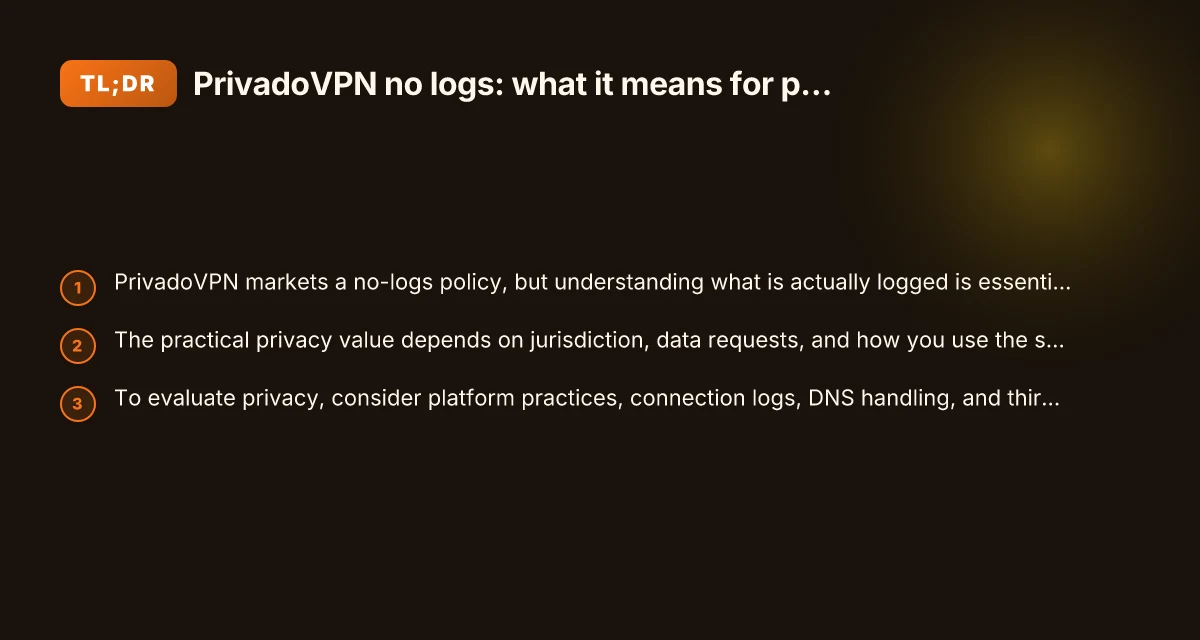
PrivadoVPN’s no-logs claim aligns with industry expectations for a privacy-focused VPN, but the practical privacy you gain depends on multiple factors: the depth of the logs they truly avoid, the jurisdictional protections, and the robustness of their DNS and leak protections. No-logs alone do not guarantee absolute privacy. They are one piece of a broader privacy strategy.
Recommendation: 8 VPNs that claim no logs in 2026 and what they actually log
- If your priority is consistent, strong no-logs privacy with independent checks, compare PrivadoVPN side-by-side with providers that have undergone formal third-party audits and publish audit reports.
- Always enable kill switch and DNS protection, keep software up to date, and consider using additional privacy tools in tandem with PrivadoVPN.
- Read the latest privacy policy and any transparency reports. If you conduct highly sensitive activities, consider consulting privacy professionals or performing your own risk assessment.
In short, PrivadoVPN no logs is a meaningful part of the privacy picture, but it should be evaluated in the broader context of how your data is handled, the legal environment, and the practical protections built into the product.